This blog post is based on advice I provide to my clients applying to MBA programs that use video essays, such as Booth, INSEAD, Kellogg, MIT Sloan, UC Berkeley Haas and Yale. For random questions, I also provide my clients with school specific past question reports as well.
There are three types of Video Essays:
You upload a recorded video or your own.
You have the question in advance but will be asked to record it on the school’s online system.
You don’t have the question(s) in advance and will be asked to record it/them on the school’s online system.
One thing that all three types of videos have that they should provide a great first impression of you. This is speed dating. FOCUS ON PERFORMANCE!!!!
Let’s look at each type and how to prepare.
You upload a recorded video or your own.
What all successful versions of this video do: Answer the prompt directly.
The most famous such question is certainly the MIT Video Question 1. The question itself has changed. For 2027 entry (Class of 2029), it is:
"Every applicant has a story that can't be captured in a resume. Take up to 90 seconds to share yours: who you are, where you come from, and what's shaped the person you are today. Be conversational, be yourself. We can't wait to meet you.
Videos should adhere to the following guidelines:
No more than 90 seconds long
Single take (no editing)
Speaking directly to the camera
Do not include background music or subtitles
Speak authentically to the camera — in your own words, as if talking to a friend. Avoid reading from a script or pre-written response."
How to make the video:
Write a script. It will mostly likely be too long. (Once you add in breathing, facial expressions, in acting you might do, and speaking a speed to heard effectively, assume a one minute of speaking equals a script of 90-120 words. You are making script so you know what you want to say and can do say in a way that will appear sufficiently personal. If you are great at memorizing script, wonderful, but if not focus on using it enough so you know what you want to say when you record it.
Have your script reviewed by your admissions consultant or whoever else you are getting advice from. While an AI will give you advice on anything, be careful with that. A trusted human advisor paid or unpaid is best.
Make an initial video. If your script is too long at this point, edit it down again.
Don't look like you are reading the script. Memorize it sufficiently to feel comfortable presenting it without obvious reading.
Have your trusted human advisor review your video, taking feedback into consideration, alter the script as needed. You would have to be incredibly stupid or desperate to use an AI to evaluate a human performance. A friend, partner, parent, anyone who watches TikTok, YouTube, or other short content can provide feedback on human performance. Just use someone whose opinion you value and who will give you honest feedback. If I had to do this I would ask my wife, who is by far, my harshest, most constructive, and best critic.
Record until you have an acceptable take. Doing this last minute is not great. Doing this when you are tired and look exhausted is to be avoided. Record under optimal conditions for purpose of making a strong positive impression. Practicing and taking multiple takes is likely the best way to get a good one minute.
A good take is one where you look authentic and don't appear to be reading while talking and don't look like you are simply reciting something you memorized.
Remember the focus is on making a positive first impression, so speaking at a speed that is comfortable for your listener is important. I find that some of my Indian clients naturally speak rather fast and have to slow down. On the other hand, I have had Japanese clients who spoke too slowly and needed to increase their speed. If you think speed will be an issue, have someone who can judge that give you feedback.
Most instructions say, don’t edit it. They don’t want a well-produced TV commercial, but a single take video. AUTHENTICITY ROCKS!
Other considerations:
Regardless of where you film this video, you should focus on how well the viewer can hear your voice and see your face. Recording outside is fine as long as you have a mike good enough for a high quality audio recording.
Don’t focus on props or location first, focus on content. If you have props and/or location that complements your content, that is fine as long as it is consistent with the instructions provided by the school.
Humor or irony can be used effectively but you need to make sure that will work for your audience. If you are using humor, it is especially important that you test it out with people (consultant, friends, alumni) who can fully consider what you are saying from the perspective of an admissions officer.
You have the question in advance but will be asked to record it on the school’s online system.
Please see the above as what it is there generally applies. Scripting and feedback is critical here as well.
The difference is that any feedback anyone provides on test recordings should be completely focused on how you deliver your response and the content of the response and they need not be concerned with video or audio quality.
UC Berkeley Haas uses this format for Required Essay 1. This is a question that they previously asked for in written format and now want a video:
"Briefly introduce yourself, then tell us what makes you feel alive when you are doing it, and why?
Please share something about yourself that may not be evident in other parts of your application. We are looking for an authentic and introspective response that demonstrates how you will contribute to the MBA class and culture at UC Berkeley Haas.
You will be able to test your audio-visual connection before recording. Video essays should last 1-2 minutes and may not exceed 2 minutes. You have two (2) attempts to record your video essay."
A good answer to this question actually takes time to develop because it consists of three components, self-intro, what makes you feel most alive while doing it, and makes it clear how you will contribute at Haas. I would treat scripting this with a significant amount of effort. It actually is harder than writing an essay because you have to speak out the answer.
You don’t have the question in advance and will be asked to record it on the school’s online system.
My suggestion is to go over past questions but given the possible range, just understand that you will have to likely handle a question you have not seen before. Schools typically employee systems like Kira that have a huge range of questions, but past reports and whatever topic specific advice the school provides are good indicators of what you should expect. This is the most common video question type and is used by Booth, Kellogg, INSEAD, MIT (Video Question 2), and Yale, et al.
General Advice for Preparation:
When answering an unfamiliar question, focus on the following in the 10-20 seconds typically given prior to recording: Understand the question and quickly formulate a topic.
In your response (typically with a 1-minute limit) focus first on providing a direct answer to the question and then elaborate. This is not a time for an initial high context response but for a rational clear short and direct answer. Use remaining time for elaborating on your answer. (See 7 below for question types that you should have strong content focused answers for. They are the exception to the totally random question)
Given that you will have very little time, focus just on the question and don't think about overall strategy or being particularly clever if that will undermine your ability to give an effective response. Being mindful albeit at high speed is likely to result in a better answer.
While you can understand the range of possible questions to some extent, it is not inherently going to help that much depending on how big the school's question bank is and how much structure they apply to question types used. (7 below is the exception).
Except for 7 below, writing scripts based on what has been asked before is probably a total waste of time, better to use such questions or ones like it as a drill.
For my clients, I provide feedback. Except for 7 below, rather than bothering with scripts, I focus almost exclusively on my clients' ability to provide well structured answers, overall approach likely to relate to similar questions, and performance. If you have someone review audio or video recordings, tell them that the quality of your response should be judged on the clarity of your answer, your performance (speaking and body language), and less so on the actual content with one question class exception. See next point.
QUESTIONS YOU SHOULD HAVE SCRIPTS FOR. While you should not focus primarily on content, this does not apply to questions like Why MBA? Why this school? What will contribute? (INSEAD frequently asks questions like those) What are your goals? Tell us something about you that is not found in your resume/application (Kellogg asks this). If past video reports for the school include such questions be ready for them and prepare strong content. With such questions having your consultant or other trusted advisor review is a good idea.
CHICAGO BOOTH IS NOW ONE OF THE EASIEST SCHOOLS TO APPLY TO!
Prediction: If an M7 school makes their application this easy, they will most likely increase the number of applications. So, don't be surprised if Booth becomes harder to get into than in past years.
Chicago Booth killed its essays for the Class of 2029and replaced them with four very short answer prompts (300 characters with spaces each, about 60 words). Unlike in previous years when knowing in detail about Booth was necessary for writing an effective application, no such knowledge is necessary. While it can be helpful to know about Booth for determining whether to apply, you don't need to know about the program in detail in order to apply. A general understanding of the program would be useful. However, if you get an interview, you will have to do video essays (content unknown at this time. Booth is not revealing any details about this yet) and should be ready to explain why Booth in detail for the interview and possibly for the video essays.
In this post, I will discuss the four prompts, optional statement, and reapplication essay. I often refer to posts for other schools for more elaborated analysis. My focus here will be on providing simple analysis and I make the assumption that you are most likely applying to other schools. If you have completed one or more applications to schools, writing Booth should take very little time. It is most likely to be exercise in editing for the goals questions and a bit of time for brainstorming and then writing the two other questions.
"All candidates are required to submit responses to the following four prompts (300 character limit per response)." We can divide the prompts into two categories, one focused on goals and one focused on you as a person.
THE TWO GOAL PROMPTS If you have not already formulated your answers to the two goal prompts, please refer to my extensive discussion about goals in my Columbia Business School analysis.
What is your immediate post-MBA career goal? In 300 characters you have enough space to explain the role, industry, and type of company you want to work for after your MBA. You can provide a very brief explanation for why you want that role. But clearly Booth is not looking for a highly detailed explanation. I would highly recommend being specific and providing an answer that is easy for the reader to understand. This should be a plan. If necessary you can elaborate on anything else that is really critical to know about this goal in the optional statement.
What is your long-term post-MBA career goal? In 300 characters you can briefly explain what you want to do in the long-term. Long-term goals have greater flexibility in the degree of their specificity than immediate post-MBA goals. So you might be discussing this goal in a manner that is relatively visionary rather than very specific. My suggestion is that you make it intuitively obvious what the connection is between the short and long-term goal for ease of the reader's understanding. You can build that in to either this answer or the answer above. If necessary you can elaborate on anything else that is really critical to know about this goal in the optional statement.
WHAT ARE TWO IMPORTANT THINGS THAT YOU WANT BOOTH TO KNOW ABOUT YOU AS PERSON? The thing that connects these two prompts together is that Booth wants to learn something about you. My advice is that whatever it is, you are telling them something that will give them insight into who you are. Strategically Booth is a school that values collaboration amongst Boothies, intellectual ability, and that general category of diversity that will make you a unique addition to the Class of 2029. Diversity of experience, perspective and/or background can make for effective topics here. Also, it can be very effective to discuss something about you that is not obvious from reviewing the rest of your application. Finally, make sure that you are not telling the same story about yourself twice. Each of these answers should be distinct.
Upload an image and explain its significance to you. What one image captures something important about you? I find that image questions like this one are great for highlighting values and critical experiences. The key word in the prompt is "significance." Whatever image you use should be significant in terms of what it reveals about you.
Share a fun fact or something unique about yourself. Fun does not mean trivial and something unique should not be something odd but of no value. Make this one count. If you can be funny in the process, great. But you don't have to be funny. The tests for answer here like with the above question are as follows: How does this give Booth further insight into who you are? Why would this answer give them a reason to interview you?
THE OPTIONAL QUESTION
"The following question is optional: Is there any unclear information in your application that needs further explanation or additional details you would like to share with the Admissions Committee? (Maximum 300 words.)" I would only complete this section if there is something you can't account for in the rest of the application, so do the online application first before writing this. Also, I mentioned above about the goals prompts, if you think you need to further explain your goals here do so. If you have any concerns about your academics or other issues, explain them here if they don't fit elsewhere. Booth actually provides a lot of space in the online app form for explaining many things, such as "anything about your upbringing or family/household circumstances," and choice of recommenders.
An effective answer here may cover several points and often the best form of it is a memo rather than an essay on one topic, but that will really depend on what you need to cover.
This is not the place to write about why you want to attend Booth or how you can contribute because they no longer are asking such questions in their essays and hence don't need those answers in this part of the application. As I mentioned above, Booth will likely ask Why Booth in the interview or may do it in the yet to be disclosed contents of their video essay component.
If you are Booth Reapplicant, you will need to also write the reapplication essay: "Upon reflection, how has your perspective regarding your future, Chicago Booth, and/or getting an MBA changed since the time of your last application?"
See my reapplication analysis for HBS and CBS to formulate this answer.
Good luck with your Booth application! If you get an interview a and want to be really nice to me, let me know what questions you got asked in the video essay section.
The Columbia Business School MBA program is one that I have extensive experience experience helping clients get admitted to. Most recently, I had 10 clients admitted for August 2026 entry and 1 client admitted for J-Term 2026. You can find testimonials from my clients admitted for Columbia Business School here. Since 2007, when I established my own consultancy, I have been fortunate to work with 104 clients admitted to Columbia Business School for Fall term, J-Term, and Deferred Admission. The advice I provide here is based on my almost twenty-five years of experience of helping clients get admitted to the world's top MBA programs.
The most important thing I can tell you about gaining admission toColumbia Business School, aside from my essay and application form analysis below, isto apply in Round 1 for either January (Deadline: June 17, 2026. R2 is August 13, 2026) or August (Deadline September 9, 2026. R2 is January 5, 2027 and R3 is March 29, 2027). Based on what has occurred in prior years, Round 1 is best to maximize admission because the rate of waitlisting and outright dings goes up significantly in subsequent rounds. Given that CBS takes the Executive Assessment (Try to get at least a 150, 155 is better and 160 or over is good) in lieu of GMAT or GRE, it is along with other schools that take the EA (NYU, Duke, Darden, Stanford MSx), an easy place to apply to R1. Even if you are applying everywhere else in R2, apply to CBS in R1 if you want to maximize your shot at admission.
The second most important thing I can tell you, aside from my essay analysis, is thatyou need to learn about a lot about CBS. It is one of the schools that requires knowing a lot about it through networking with current students and alumni. CBS wants to be loved. Comparatively speaking, the amount of engagement you should have with this school is very high compared to the rest of the M7 because they ask in their application forms for your student, alumni, and adcom contact. For more about this issue, see How much do I really need to know about an MBA program to prepare a strong application for it? It varies!It provides a comprehensive guide to this issue for CBS, the rest of the M7, and many other top schools. Keep in mind that CBS provides a specific place in the "Application Information" page to highlight the ways you have engaged with the school:
My advice is make effective use of this part of the application. You don't need to name drop in your essays because it is highly redundant. Do it here and provide multiple admissions, student and alumni contacts if possible. You even have space to explain your connection to the contact. While 3-4 contacts is enough, I have certainly had a number of clients, who were rather enthusiastic and had 10 or more contacts listed. This often included friends, coworkers, those met at alumni info sessions, outreach via LinkedIn, and the Hermes Society (a first stop for anyone who has no contacts with CBS current students). Hermes allows you to find current students who share your interests. It is a great platform for engagement and it is pity not to use it if you don't have personal connections with current CBS students already.
Along with Stanford, and INSEAD, I think CBS is one of the best first applications to work on. In the case of CBS, Essay 1 requires more of a focus on goals than any other school, so doing it gives applicants all the content they need for any school's goals essays. Also Essay 3, provides a perfect length for explaining why you want to attend a specific MBA program. Make that argument right for CBS and it will help you with other schools that require similar essay content.
For my post on reapplication to Columbia, see here. For my analysis of recommendations , please see here. For my analysis of Columbia Business School application interviews, please see here.
Before discussing the essays, for those applying or considering applying for January entry, please see the next section.If you are applying for August entry, you can ignore this section.
J-Term
The Accelerated MBA, J-Term, can be a great program for those who don't need an internship and don't need a Merit Fellowship. J-term is not for career changers, it is those looking to enhance their position within their present career trajectory and/or entrepreneurs. The program is designed for those students who do not want or need a full-time internship and don't require Merit Fellowships. The principal advantage of the 16-month program is its accelerated format, which allows members of the smaller January class to network quickly and effectively and return to the workplace sooner. You need to make the case in Essay 1 and/or Essay 3 and/or the Optional Essay that you meet the special criteria for this program and that an internship is not something critical for you. For those who don't need a summer internship, this is really a great program. Internships for J-Term? Based on what former clients tell me, it is common for J-Termers to do part-time internships in NYC while studying. Actually, this is often true for those attending the August Term as well. These are not the same as summer internships but such part-time internships can surely serve the same function.
Is J-term easier to get into than August entry? I have always thought so. The lack of Merit Fellowships, an internship, and the nature of who the program is designed for, clearly indicate that it is going to attract fewer applicants, so my assumption is that it is surely easier. Happy to proven wrong if CBS admissions provides data showing otherwise (They don't). Unlike an August entry applicant, someone applying to Columbia J-term can really be assumed to prefer Columbia over all alternatives. This can make interviews a bit easier in the sense that August entry Columbia alumni interviewers are notorious for being particularly aggressive at determining whether the interviewee's first choice is really Columbia. Since J-term has no real US rival, this topic can be easily dispensed with in an interview.
Program Alternatives to J-term: There are no US alternatives to J-term worth mentioning if someone wants a January 2025 start. Cornell Tech, Kellogg and NYU Stern (Tech and Fashion & Luxury) offer one year MBAs, but none start their programs in January, Cornell Tech and NYU are specialized degrees, and Kellogg is an accelerated program in terms of the number of courses taken. Only J-term makes it possible to do two years of courses on such an expedited basis. In addition, the Kellogg program is extremely restrictive, since one has to have taken many core business courses or come from a consulting firm that has established a relationship to apply to it. There are a number of European programs with a January starts but really only INSEAD could be said to be at a similar rank and reputation, at least as perceived by my clients. I have had clients who apply to J-term and INSEAD and, less often, IMD, as both have January entry. Still J-term is an incredibly different program in terms of length and content from either of these top non-US programs. LBS, which does not have a January start, would also be another alternative to CBS in the sense that it can be completed on an accelerated basis, but it has no January start. There are many other programs in the Europe that can be completed in around 16 months or less, such as HEC.
Can an August entry applicant reapply to J-term? Yes! You could be rejected from ED or RD for 2026 entry and reapply for J-term 2027 entry. If you entered in J-term 2027, you would graduate in the Class of 2029 with those who entered in Fall 2027. I have worked with a number of reapplicants who were admitted to J-term after being dinged from the August entry for the same graduating class. In that situation, the key issues for the reapplicant essay are explaining why J-term is now a better choice and you are a better candidate.
EMPLOYMENT SECTION QUESTIONS RELATED TO FUTURE CAREER GOALS
While the essays have not changed, CBS has modified its "Employment" page related to future career goals. The changes to this section are related directly to international applicants. For US citizens and permanent residents this section is just pull downs.
I have added comments
Future Experience (INTERNATIONAL APPLICANTS)
ADAM's ANALYSIS: This answer should align with your goals and CBS essays. It is only 50 characters long, about 12 words. So feel free to elaborate as needed in your longer essays. In general, I would not recommend being focused on wanting to work in the US, but rather on network, education, and experience in your answer. While you may want to work in the US and can certainly indicate that, being geographically flexible is generally the best strategy, especially in the current job market for international students in the US. On the other hand, if you are company-sponsored and will be working in the US post-MBA, you should indicate that here. I have had many Japanese clients who were sponsored by their companies for MBA to prepare for working in the US. Whether you are Japanese or not, if you company intends for you to work in the US post-MBA, certainly indicate that here. Your visa situation is different from other international students who have to find an employer.
ADAM's ANALYSIS: These two questions are rather straightforward and should align with your essays. That said, don't worry if these pulldowns don't allow for absolute precision. If you are concerned about that, write a brief note in the Optional Essay.
ADAM's ANALYSIS: OPT has been a standard intention on the part of international students forever, however the current job market can make this challenging. You should be aware of this issue, but don't overthink it. You can certainly indicate "Yes" but doing so does not mean you can't maintain geographic flexibility. In your essays, you may be referring to the function and industry you want to work in, but that does not mean you need to mention the exact country. It is no contradiction to indicate "Yes" here. On the other hand, if your short-term goal does not involve staying in the US or using OPT, indicate "No." I increasingly have clients from India who fully intend to return to India immediately post-MBA. While this has often been the case for Indians joining their family business post-MBA, it is increasingly the case that I have clients who view a return to India as their short-term career goal.
ADAM's ANALYSIS: If your short or long-term goals relate to your family business, you should indicate that here. Otherwise it would be potentially confusing to indicate "Yes."
The Future Experience (US CITIZEN OR PERMANENT RESIDENT) section does not include the "Why do want to study in the US?" and OPT questions as they would not apply, but it does ask "Do you intend to seek employment in the United States post-graduation?" If you answer "No", I assume that you will be explaining that in your goals essay. The other three questions are the same.
The Three Essay Questions and the Two Short Statements
What is your immediate post-MBA professional goal? (50 characters maximum)
Examples of possible responses: “Work in business development for a media company.” “Join a strategy consulting firm.” “Launch a data-management start-up.”
Remember this is 50 characters, not words! This would be about 12 words maximum. The question itself, fortunately, includes the above examples to make it clear what Columbia is looking for here. Given the length, you can't possibly expect to explain what you want to do short-term. That is what Essay 1 is for. In fact, it is best to simply write this little statement after you have a good working version of Essay 1. CBS is looking for a short, but a very clear statement of what you intend to do after your MBA. If you have difficulty explaining your immediate post-MBA plans in the space given, I think that is likely an indication that your plans are too complex, vague, or otherwise not well thought out. What you state here should be backed up by what you discuss in Essay 1 and 3 (or the reapplicant essay for reapplicants).
If you can be clever or catchy in formulating this response that is fine, but it is a completely secondary consideration to simply stating something that is very clear and that is completely consistent with what you write in Essay 1 and 2. Being clever is not critical here, being clear is.
Short Answer Question 2 for JANUARY ENTRY: Why do you prefer the January-entry term? (50 characters maximum)
This is an opportunity to explain why J-term. You might need to expand on this further in the application, but here is a chance to give a very direct and fact-based answer.
Short Answer Question 2 for AUGUST ENTRY (Based on last year's application. Will update if this changes when the August Entry Application is opened in June 2026): How do you plan to spend the summer after the first year of the MBA? If in an internship, please include target industry(ies) and/or function(s). If you plan to work on your own venture, please indicate a focus of business. (50 characters maximum)
This is an opportunity to show you really have a plan for the summer between your first and second year at CBS. The more specific you can be, the better. The answer should align completely with Short Answer 1 and Essays 1 and 3 to show that you have a fully worked out plan for CBS. See more about formulating that plan in my discussion of Essay 1.
Essay #1: Through your resume and recommendation, we have a clear sense of your professional path to date. What are your career goals over the next three to five years and what is your long-term dream job? (500 words)
Since I have found it necessary to make this clear to clients: THIS ESSAY IS COMPLETELY FUTURE FOCUSED. That is why they say they "have a clear sense of your professional path to date." Any statements you make about your past experience should be analytical rather than descriptive and for the sole purpose of explaining what you want to do in the future and why. Discuss your past to help establish your motivation for your goals. If they wanted a detailed past history, they would not have worded the question the way they do.
A BAD CBS Essay 1 will typically consist of extended discussion of past experience, lack of explanation of post-MBA goals, and inability to distinguish between long-term goals as typically required by other schools and a long-term dream job. Here is what you can do to avoid that:
Using your 500 words
I think a good essay will consist of the following components
-A first paragraph that begins to the answer directly (briefly states either or both goals or an overall mission relating to both so the reader does not have to guess what the subject of the essay is) and that VERY BRIEFLY explains whatever aspects of background and/or personal motivation that are necessary to help the reader understand your answers to the two questions CBS is asking here.
- A clear short-term 3-5 year plan. Explain motivation and past experience if it has not already been discussed sufficiently.
- A clear dream job, not just a long-term goal or vision but an actual imagined highly aspirational role. Explain motivation and past experience if it has not already been discussed sufficiently.
- Since Essay 3 is focused on why CBS, you should not write about that here. However you may need to explain why you need an MBA in general to achieve your goals.
"What are your career goals over the next 3-5 years"
CBS wants to know exactly what you want to do after your MBA and why. You need to have a clear plan. Explain not only what you want to do, but why you want to do it. Some questions you want to answer here:
How does the post MBA role you will have relate to your longer term career objectives?
How does it relate to your past experience?
What kind of firms do you want to work for?
What is the intended role?
Don't hedge more than is absolutely necessary because you want provide a clear believable, achievable story.
You want want to explain why need an MBA now to get into that role but only briefly as you have an entire essay for explaining why CBS. The point of mentioning MBA here would be if it is not obvious why an MBA is needed to achieve this goal or if you cannot get the topic into Essay 3.
This is a reality based question so provide a well-researched reality based answer. See https://www8.gsb.columbia.edu/recruiters/employmentreport to figure out where CBS graduates go. If you are mentioning a role, industry, or company that does not recruit at CBS and your post-MBA goals are not entrepreneurial or in a family business, you have a problem. Make CBS adcom believe in your short-term plan. This is not a good school for confused people, it is one for those who know what they want and have an initial plan for how to achieve it. If you need a lot of hand holding and want to be part of a highly collaborative intense community this is not the best school for you. It is a commuter school (now more than ever because no lives around the Manhattanville campus)
what would be your long-term dream job?
IT IS A DREAM! Tell them a story about the future, not just mentioning a role but painting a picture. CBS is inviting you to showcase your ambition and future potential. What is your vision? What kind of impact do you want make in your life? Assume you succeed and don't just become another middle management type.
Think about the future. Imagine not on how the world is now, but on how it might be in10, 20, 30 years from now. Describe that future and how you see yourself in it. The future you present might be 10 years from now or 20 or 30 or more years. The point is to showcase your ambition and vision.
What makes your vision of the future different? Consider the following when formulating a vision:
- Is your vision based on a problem you want to solve? If you are are merely providing a solution that already exists and just saying you want to be in charge of implementing it, your vision is dull if the problem is a well known one. You need have a unique proposed solution and/or a unique problem to be solved.
-Is your vision based on a future opportunity that you are forecasting? You don't need a business plan but you need to be able to articulate what the opportunity is and hypothesize how you might address it.
-Is your vision based on a coming technology? That is say, are you predicting the future and making a bet on what technology will enable and you can do with it? Avoid fake futures: A fake future is merely the present expressed as a future desire but without anything that actually sounds like the future. Imagine future tech platforms and technologies. Think like an inventor, a science fiction writer, or a futurologist.
-Is your vision based on a specific value or focus that differentiates it from others? Your vision can be informed by a value that is a source of motivation and can help to distinguish your way of discussing your role in the future from others.
-Is your vision based on a specific organizational role you see yourself in? For example, such as head of your family business or being a CEO? Such roles seem generic but can become specific if you tell the right story about why you want the role and what you would do with it.
-While your vision of your long-term should be a dream, I think it should not be a total fantasy but rather a dream that, while potentially hard to achieve is not outside the realm of what a reader could be believe.
When I work with clients on their long term vision, I typically ask them to come up with a few different initial answers if they don't already have a good one in place. We use these as the basis for a conversation that then leads to the creation of a specific future vision.
GOALS AND WHY MBA ANALYSIS FOR THOSE WHO NEED IT
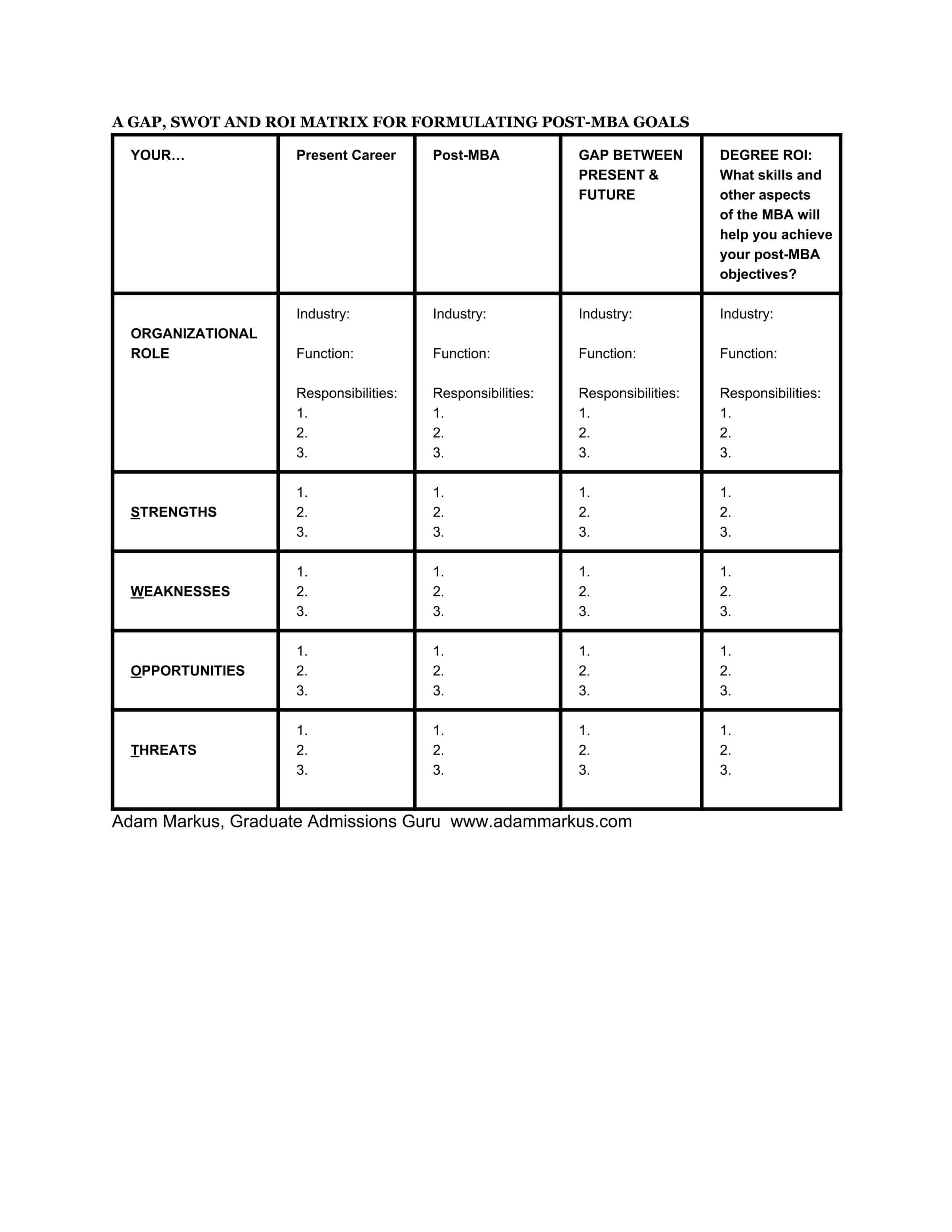
If you are having problems clearly articulating your goals either in Essay 1 or in the 50 character statement, I think Gap, SWOT, and ROI analysis are great ways for understanding what your goals are, why you want a degree, and how you will use it. The following table will help you with both Essay 1 and Essay 3.
The following image may not work for all browsers. If so, see here.
Step 1. Begin by analyzing your "Present Career." What roles and responsibilities have you had in clubs, part-time jobs, internships, volunteer activities, etc.? What was/is your functional role(s)? What was/are your responsibilities? Next, analyze your present strengths and weaknesses for succeeding in your present career. In particular, some of your greatest strengths may have been demonstrated outside of work, so make sure you are accounting for them. Strengths: What are you good at? Where do you add value? What are you praised for? What are you proud of? Weakness: What are you bad at? What are you criticized for? What do you try to avoid due to your own limitations? What do you fear? Next, analyze your situation in right now. What opportunities exist for your growth and success? What threats could limit your career growth?
Step 2. Now, do the same thing in Step 1 for your "Post-MBA" future after you have earned your graduate degree. If you cannot complete this step you need to do more research and need to think more about it. I frequently help clients with this issue through a process of brainstorming.
Step 3. If you could complete step 2, then you should see the "Gap" between your present and your future. What skills, knowledge, and other resources do you need to close the gap between your present and future responsibilities, strengths, and opportunities? THIS IS WILL HELP YOU ANSWER ESSSAY 3.
Step 4. After completing Step 3, you now need to determine how an MBA will add value to you. It is possible that an increased salary as a result of job change will be sufficient "ROI" for the degree to justify itself, but you should show how a degree will allow you to reach your career goals. How will the degree enhance your skills and opportunities and help you overcome your weaknesses and external threats? If you can complete Step 4, then you should be ready to explain what your goals are, why you want a degree, and the relationship between your past and future career, as well as your strengths and weaknesses.
The above table will also help you answer such common interview questions as: Where do you want to work after you finish your degree? Why do you want an MBA? What are you strengths? What are your weaknesses? What are your goals?
Be informed about your goals. Columbia Admissions needs to believe you know what you are talking about. If you are changing careers, no one expects you to be an expert, but you should come across as having a clear plan based on real research into your future. If you are planning on staying in your present industry, you should be well informed not only about the companies you have worked for but about the industry as a whole. If you are not already doing so, read industry related publications and network.
Those applicants who are changing fields should most certainly read industry related publications in their intended field. Additionally, I suggest conducting informational interviews with at least one peer level and one senior level person in that field. Conduct a peer level interview to get a good idea of what it would be like to actually work in that industry. Conduct a senior level interview to get the perspective of someone who can see the big picture and all the little details as well. Don't know anyone in your intended field? Network! One great way to start is through LinkedIn. Another is by making use of your undergraduate alumni network and/or career center. No matter whether you are changing fields or not, learn what is hot now and try to figure out what will be hot by the time you graduate. Now, of course, this is just a plan and chances are that what is hot in your industry or field now may very well be cold in the future.
If at the end of the above process you feel as though you are uncertain about whether you need an MBA, please see Do You Really Need an MBA?
Essay 2. Please share a specific example of how you made a team more collaborative, more inclusive or fostered a greater sense of community within an organization. (250 words)
What is nice about this question is that can be used for a wide variety of answers in a personal, academic, professional, or extracurricular content. The actual question itself is behavioral and really fits the STAR (Situation, Task, Action(s), Result) approach to such questions. While CBS does not mention the task (your role), I think it is important that you keep that in mind. A good answer will efficiently explain the situation (and given the length of the essay, cannot be context heavy), explain your role in the situation, explain what you did, and clearly state the result. The word breakdown might be: Situation/Task (~50 words), Action(s) ~150 words consisting of 1-3 actions, Outcome (~50 words).
You should have succeeded in whatever team organizational situation you choose.Whether the team was at work, school, or extracurricular does not matter. Focus on how impactful you were. That said I would not recommend selecting something prior to university. For those who have been out of school for more than 3 years, I would also recommend trying to use either a professional or post-college extracurricular activity.
Making a team more collaborative would imply that there was a problem in the team. Define the team. Explain what the problem was. Explain what action(s) you took to overcome the problem. This is a test of your teamwork skills. The harder the problem, the more likely it is that you will be able to highlight your impact. Likely collaborative problems in teams include: lack of a shared sense of purpose (mission), miscommunication, improper delegation of tasks, underperforming member or members, over dominant members, and lack of clarity about what the team's output should be.
Making a team more inclusive would imply that there was a problem in the team. Based on a definition of an inclusive found here, I define an inclusive team as follows: A team where every person feel valued while also acknowledging their differences and how these differences contribute to a group/team/organization’s culture and outcomes. Hence an effective answer would highlight the way(s) in which you made (or attempted to make) a professional/academic/extracurricular/personal environment open to and benefitting from person(s)/perspective(s)/group(s) that had not previously been valued. I will give a personal example, during my first year of college (1986), I joined a student quarterly with a mostly male staff. Soon thereafter, as co-editor, I helped introduce a women's section to the paper in order to get women involved in the newspaper, to get their perspectives effectively included, and to increase our staff. The biggest challenges involved overcoming the perspectives of older male staff members who did not understand why there needed to be a women's section and to convince female students that we were earnest in our objectives to include and empower them. We benefited from a greatly expanded gender balanced team, went on to win Columbia Student Journalism awards, and my eventual replacement as editor -in-chief was a woman.
Fostering a greater sense of community within an organization, while certainly a problem that could exist at any time and place, seems particularly relevant during the post-Covid years. Going remote put an immense strain on creating a sense of community for many organizations. While Zoom and WhatsApp groups helped us all during the bad years, they often did not fully replace what had been lost by no in-person contact. Overcoming the challenges of the Covid years is likely to be a topic in some applicants essays. Additionally restoring a full sense community to an organization after remote ended and in-person began again is equally challenging. Whatever the case, whether Covid related or not, creating a sense of community requires a range of actions that bring people together and bond them. If you have contributed to building community in an organization, this is an ideal topic.
ESSAY 3: WHY CBS? We believe Columbia Business School is a special place with a collaborative learning environment in which students feel a sense of belonging, agency, and partnership--academically, culturally, and professionally. How would you co-create your optimal MBA experience at CBS? Please be specific. (250 words)
Keep in mind that this question is focused on why Columbia Business School is the right MBA program for you. That is to say what does its curriculum, community, and network offer you that will help you reach the professional objectives you have mentioned in Essay 1? And beyond, professional objectives who does CBS fit you as a person from an academic and cultural perspective. For a more general discussion about the whole issue of academic fit, see here. If you are unclear about why you need from an MBA program, see the GAP, SWOT, and ROI table above.
I think there are two aspects to the question: (1) Why CBS is right for you and (2) Co-creation.
WHY CBS IS RIGHT FOR YOU
Balance and integrate Goals and Why Columbia?
A good version of Essay 3 will connect goals with Columbia. If you use the GAP/SWOT table above, Step 3 relates directly to the content of this essay. That is to say, the objective is not merely to explain why Columbia fits you, but why it aligns with the goals discussed in Essay 1. Your objective is to write an essay that shows Columbia why it is the best possible place for you to achieve your career goals. If your goals are not showing themselves to be particularly well supported by Columbia, you may need to either change your goals or decide to apply elsewhere.
Beyond Goals
Beyond direct goals reasons for why Columbia is right for you, consider what aspects of its curriculum or community support your personal and professional interests. This might be a club or activity that you want to engage in. For more about CBS clubs, see here.
The resources available at CBS and Columbia University are vast, so figure out specifically what you want from the school as you will need to discuss that. The program is flexible, so identify your needs from Columbia as specifically as possible. After all, you want to show them you love and need them For learning about what is hot at Columbia, I suggest taking a look at their Ideas and Insights Homepage. You will likely want to write about taking a Master Class. I also recommend learning about the Cluster system as it core part of the CBS experience. Japanese applicants should most certainly visit https://www.jbacolumbia.com/. All applicants should attend online chats and reach out to alumni and current students if they have not done so. Feel free to visit campus if you want, but the most important thing to do is connect with students and alumni because you will need to mention that in the application form.
Explaining your learning needs:
WHAT NOT TO DO
An example of circular (tautological) reasoning: "I want to take Capital Markets & Investments because I am interested in learning about capital market investing."
This kind of circular reasoning is so common. Usually it takes place within a paragraph consisting of many such sentences. They actually convey nothing about the applicant. They are just abstract needs and will have limited impact on your reader. The admissions reader wants to learn about you, not about their own program.
WHAT TO DO
An example of an explanation for why: "While I have been exposed to finance through my work at MegaBank of Joy, I presently lack the kind of comprehensive understanding of capital market investing that I will need to succeed as an investment analyst and I know I can gain at Columbia." A more complete explanation would include additional details about the kind of issues that the applicant is interested in learning about and/or specific ways the applicant intended to apply what he or she would learn at Columbia. By focusing on very specific learning needs and explaining those needs in relationship to one's goals and/or past experience, the admissions reader will be learning about you.
While in recent years, the school emphasized its New York City location in Essay 3 it no longer does. You need only discuss that if it is especially useful for making the best possible argument for why CBS fits you. In general, such arguments are often dumb cliches and since they are not what the question is focused, don't waste words on the topic.
Co-creation
The use of "co-create" is new this year and indicates that they are looking for answer that includes how you will actively optimize on your CBS experience. CBS is not a hand-holding kind of place. It is a commuter school with a core curriculum but with extensive opportunities for defining your curricular and extracurricular experience that is specific to you. Think about what you really want to focus your time on and contribute to.
WHAT NOT TO DO: Don't write an essay consisting of a laundry list of activities you want to engage in.
WHAT TO DO: Make highly personalized intelligent choices in the form of a learning plan specific to you. In 250 words, you can highlight like 3-4 specific topics. Say something meaningful. Show how you be an engaged member of the CBS community.
If you wish to provide the Admissions Committee with further information or additional context about your application, please include it here. You may write an essay or submit bullet points. (Maximum 500 Words)
As with other school's optional questions, do not put an obvious essay for another school here.
It is not necessary to write anything here. Many admits I have worked with had nothing to mention. Some have. THIS IS NOT AN OPPORTUNITY TO WRITE AN ACCOMPLISHMENT ESSAY OR TO DISCUSS SOMETHING THAT IS NOT NECESSARY TO INCLUDE.
Additional context can relate to something positive or negative.
You can certainly write on something positive here if you think its omission will be negative for you, but before you do, ask yourself these questions:
1. If they did not ask it, do they really need to know it? 2. Will the topic I want to discuss significantly improve my overall essay set? 3. Is the topic one that would not be covered from looking at other parts of my application? 4. Is the essay likely to be read as being a specific answer for Columbia and not an obvious essay for another school? If you can answer "Yes!" to all four questions, it might be a good topic to write about.
-Likely possible topics would include issues related to personal background (ethnicity, financial issues, other family or personal background issues) that you think admissions needs to know about.
-Other possible positive topics would be some aspect of your past experience that you could not sufficiently highlight that is key to understanding who you are. Again, the focus should be on an explanation, not a narrative essay. Please no GSB what matters most essays!
-Choice of recommenders is another possible topic here if that requires explanation.
-In some cases issues related to MBA company sponsorship and family business related issues might require explanation.
-If you own/ lead a business and would be temporarily leaving it, explaining who will be running it in your absence would be another topic that could be discussed here.
Negative topics: In addition to GMAT/GRE, TOEFL, and GPA problems, other possible topics include issues related to recommendations, serious gaps in your resume, concerns related to a near total lack of extracurricular activities, and major issues in your personal/professional life that you really think the admissions office needs to know about.
Columbia Loves to Be Loved
One thing that is consistent about Columbia Business School is that they want to know that their school is your first choice. If you have an alumni interview you can be expected to be asked about that very directly. See here for my advice on Columbia interviews. Best of luck for gaining admission to Columbia Business School!
There is a significant amount of concern expressed about AI generated essays. The main reason I would be concerned about it has nothing to do with the graduate admissions process: Becoming dependent on AI makes people stupid. MIT's study on this issue is worth reviewing. See abstract (https://www.media.mit.edu/publications/your-brain-on-chatgpt/) and an interview with the primary researcher (https://www.media.mit.edu/articles/a-i-s-effects-on-the-brain/). I would also recommend INSEAD Dean Mortensen's Have You Really Counted the Costs of GenAI? as it explains in detail what is lost by over reliance on AI specifically in reference to the cognitive skills required for success both academically and professionally. Note, my use of the word "dependent." I am no Luddite. I think AI is useful if used effectively. That is why I am not against using AI for making MBA or graduate applications. It has its place.
For MBA Admissions purposes in particular, my AIGAC colleague, Petia Whitmore, has put together an incredibly helpful article for all MBA applicants on how to use and not use AI. I will not repeat what she has written there.
Instead I want to make a different point: THERE HAVE BEEN AND ALWAYS WILL BE SHITTY ESSAYS AND AI IS JUST A VERY EASY WAY TO CREATE THEM!
I like the word "shitty" because it is captures the full essence of a bad essay: It stinks. Humans have been writing shitty essays forever. Hence AI, utilizing the corpus of content upon which it provides answers, will produce some shitty essays. Based on what I see it can certainly do that. Again, not all essays generated by an AI will be shitty, but if you don't have a human with the actual capability to judge what constitutes a non-shitty essay, problems will arise.
Some thoughts on the continued role of human incompetence in the essay writing process: What makes an essay shitty?
It fails to answer the question. People have been writing essays that did not answer the question correctly forever. Even with AI, I receive shitty essays from clients that totally fail to answer the question because (1) the writer did not use the correct prompts, (2) the writer did not insert the correct raw data for the essay, (3) the AI failed to really address the question being asked, and/or (4) the writer did not understand the question and therefore could not effectively judge the AI output. Only a person with good judgement can determine whether an answer is effective or not. Many applicants can certainly do that themselves, but not everyone.
It lacks strategy. Since MBA and other graduate admissions essays have only one sole objective, which is admission, you would think getting the strategy right would be easy. But this is the hardest part because what will work for one candidate will not work for another. That is often why advice from admits fails to help an applicant. Prior applicants (alumni and current students) tend to give advice based on their own experience. However, what got Jane admitted is not the same thing that will get Mary admitted. They are different people with different strengths and applying at different times. What worked at one point in time simply no longer always works at a different point in time. AI can provide strategic options and help with brainstorming but it can't provide holistic judgement that fully accounts for a particular candidate. Candidates and good advisors (professional or otherwise) must make the ultimate judgment about what will work best in an application now.
It is boring. I have been an admissions consultant since 2001. The number of absolutely dull essays I have read and then helped a client make engaging is something I have never counted, but well into the thousands. How to make a shitty boring essay: Tell an obvious story that contains no real development, lacks detail, does not attempt to connect to the reader on an emotional/intellectual/mission level, but is perfectly rational in the most soulless way possible. Often they are mere extended versions of a resume bullet point. Many people don't know how to tell a story, especially in writing. It is not a skill distributed evenly throughout the human population, which is why we value those who do it well. That said, story telling can be taught. I know because I have taught it to thousands of people over the last 24 years. However, AI's are not inherently good at storytelling unless you provide a prompt with such sufficient details that you might have well written it yourself. They will tell a story for sure, but not inherently a good one. If you don't know how to tell a story, chances are unlikely you will be inherently good at knowing whether an AI produced story is any good. I can say this because I have 24-year sample size that makes it perfectly clear to me that many people can't tell a good story about themselves without being taught how to do it. A language engine, an AI, is not an aesthetic judgment engine and also not a judgmental reader, which is what required for judging a story.
It lacks sufficient details. This is a subset of boring to a certain extent but worthy of its own categorization here. For as long as I have been an admissions consultant, I have been impressed by the ability of some writers to be completely blind to the importance of detail in MBA essays. It is though they never read a news article, story story, or any narrative prose. No time provided. No company name. No characters in stories (such as teammates in an essay where the theme relates to teamwork). No details about how the applicant solved a problem, succeeded, failed, etc. No numbers to back up their arguments. An AI will certainly populate a story with detail, but that requires providing the AI with the detail or adding it later, which are both dependent on the human knowing they need to have such details.
It is based on bad argumentation, often found in the conclusion. A good example of this is an essay that discusses learning something when, in fact, what was supposedly learned, was clearly already known by the applicant because the actions that applicant took in the situation being described demonstrate that. For example, an applicant writes about how he or she collaborated with a team by using their existing teamwork skills and then writes about how they learned the power of collaboration from this experience. It makes no sense, since they already knew how to collaborate, so they did not learn that. They already knew it. False learning is any situation when you indicate that you learned something, but actually it was something that you already knew or others are likely to assume that you know. False learning tends to undermine the credibility of applicant in terms of their intelligence and honesty. A related form of this, which AI argumentation seems to produce is that an experience is reaffirming what the writer knew already. Reaffirming something is not learning something either. Again I have read thousands of essays that suffered from bad argumentation. Why wouldn't AI fix this problem? Because the world is filled with bad arguments and an AI can't always distinguish between a good and bad argument as both can be found in the corpus upon which it makes judgements.
Big Takeaway: Anyone can use AI, just like anyone can use a keyboard, but the result is still dependent on human judgment. If someone's human judgment skills are undermined as a result of an over-reliance on having an AI do their thinking, it is best that they never get into any kind of position of responsibility where they would be required to think because they will be unable to do through lack of practice. In this sense, AI rather than enabling the incompetent and lazy to gain entry into MBA programs will likely have the opposite effect if the reader is a discerning human being (I will assume that is the case with most admissions officers). The opposite is also true, those that are competent and hardworking and use AI effectively are likely to have a significant advantage in the admissions process and in their professional lives. At least is that is what I hope for, otherwise full corporate Idiocracy is likely to be achieved within my lifetime.
In this post, I analyze the essay questions for the Wharton School of the University of Pennsylvania for Fall 2026 admission. For my most recent posts on Wharton interviews, please see here.
My clients have been admitted to Wharton every year since 2002. Since I started my own counseling service in 2007, I have had 103 clients admitted to Wharton's MBA program (88 admitted to Wharton, 1 to Wharton Deferred and 14 admitted to Wharton Lauder). My clients' results and testimonials can be found here.
The thing I like most about Wharton is that they really do admit a very diverse class. The class size certainly helps, but beyond that, Wharton is a school where applicants are evaluated holistically and one need not be perfect to gain admission. Such factors as a less than stellar GPA, a less than super GMAT or GRE, being older (30+) or work experience in companies that are not necessarily prestigious are not inherent barriers to admission to Wharton's MBA program. I have worked with clients who had such issues, but also had amazing strengths which helped them gain admission. This could also happen at HBS or only rarely at Stanford, but it happens more at Wharton. The school's diversity is also shown through the range of courses offered and the many international programs. Some people think of Wharton narrowly as a finance school, but to do so is to ignore the huge course catalog, numerous clubs, and diverse recruiting results.
The deadlines are Round 1: Sep 3, 2025, Round 2: Jan 6, 2026, and Round 3: Apr 1, 2026.
Big Changes to the Wharton Essays for the Class of 2028:
-Instead of writing 900 words max for Essay 1 and 2, you now have 550.
-Essay 1 is divided into 2 short goals questions with a total word count of 200 words. The Wharton related part of the question has been deleted:
"Essay 1: Two short-form questions Essay 1 has been restructured into two short-answer questions, allowing candidates to focus exclusively on their professional goals.
What is your immediate post-MBA professional goal? (50 words)
What are your career goals for the first three to five years after completing your MBA, and how will those build towards your long-term professional goals? (150 words)"
-Essay 2 is unchanged in terms of content but is now 350 instead of 400 words long:
"Essay 2: Long-form essay Essay 2 remains a long-form response but has been refined to center on the impact you’ll bring to the Wharton community, rather than how you’ll spend your time while in the program.
Taking into consideration your background – personal, professional, and/or academic – how do you plan to add meaningful value to the Wharton community? (350 words)"
-The Recommendation requirements have also changed: Wharton no longer has its own questions but is using GMAC's The Common Letter of Recommendation (LOR) and only wants one recommendation. This is big change because Wharton rec questions were totally different from the rest of the M7 and other US MBA programs. This is very helpful to both applicants and their recommenders.
KEY TAKEAWAYS:
They are focused on your professional goals and wanted them stated clearly.
They want to know how you will contribute to Wharton.
They DON'T want to know about overall plan for studying at Wharton and how that relates to your goals unless it is relationship to how you can contribute.
Given the very limited length of the essay set, your resume, which is always critical for any school, and the application form content as well as the recommendation are major ways they will be learning about you.
Except for Essay 2, this is extremely simple and fast application to complete if you are applying to other MBA programs and if this is not the first essay set you are working on.
"Essay 1: Two short-form questions Essay 1 has been restructured into two short-answer questions, allowing candidates to focus exclusively on their professional goals.
What is your immediate post-MBA professional goal? (50 words)
What are your career goals for the first three to five years after completing your MBA, and how will those build towards your long-term professional goals? (150 words)"
If you have not written goals statements for other schools, this will be an extremely easy task. If you need to brainstorm goals, please see my Stanford or CBS posts.
What is your immediate post-MBA professional goal? (50 words)
Write as directly as possible what job you want immediately after graduating from Wharton. Keep it simple and to the point. They are not really asking about why this is your goal, but rather what it is. They are not looking for a deep story here, just a direct and simple plan. Given the current job market, you better have a plan that makes them think you can achieve it.
What are your career goals for the first three to five years after completing your MBA, and how will those build towards your long-term professional goals? (150 words)"
They want you to connect what you will have done in the short-term (3-5 years) after your MBA to your long-term professional goals. In other words, what skills, experiences, network, etc. will you have gained in the short-term that will put you on the pathway to reaching your long-term professional goals and what are those goals?An effective answer will establish the connection to your short-term and long-term goals, explain what you will have gained in the short-term, and explain your long-term goals. While this is a very short essay, I would devote a sentence to explaining the reason/motivation for your long-term goals in about a sentence.
"Essay 2: Long-form essay Essay 2 remains a long-form response but has been refined to center on the impact you’ll bring to the Wharton community, rather than how you’ll spend your time while in the program.
Taking into consideration your background – personal, professional, and/or academic – how do you plan to add meaningful value to the Wharton community? (350 words)"
WHAT CAN YOU GIVE TO THE WHARTON COMMUNITY?
I have been an MBA admissions consultant since 2001 and the contribution question is one that I could explain to a client in my sleep. I have done it on this blog many times before. Here is one of my old (2008) favorites, which includes a table that I have also used below.
One of the chief functions of an MBA admissions committee is to select people who will add value to the community. The director and the rest of the committee have done their job properly if they have selected students who can work well together, learn from each other, and if these students become alum who value the relationships they initially formed at business school. Your contribution(s) need to clearly connected to the community. Maybe it will be through the way you work with others, the knowledge you share, or the activities you organize but make sure the reader can fully understand how this be a contribution at Wharton. You should know enough about the Wharton community to show specific ways you might contribute.
Within the context of the Wharton application, Essay 2 is really one of the important places to show why you will add value to Wharton. One way, I like to think about contribution questions is to use a table like the following:
CONTRIBUTIONS
Is it a personal, professional or academic experience?
What skill, value, or unique experience is being showcased?
So what will you contribute to the Wharton community?
Is this special? Why?
Story 1:
Story 2:
Story 3:
adammarkus@gmail.com. Free to use, contact me if you republish it.
I use the above table for all types of contribution questions, modifying the categories to fit the question. What this kind of table does is force you to think about exactly how something from your background is meaningful enough to add value at Wharton.
ADVICE:
Tell your best story or stories that highlight how you will add value at Wharton. Help the reader understand what is special about you, about the story you tell, and the contribution you make.
You need to learn about a lot about Wharton. Talk to alumni and current students, attend online chats, and dig through the website and otherwise. Google and network your way into Wharton expertise in order to be able to have really deep contributions. It is one of the schools that requires knowing a lot about it through networking with current students and alumni as well as looking at the program in depth. Wharton wants to be loved. It suffers from an HBS and Stanford inferiority complex. Comparatively speaking, the amount of engagement you should have with this school is very high compared to the rest of the M7 except CBS because this essay requires a significant understanding of how you will contribute to Wharton. For more about this issue, see How much do I really need to know about an MBA program to prepare a strong application for it? It varies!It provides a comprehensive guide to this issue for Wharton, the rest of the M7, and many other top schools.
With respect to the kind of contributions you make, don't fall into the "Obvious Knowledge Trap." What do I mean? Here is an example: "As my work on the Tesla/McDonalds Merger and Acquisition shows, I have deep knowledge of finance and accounting which I will use to help my classmates without a finance background." This topic is bad for a number of reasons. First, that you have such knowledge will be obvious from your resume, application form and/or transcripts, so it is better to focus on something that the reader will not already know about you. Second just sharing knowledge is not enough, better to focus on how you would do that. For example, instead of writing about your knowledge of a topic, write about how you helped others learn something and how you will use that to make a contribution at Wharton. Then specify the Wharton specific context (Classes, clubs, activities, Learning Teams) where you will make that contribution.
SPECIFIC ESSAY 2 REQUIREMENTS: Since the question calls for contributions, my suggestion is to include at least two contributions. The question does not indicate how many aspects of your background you need to focus on. So you can focus on one story from your background or multiple stories. In 350 words, I think 3 topics would be a maximum from your background to focus on but that 2 topics makes more sense.
ESSAY STRUCTURE:
It will depend on whether you cover 1 or more topics. Here are two sample structures that I think are most common:
One Background Topic Essay Structure:
Discuss one personal, academic, or professional story.
Explain one specific and meaningful contribution that you will be able to make at Wharton based on what you do or learn from this story.
Explain another specific and meaningful contribution that you will be able to make at Wharton based on what you do or learn from this story.
Two or Three Background Topic Essay Structure:
Discuss one personal, academic or professional story. Explain at least one specific and meaningful contribution that you will be able to make at Wharton based on what you do or learn from this story.
Discuss another personal, academic or professional story. Explain at least one specific and meaningful contribution that you will be able to make at Wharton based on what you do or learn from this story.
Discuss another personal, academic or professional story. Explain at least one specific and meaningful contribution that you will be able to make at Wharton based on what you do or learn from this story.
Both of the above structures can work well for this kind of essay. It just depends on whether you want to cover one story in depth and then show two or more contributions from it or show greater diversity of your experience and focus on 2-3 stories. To tell a story about your background sufficiently and also explain what it shows you will add value at Wharton is very hard to do really effectively in less than 100 words, so 3 topics would be a maximum from my perspective. That said, I will encourage my clients to focus on 2 topics.
Additional Question (required for all Reapplicants): Please share with the Admissions Committee how you have reflected and grown since your previous application and discuss any relevant updates to your candidacy (e.g., changes in your professional life, additional coursework, extracurricular/volunteer engagements, etc.). (250 words)"
Reapplicants, an effective answer here will do the following:
1. Showcase what has changed since your last application that now makes you a better candidate.
2. Refine your goals. I think it is reasonable that they may have altered since your last application, but if the change is extreme, you had better explain why.
3. Make a better case for why Wharton is right for you.
"Additional Information: Please use this space to share any additional information about yourself that cannot be found elsewhere in your application. This space should be used to clarify information provided in the application or address extenuating circumstances (e.g., unexplained gaps or inconsistent performance in academic career, choice of recommenders, areas of weakness, etc.) that you would like the Admissions Committee to consider. Please note that this section is not intended to be an additional essay." (500 words)
Use this space to explain anything that can't be explained elsewhere in the application, but as the last sentence indicates they are not looking for an additional essay. This is a great place to explain your choice of recommenders, a problem in your past (grades, gaps, etc), or to add in information about something you really think Wharton needs to know. It is completely fine to leave this space blank if you have nothing you need to add. This is not the place for a mini-essay on some random accomplishment, but for information or explanations that cannot be included elsewhere. A list is fine. You don't need to write this like an essay but treat it like an administrative statement. Just fact-based critical information that fits nowhere else and that you want Wharton to consider.
Best of luck with your Wharton application for the Class of 2028!