The Columbia Business School MBA program is one that I have extensive experience experience helping clients get admitted to. Most recently, I had 10 clients admitted for August 2026 entry and 1 client admitted for J-Term 2026. You can find testimonials from my clients admitted for Columbia Business School here. Since 2007, when I established my own consultancy, I have been fortunate to work with 104 clients admitted to Columbia Business School for Fall term, J-Term, and Deferred Admission. The advice I provide here is based on my almost twenty-five years of experience of helping clients get admitted to the world's top MBA programs.
The most important thing I can tell you about gaining admission to Columbia Business School, aside from my essay and application form analysis below, is to apply in Round 1 for either January (Deadline: June 17, 2026. R2 is August 13, 2026) or August (Deadline September 9, 2026. R2 is January 5, 2027 and R3 is March 29, 2027). Based on what has occurred in prior years, Round 1 is best to maximize admission because the rate of waitlisting and outright dings goes up significantly in subsequent rounds. Given that CBS takes the Executive Assessment (Try to get at least a 150, 155 is better and 160 or over is good) in lieu of GMAT or GRE, it is along with other schools that take the EA (NYU, Duke, Darden, Stanford MSx), an easy place to apply to R1. Even if you are applying everywhere else in R2, apply to CBS in R1 if you want to maximize your shot at admission.
The second most important thing I can tell you, aside from my essay analysis, is that you need to learn about a lot about CBS. It is one of the schools that requires knowing a lot about it through networking with current students and alumni. CBS wants to be loved. Comparatively speaking, the amount of engagement you should have with this school is very high compared to the rest of the M7 because they ask in their application forms for your student, alumni, and adcom contact. For more about this issue, see How much do I really need to know about an MBA program to prepare a strong application for it? It varies! It provides a comprehensive guide to this issue for CBS, the rest of the M7, and many other top schools. Keep in mind that CBS provides a specific place in the "Application Information" page to highlight the ways you have engaged with the school:
Along with Stanford, and INSEAD, I think CBS is one of the best first applications to work on. In the case of CBS, Essay 1 requires more of a focus on goals than any other school, so doing it gives applicants all the content they need for any school's goals essays. Also Essay 3, provides a perfect length for explaining why you want to attend a specific MBA program. Make that argument right for CBS and it will help you with other schools that require similar essay content.
For my post on reapplication to Columbia, see here. For my analysis of recommendations , please see here. For my analysis of Columbia Business School application interviews, please see here.
Before discussing the essays, for those applying or considering applying for January entry, please see the next section. If you are applying for August entry, you can ignore this section.
J-Term
Is J-term easier to get into than August entry? I have always thought so. The lack of Merit Fellowships, an internship, and the nature of who the program is designed for, clearly indicate that it is going to attract fewer applicants, so my assumption is that it is surely easier. Happy to proven wrong if CBS admissions provides data showing otherwise (They don't). Unlike an August entry applicant, someone applying to Columbia J-term can really be assumed to prefer Columbia over all alternatives. This can make interviews a bit easier in the sense that August entry Columbia alumni interviewers are notorious for being particularly aggressive at determining whether the interviewee's first choice is really Columbia. Since J-term has no real US rival, this topic can be easily dispensed with in an interview.
Program Alternatives to J-term: There are no US alternatives to J-term worth mentioning if someone wants a January 2025 start. Cornell Tech, Kellogg and NYU Stern (Tech and Fashion & Luxury) offer one year MBAs, but none start their programs in January, Cornell Tech and NYU are specialized degrees, and Kellogg is an accelerated program in terms of the number of courses taken. Only J-term makes it possible to do two years of courses on such an expedited basis. In addition, the Kellogg program is extremely restrictive, since one has to have taken many core business courses or come from a consulting firm that has established a relationship to apply to it. There are a number of European programs with a January starts but really only INSEAD could be said to be at a similar rank and reputation, at least as perceived by my clients. I have had clients who apply to J-term and INSEAD and, less often, IMD, as both have January entry. Still J-term is an incredibly different program in terms of length and content from either of these top non-US programs. LBS, which does not have a January start, would also be another alternative to CBS in the sense that it can be completed on an accelerated basis, but it has no January start. There are many other programs in the Europe that can be completed in around 16 months or less, such as HEC.
Can an August entry applicant reapply to J-term? Yes! You could be rejected from ED or RD for 2026 entry and reapply for J-term 2027 entry. If you entered in J-term 2027, you would graduate in the Class of 2029 with those who entered in Fall 2027. I have worked with a number of reapplicants who were admitted to J-term after being dinged from the August entry for the same graduating class. In that situation, the key issues for the reapplicant essay are explaining why J-term is now a better choice and you are a better candidate.
EMPLOYMENT SECTION QUESTIONS RELATED TO FUTURE CAREER GOALS
While the essays have not changed, CBS has modified its "Employment" page related to future career goals. The changes to this section are related directly to international applicants. For US citizens and permanent residents this section is just pull downs.
I have added comments
ADAM's ANALYSIS: This answer should align with your goals and CBS essays. It is only 50 characters long, about 12 words. So feel free to elaborate as needed in your longer essays. In general, I would not recommend being focused on wanting to work in the US, but rather on network, education, and experience in your answer. While you may want to work in the US and can certainly indicate that, being geographically flexible is generally the best strategy, especially in the current job market for international students in the US. On the other hand, if you are company-sponsored and will be working in the US post-MBA, you should indicate that here. I have had many Japanese clients who were sponsored by their companies for MBA to prepare for working in the US. Whether you are Japanese or not, if you company intends for you to work in the US post-MBA, certainly indicate that here. Your visa situation is different from other international students who have to find an employer.
The Three Essay Questions and the Two Short Statements
The questions are taken from the website.
SHORT QUESTION 1:
What is your immediate post-MBA professional goal? (50 characters maximum)
Examples of possible responses:
“Work in business development for a media company.”
“Join a strategy consulting firm.”
“Launch a data-management start-up.”
Remember this is 50 characters, not words! This would be about 12 words maximum. The question itself, fortunately, includes the above examples to make it clear what Columbia is looking for here. Given the length, you can't possibly expect to explain what you want to do short-term. That is what Essay 1 is for. In fact, it is best to simply write this little statement after you have a good working version of Essay 1. CBS is looking for a short, but a very clear statement of what you intend to do after your MBA. If you have difficulty explaining your immediate post-MBA plans in the space given, I think that is likely an indication that your plans are too complex, vague, or otherwise not well thought out. What you state here should be backed up by what you discuss in Essay 1 and 3 (or the reapplicant essay for reapplicants).
If you can be clever or catchy in formulating this response that is fine, but it is a completely secondary consideration to simply stating something that is very clear and that is completely consistent with what you write in Essay 1 and 2. Being clever is not critical here, being clear is.
Short Answer Question 2 for JANUARY ENTRY: Why do you prefer the January-entry term? (50 characters maximum)
This is an opportunity to explain why J-term. You might need to expand on this further in the application, but here is a chance to give a very direct and fact-based answer.
Short Answer Question 2 for AUGUST ENTRY (Based on last year's application. Will update if this changes when the August Entry Application is opened in June 2026): How do you plan to spend the summer after the first year of the MBA? If in an internship, please include target industry(ies) and/or function(s). If you plan to work on your own venture, please indicate a focus of business. (50 characters maximum)
Essay #1: Through your resume and recommendation, we have a clear sense of your professional path to date. What are your career goals over the next three to five years and what is your long-term dream job? (500 words)
Since I have found it necessary to make this clear to clients: THIS ESSAY IS COMPLETELY FUTURE FOCUSED. That is why they say they "have a clear sense of your professional path to date." Any statements you make about your past experience should be analytical rather than descriptive and for the sole purpose of explaining what you want to do in the future and why. Discuss your past to help establish your motivation for your goals. If they wanted a detailed past history, they would not have worded the question the way they do.
A BAD CBS Essay 1 will typically consist of extended discussion of past experience, lack of explanation of post-MBA goals, and inability to distinguish between long-term goals as typically required by other schools and a long-term dream job. Here is what you can do to avoid that:
If you are having problems clearly articulating your goals either in Essay 1 or in the 50 character statement, I think Gap, SWOT, and ROI analysis are great ways for understanding what your goals are, why you want a degree, and how you will use it. The following table will help you with both Essay 1 and Essay 3.
The following image may not work for all browsers. If so, see here.
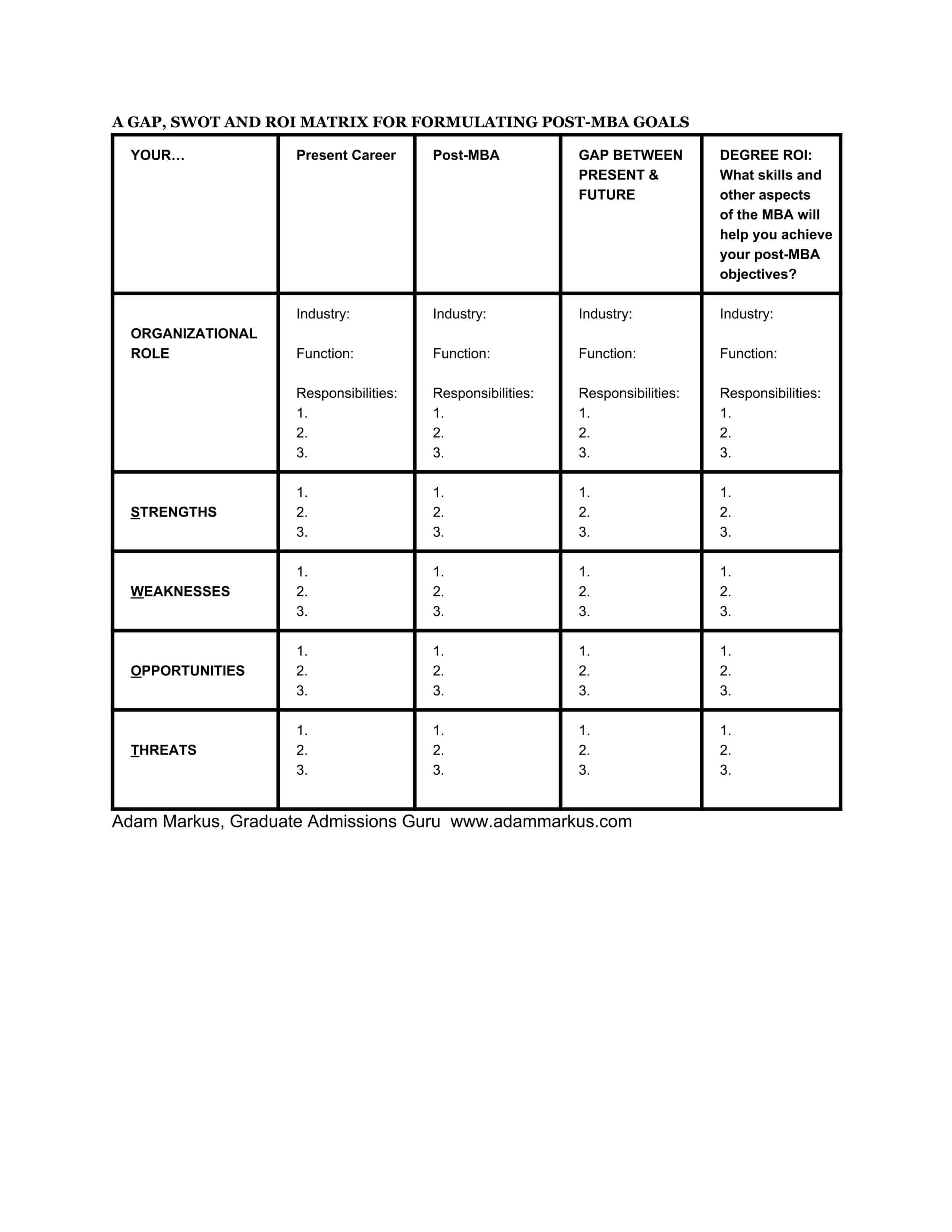
(A Google Docs version of this matrix can be found at https://docs.google.com/document/d/1WobczFFLHBzQRxUeuwBRNmGQ3q-RKP_94iGHuLlXXEs/edit?usp=sharing)
Next, analyze your present strengths and weaknesses for succeeding in your present career. In particular, some of your greatest strengths may have been demonstrated outside of work, so make sure you are accounting for them.
Strengths: What are you good at? Where do you add value? What are you praised for? What are you proud of?
Weakness: What are you bad at? What are you criticized for? What do you try to avoid due to your own limitations? What do you fear?
Next, analyze your situation in right now. What opportunities exist for your growth and success? What threats could limit your career growth?
What is nice about this question is that can be used for a wide variety of answers in a personal, academic, professional, or extracurricular content. The actual question itself is behavioral and really fits the STAR (Situation, Task, Action(s), Result) approach to such questions. While CBS does not mention the task (your role), I think it is important that you keep that in mind. A good answer will efficiently explain the situation (and given the length of the essay, cannot be context heavy), explain your role in the situation, explain what you did, and clearly state the result. The word breakdown might be: Situation/Task (~50 words), Action(s) ~150 words consisting of 1-3 actions, Outcome (~50 words).
You should have succeeded in whatever team organizational situation you choose.Whether the team was at work, school, or extracurricular does not matter. Focus on how impactful you were. That said I would not recommend selecting something prior to university. For those who have been out of school for more than 3 years, I would also recommend trying to use either a professional or post-college extracurricular activity.
Making a team more collaborative would imply that there was a problem in the team. Define the team. Explain what the problem was. Explain what action(s) you took to overcome the problem. This is a test of your teamwork skills. The harder the problem, the more likely it is that you will be able to highlight your impact. Likely collaborative problems in teams include: lack of a shared sense of purpose (mission), miscommunication, improper delegation of tasks, underperforming member or members, over dominant members, and lack of clarity about what the team's output should be.
Making a team more inclusive would imply that there was a problem in the team. Based on a definition of an inclusive found here, I define an inclusive team as follows: A team where every person feel valued while also acknowledging their differences and how these differences contribute to a group/team/organization’s culture and outcomes. Hence an effective answer would highlight the way(s) in which you made (or attempted to make) a professional/academic/extracurricular/personal environment open to and benefitting from person(s)/perspective(s)/group(s) that had not previously been valued. I will give a personal example, during my first year of college (1986), I joined a student quarterly with a mostly male staff. Soon thereafter, as co-editor, I helped introduce a women's section to the paper in order to get women involved in the newspaper, to get their perspectives effectively included, and to increase our staff. The biggest challenges involved overcoming the perspectives of older male staff members who did not understand why there needed to be a women's section and to convince female students that we were earnest in our objectives to include and empower them. We benefited from a greatly expanded gender balanced team, went on to win Columbia Student Journalism awards, and my eventual replacement as editor -in-chief was a woman.
Fostering a greater sense of community within an organization, while certainly a problem that could exist at any time and place, seems particularly relevant during the post-Covid years. Going remote put an immense strain on creating a sense of community for many organizations. While Zoom and WhatsApp groups helped us all during the bad years, they often did not fully replace what had been lost by no in-person contact. Overcoming the challenges of the Covid years is likely to be a topic in some applicants essays. Additionally restoring a full sense community to an organization after remote ended and in-person began again is equally challenging. Whatever the case, whether Covid related or not, creating a sense of community requires a range of actions that bring people together and bond them. If you have contributed to building community in an organization, this is an ideal topic.
ESSAY 3: WHY CBS? We believe Columbia Business School is a special place with a collaborative learning environment in which students feel a sense of belonging, agency, and partnership--academically, culturally, and professionally. How would you co-create your optimal MBA experience at CBS? Please be specific. (250 words)
Keep in mind that this question is focused on why Columbia Business School is the right MBA program for you. That is to say what does its curriculum, community, and network offer you that will help you reach the professional objectives you have mentioned in Essay 1? And beyond, professional objectives who does CBS fit you as a person from an academic and cultural perspective. For a more general discussion about the whole issue of academic fit, see here. If you are unclear about why you need from an MBA program, see the GAP, SWOT, and ROI table above.
I think there are two aspects to the question: (1) Why CBS is right for you and (2) Co-creation.
WHY CBS IS RIGHT FOR YOU
Balance and integrate Goals and Why Columbia?
A good version of Essay 3 will connect goals with Columbia. If you use the GAP/SWOT table above, Step 3 relates directly to the content of this essay. That is to say, the objective is not merely to explain why Columbia fits you, but why it aligns with the goals discussed in Essay 1. Your objective is to write an essay that shows Columbia why it is the best possible place for you to achieve your career goals. If your goals are not showing themselves to be particularly well supported by Columbia, you may need to either change your goals or decide to apply elsewhere.
Beyond Goals
Beyond direct goals reasons for why Columbia is right for you, consider what aspects of its curriculum or community support your personal and professional interests. This might be a club or activity that you want to engage in. For more about CBS clubs, see here.
While in recent years, the school emphasized its New York City location in Essay 3 it no longer does. You need only discuss that if it is especially useful for making the best possible argument for why CBS fits you. In general, such arguments are often dumb cliches and since they are not what the question is focused, don't waste words on the topic.
Co-creation
The use of "co-create" is new this year and indicates that they are looking for answer that includes how you will actively optimize on your CBS experience. CBS is not a hand-holding kind of place. It is a commuter school with a core curriculum but with extensive opportunities for defining your curricular and extracurricular experience that is specific to you. Think about what you really want to focus your time on and contribute to.
WHAT NOT TO DO: Don't write an essay consisting of a laundry list of activities you want to engage in.
WHAT TO DO: Make highly personalized intelligent choices in the form of a learning plan specific to you. In 250 words, you can highlight like 3-4 specific topics. Say something meaningful. Show how you be an engaged member of the CBS community.
If you wish to provide the Admissions Committee with further information or additional context about your application, please include it here. You may write an essay or submit bullet points. (Maximum 500 Words)
2. Will the topic I want to discuss significantly improve my overall essay set?
3. Is the topic one that would not be covered from looking at other parts of my application?
4. Is the essay likely to be read as being a specific answer for Columbia and not an obvious essay for another school?
If you can answer "Yes!" to all four questions, it might be a good topic to write about.
Columbia Loves to Be Loved
One thing that is consistent about Columbia Business School is that they want to know that their school is your first choice. If you have an alumni interview you can be expected to be asked about that very directly. See here for my advice on Columbia interviews. Best of luck for gaining admission to Columbia Business School!