Go to a better blog!


You can find a better version of my blog at http://www.adammarkus.com/blog/.

Be sure to read my Key Posts on the admissions process. Topics include essay analysis, resumes, recommendations, rankings, and more.

July 19, 2011

Stanford GSB MBA Essay 3 for Class of 2014 Admission

This is the fourth of five posts analyzing the Stanford GSB MBA Essay Questions for Class of 2014 Admission. The five posts are overall comments, Essay 1, Essay 2, Essay 3, and additional information/resume/employment history/activities. My analysis of Stanford GSB interviews can be found here. In addition to the Class of 2014 posts, I also recommend reading and/or listening to my presentation, "So you want to get into Stanford GSB?" which was made to a Japanese audience in March 2011. That presentation focuses on issues that are applicable to all applicants as well as some issues specific to Japanese applicants.
 
"Essay 3: Answer two of the four questions below. Tell us not only what you did but also how you did it. What was the outcome? How did people respond? Only describe experiences that have occurred during the last three years.

Option A: Tell us about a time when you built or developed a team whose performance exceeded expectations.
Option B: Tell us about a time when you made a lasting impact on your organization.
Option C: Tell us about a time when you generated support from others for an idea or initiative.
Option D: Tell us about a time when you went beyond what was defined or established."


The Place of Essay 3 within the Stanford GSB Application Essays for the Class of 2014
If Essay 1 is ultimately about what you value and Essay 2 is about what you want, Essay 3 is about what you can do.

When Stanford GSB started asking behavioral essay questions, it was clear that they had borrowed this from MIT Sloan. This distinctive style of behavioral essay questions that MIT and Stanford ask have their origins in behavioral interviewing. This method is not old (well, at least for me, since I was born in 1968):

In fact, the STAR technique outlined in MIT’s guide was developed by Byham as THE WAY to answer behavioral questions:


The STAR technique is really the core method you need to use for answering behavioral questions in Stanford's essays. It is simply the following, which is taken from the 2005 MIT Sloan Guide (No longer available for easy download, but if you search on "Situation: define the situation or “set the stage.” you can find it. The current guide is is not as helpful.):

• Situation: define the situation or “set the stage.”
• Task: identify the task/project performed.
• Action: describe the action you took.
• Result: summarize the outcome

Just keep in mind that you need to be introspective as well, so write what you thought as well as what you did. Don’t just present “the facts” but actively interpret your actions. There is really nothing overly complicated about this as long as you understand that you need to tell a DETAILED story. Pure abstractions disconnected from a concrete set of action steps are highly likely to result in a weak answer. Similarly, grand actions not told in any depth are also likely to be weak. Identify specific actions that contributed to the result so as to establish a clear link between cause and effect.

As when answering any kind of question, another important consideration is to think very critically about what your story selection, understanding of the task, actions taken, and results say about you. Keep in mind that the whole point of asking behavioral questions is to determine how someone acts and thinks as a basis for selecting or rejecting that person. It is obviously critical to be aware of your own message.

Before looking at the specific questions, lets look at the instructions:
"Essay 3: Answer two of the four questions below. Tell us not only what you did but also how you did it. What was the outcome? How did people respond? Only describe experiences that have occurred during the last three years.
Stanford GSB specifically requires that these experiences come from the last three years. This time constraint is important to keep in mind. One of the easiest ways to trash your application is to ignore this time limit. Essay 3 is the space to focus on the present or recent past.

I will analyze one question at a time, but four things to keep in mind are:

1. You need to show the capacity for analyzing and acting in different ways, so, while both essays should utilize STAR, don’t tell them in the same way. Make sure you are presenting different sides to who you are by telling your stories differently.

2. If at all possible discuss different situations in these essays, not two different stories from the same situation because you are trying present as wide a spectrum of events and qualities about yourself as you can.

3. You should ask yourself “What does this essay reveal about me?” If you can’t answer that clearly, you need to clarify your message. When asking this question, think about both what you intend the reader to think and what you might also be revealing. Control for the possibility of sending out unintended signals. One of the best ways of handling this issue is to have a very careful and intelligent reader review these essays. If you are working with an admissions consultant, they should be able to do this. Getting multiple perspectives on what you wrote will help you better understand your likely impact on an admissions' reader.

4. All four options below allow for great variation and the most important thing is to tell the best stories you can:

THE OPTIONS ARE ALL ABOUT HAVING AN IMPACT:
Option A: Tell us about a time when you built or developed a team whose performance exceeded expectations.
Option B: Tell us about a time when you made a lasting impact on your organization.
Option C: Tell us about a time when you generated support from others for an idea or initiative.
Option D: Tell us about a time when you went beyond what was defined or established.


    One thing that is common to all four is that you must tell stories that show how you had an impact. Keep in mind what Derrick Bolton has written about this question:

    LEADERSHIP IN ACTION STORIES
    I have developed the following grid to help you outline leadership stories. The categories this grid employs may go beyond any particular school's essay requirements. Filling it out completely will help you write about your leadership in a way that will convince admissions of your leadership potential.
    CLICK TO ENLARGE. 
    How to use the grid:
    1. Decide on a specific story.
    2. Identify the most significant things you did in the situation- these are you action steps.
    3. For each action step identify:
    • What skills or qualities you demonstrated to complete this step
    • The strengths you demonstrated to complete this step
    • The kind of leadership you demonstrated
    • What you still need to learn about leadership
    4. Think about the results and identify how they relate to your action steps. So at minimum, you should be able to state the impact on others and/or yourself.

    5. After completing the chart you will see that some aspects of your action steps may be repeated. If there is a total duplication and nothing new is shown, either you need to redefine the action step or you may decide not to focus on it very much.

    6. Once you think you have two to four fully worked-out action steps, write your first draft.

    7. Next start re-writing. Eliminate duplicate points made between action steps. Make choices about what parts of each action to step to highlight. Given that there are usually word limits, you will have to make some decisions about what to include.

    Simply providing a description of your actions, is not enough. Think about what it signifies about you. Think about what your actions reveal about your leadership potential.

    Finally, thinking and writing about leadership is an important part of preparing for interviews because you can be certain that you will have to talk about leadership. So, you might find that the parts of the outline you jettison now will become valuable when you will want to have alternative stories for your Stanford interview.


    Specific Comments about each option:

    Option A: Tell us about a time when you built or developed a team whose performance exceeded expectations.
    Given the word limit here, you really need to be focused on your most important action steps. I also suggest you don't just simply a tell story with the following structure: "I led a team of X people. I told them what needed to be done and they agreed. They did it. The result was..." Not only will this be boring, but it will not really highlight why this story best  demonstrates your team leadership skills. It will also fail to answer the last part of the question: You need to show how the team went beyond what was expected. Don't be overly dramatic, but get admissions to understand the significance of what you have done. If you have a great extracurricular team story, don’t feel obligated to provide a work related answer to this question even though you may have developed such an answer for another school. Three questions to think about:
    1. What skills or qualities did you demonstrate in the process of building or developing the team?
    2. What does this story reveal about the way you interact with organizations and/or individuals?
    3. Specifically how did your team exceed expectations? If this is measurable, indicate that as clearly as possible.

    Option B: Tell us about a time when you made a lasting impact on your organization.Leaving a lasting organizational legacy is another way that leaders have impact. If you think something you have done in the last three years will have a lasting impact on your organization, this is a great topic. Clearly indicate what that impact is and how you achieved it. I think it is particularly important to be very clear on why you think the impact you had will become your organizational legacy.

    The one difficulty here is that the three-year limit on the topic means that the impact in question will actually not have been in place for very long. I think this is actually a poorly designed question in that regard. I think it could easily become a trap for those trying to fit  an older story into the framework. It will no doubt frustrate those who ignore the three-year limit when they begin writing. The key consideration here is that whatever you did seems like it will have a lasting impact.

    If you have the right story this can be a great question to answer.

    Option C: Tell us about a time when you generated support from others for an idea or initiative.
    Unlike Option A, this need not be focused on a team. It is quite possible that the others you  who supported your idea or initiative don't report to you: Colleagues, supervisors, clients, and customers are all possibilities. I imagine this one will be very popular with consultants, analysts, and anyone who leads by their ideas. It is also a great question for those who lead by example. It also an effective for question for those who use strategy to convince others.  You might generate support through negotiating tactics.  You generate support through personal communication that really does motivate someone.  Or you might generate support through eliminating opposition to your position.
     
    Option D: Tell us about a time when you went beyond what was defined or established.
     I have to say that I love this question. Going beyond something defined or established may involve breaking the rules. Stanford GSB is place for those who are not traditional and are flexible in their thinking. If you are a maverick, a risk-taker, or simply unconventional in your approach to adding value, this essay option is for you. Show how you alter the very rules of something that you have been a part of and have a positive impact as a result.

    IN CONCLUSION
    Behavioral questions are not necessarily harder than other types of questions, but they do have their own underlying logic: Past behavior is a guide to future behavior. Keep that in mind, so that Stanford GSB sees what you want them to see and believes in your future potential.

    -Adam Markus
     アダム マーカス
    I am a graduate admissions consultant based in Tokyo, Japan with clients worldwide. If you would like to arrange an initial consultation, please complete my intake form, which is publicly available on google docs hereand then send your completed form to adammarkus@gmail.com.  You can also send me your resume if it is convenient for you.  Please don't email me any essays, other admissions consultant's intake forms, your life story, or any long email asking for a written profile assessment. The only profiles I assess are those with people who I offer initial consultations to.  See here for why. Please note that initial consultations are not offered when I have reached full capacity or when I determine that I am not a good fit with an applicant.

    スタンフォード ビジネススクール カウンセリング コンサルティング 大学院 エッセイMBA留学

    Stanford GSB: Additional Info, Resume, Employment History, Activities


    This is the fifth of five posts analyzing the Stanford GSB MBA Essay Questions for Class of 2014 Admission. The five posts are overall comments, Essay 1, Essay 2, Essay 3, and additional information/resume/employment history/activities. My analysis of Stanford GSB interviews can be found here. In addition to the Class of 2014 posts, I also recommend reading and/or listening to my presentation, "So you want to get into Stanford GSB?" which was made to a Japanese audience in March 2011. That presentation focuses on issues that are applicable to all applicants as well as some issues specific to Japanese applicants.
     
    THINK ABOUT THE REST OF THE APPLICATION
    There is nothing more depressing to me than to look at an MBA application that is hastily put together. Worse still if it is for a school that is hard to get into. Worse yet if it is for Stanford, where, under Derrick Bolton, there is a very rigorous approach to application review.

    The application form, transcript, and resume all play a significant role in the evaluation of your suitability for admission.  Given Stanford is evaluating your intellectual vitality, demonstrated leadership potential, personal qualities, and qualifications (See the first post in this series), you can be certain that beyond your essays, the rest of the application will be highly scrutinized to determine how you benchmark against these criteria.

    Some people look at application forms as mere forms. I look at them as opportunities  to provide admissions with as complete and impressive presentation as one can. The reason admissions made the application was because they need the information to make a decision about you, so don't provide something that is done at the last minute. For a full analysis of an MBA online application, see here.

    RESUME &  EMPLOYMENT HISTORY:
    In this section of the online application, you have an opportunity to describe your employment history, including your responsibilities, your challenges, and accomplishments. Include both full-time and part-time work experiences. We value diversity of experience in our student body, so no one industry or function or background is preferred over another. As you approach your MBA application, keep in mind that we are more interested in the impact you have had in your work place than the name or stature of your organization. Have you made the most of your professional opportunities? Are you cultivating your leadership and team skills and making a difference? We look at your responses in conjunction with your recommendations to create a broad picture of the impact you have had in your work environment(s). If you have had more than one job, we also ask why you left your previous employer(s). Your response to this question will help us understand your career development and what has motivated your decision making. We also ask you to report the industry and job function you hope to pursue after you obtain your MBA. Resume After completing the Employment History section, please upload a current copy of your resume. Recommended length is one to two pages.


    Along with the essays, the resume and Employment History are the most critical documents that you control. Both should present you as effectively and honestly as possible. These two values are not in conflict: Be honest, be thorough, and do not be humble. You are being judged by your professional experience and this is where they get your complete record of it.  Please see here for the resume template that many of my clients admitted to Stanford and other top programs have used.

    TRANSCRIPTS
    At a Stanford presentation in Tokyo back a few years ago, the admissions officer emphasized that the admissions committee closely reads transcripts. While you don't control the content at this point, you have the possibility of impacting how the transcript is interpreted. Scrutinize your own transcript. If your GPA is high, this is easy. You can relax. If on the other hand,your transcript reveals an unimpressive GPA, some very low grades, gaps in study, or anything else that concerns you, you had better figure out how to address in the Additional Information section.

    USE IT OR DON'T USE IT, BUT DON'T ABUSE IT:

    Additional Information
    If there is any other information that is critical for us to know and is not captured elsewhere, include it in this section of your application.  Do not include additional essays.
    Examples of pertinent additional information include:
    • Extenuating circumstances affecting academic or work performance.
    • Explanation of why you do not have a Letter of Reference from your current direct supervisor.
    • Explanation of criminal conviction, academic suspension or expulsion, and/or failing grades.
    • Any other information that you did not have sufficient space to complete in another section of the application (begin the information in the appropriate section).
    • Additional work experience that cannot fit into the space provided.

    If you read the above, it should be clear enough that this is the place to explain anything negative or potentially negative in your background or to provide additional information that did not fit in the space provided. DO NOT USE IT FOR ANY OTHER PURPOSE. Yes, you may have written a great essay for Tuck, Wharton, Harvard, Chicago, NYU, MIT, INSEAD, Columbia, or London Business School, but unless your objective is to inform Stanford GSB about that, don't include it here. I don't think the categories above require interpretation as they are clear.

    If you really have no explanation for something negative, don't bother writing about it. For example if your GPA is 2.9 and you have no good explanation for why it is 2.9, don't bother writing something that looks like a lame excuse. This is more likely to hurt than help you. In the same vein, don't waste the committee's time telling them that your GMAT is a much better indicator than your GPA (the opposite is also true). They have heard it before and they will look at both scores and can draw their own conclusions without you stating the obvious. That said, if you have a good explanation for a bad GPA, you should most certainly write about it.

    ALMOST EVERYONE HAS SOMETHING THEY WANT TO EXPLAIN. It might be small or it might be large, but if you don't give your interpretation of something that may look odd in your application, why assume that someone reviewing it will interpret in a manner favorable to you?   Your objective is to always provide the admissions reader with an interpretation, especially of something you think is relatively obvious and potentially negative.

    Activities
    We do not expect every applicant to be involved in activities outside the classroom or workplace.
    If you have been involved in activities, however, this is an excellent way for us to learn more about your interests and experiences.


    This section is important. Of course, some applicants will not have much here, while  others will have a plethora of things to mention. In any case, provide the best answer you can. Use your judgment about what to include. The above instructions make it very clear that Stanford GSB is not looking for quantity. Give them quality and don't mention anything that will show your lack of commitment: If you joined a lot of organizations for a really short time and did nothing, I don't think that it will help you to mention it.

    Finally, please keep in mind that there is no perfect applicant, just like there is no perfect human being. If you have had to work 100-plus hours a week since graduating from university and your idea of extracurricular activity is sleep, don't assume that not having any great activities will hurt you. Admissions will evaluate your whole application. I have had the opportunity to work with great applicants who were admitted to Stanford, and I can say none of them were perfect, but what they were able to do was present themselves as honestly and effectively as possible.
    -Adam Markus
    アダム マーカス
    I am a graduate admissions consultant based in Tokyo, Japan with clients worldwide. If you would like to arrange an initial consultation, please complete my intake form, which is publicly available on google docs here, and then send your completed form to adammarkus@gmail.com.  You can also send me your resume if it is convenient for you.  Please don't email me any essays, other admissions consultant's intake forms, your life story, or any long email asking for a written profile assessment. The only profiles I assess are those with people who I offer initial consultations to.  See here for why. Please note that initial consultations are not offered when I have reached full capacity or when I determine that I am not a good fit with an applicant.

    ス タンフォード ビジネススクール カウンセリング コンサルティング 大学院 エッセイMBA留学
    July 17, 2011

    HBS CLASS OF 2013 PROFILE

    I wanted to briefly discuss the HBS Class of 2013's profile and consider what it means for future applicants.  For my analysis of the essays and recommendations for the Class of 2014, please here.

    AGE
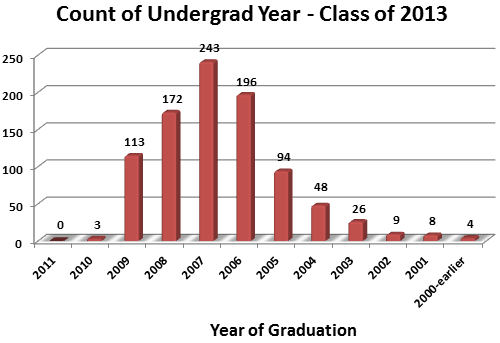
    On June 21st, Harvard Business School's Admissions Director posted the following "Class of 2013 Graduation Years" chart:

    Class of 2013 statistics


    As you can see, the 4 members of the Class of 2013 who received their undergraduate degrees in 2000 (Assuming graduation at age 22, approximately age 33 or older) or earlier represented .4% of the Class of 2013's 918 students. The total percentage of those 30 and over could be not much more than (Graduated 2003 or earlier) approximately 5% of the Class of 2013. You can look at this in a few ways:
    1. The chance for admission to HBS when you are 30 and over at the time of matriculation is pretty low.
    2.  There is a chance for admission for those over 30 and the percentage is so small because the entering class at HBS is huge. It is important to consider that while HBS only takes 12% of those that apply, it is a giant class.
    3.  Applying to HBS when you are 30 or older is very risky and hence should be combined with application to other programs except for those with a very high risk tolerance.

    According to the Class of 2013 statistics, the average age for the class will be 27. Compared to the Class of 2012 (11% acceptance rate), it was 1% easier to get into the Class of 2013, but actually the typical rate in recent years has been 12%, so I would not look at this as any sort of meaningful trend.

    Two other meaningful trends that have been widely reported about the Class of 2013 are worth keeping in mind.

    1. Percentage of Finance professionals down, manufacturing and technology professionals up 
    The Wall Street Journal did a good job on reporting on this:
    Harvard Business School's incoming class will have a substantially smaller percentage of finance professionals than in previous years. Instead, a higher number of students will have manufacturing and technology backgrounds.

    According to preliminary figures from Harvard's admissions department, about 25% of the 919 students in the class of 2013 are from finance industries— including private equity, banking and venture capital—compared with 32% last year. 
    Harvard administrators say the change reflects a greater quantity of strong applicants from nonfinance industries. The number of applicants from the finance world decreased as recession woes eased, as well. 
    Students with manufacturing backgrounds make up 14% of the class of 2013, up from 9% the previous year. Technology rose three percentage points to 9%.
    Though the school continually seeks to bring in a diverse mix of students, "We don't run with quotas or targets," says Deirdre Leopold, managing director of M.B.A. admissions and financial aid. "We drive towards what they can contribute to the overall learning.
    I am not surprised to see schools like HBS decide to better diversify their classes.  It would seem to be schools interests to make sure that they don't let in too many finance people, especially as the American job market in this area is by means looking attractive.  Assuming these trends continue, it will certainly impact future candidates.  For those who had erroneously thought that HBS was not a school for engineers, they will hopefully take a second look.  For those coming from the finance industry, all I can say is leverage your risk.


    2.  A very positive indicator is the increase in the percentage of woman who are part of the Class of 2013. With 39% female, this will be the highest percentage ever. Hopefully this percentage will continue to grow.


    Finally, whatever categories you might fall into, just operate on the assumption that you are more than your statistical breakdown.  The admissions process at HBS goes beyond such facts to the individual.  If you think you are right for HBS, the only way to find out is to apply!


    -Adam Markus
     アダム マーカス
    I am a graduate admissions consultant based in Tokyo, Japan with clients worldwide. If you would like to arrange an initial consultation, please complete my intake form, which is publicly available on google docs hereand then send your completed form to adammarkus@gmail.com.  You can also send me your resume if it is convenient for you.  Please don't email me any essays, other admissions consultant's intake forms, your life story, or any long email asking for a written profile assessment. The only profiles I assess are those with people who I offer initial consultations to.  See here for why. Please note that initial consultations are not offered when I have reached full capacity or when I determine that I am not a good fit with an applicant.


    MBA留学 ビジネススクール カウンセリング コンサルティング  ハーバード MBA

    July 16, 2011

    ON POST-MBA ENTREPRENEURIAL GOALS

    I wanted to provide some admissions advice for MBA applicants with entrepreneurial goals. As with all my advice, it is based simply on what is intended to generate a positive admissions result from an MBA program and is not primarily intended to be actual career advice.

    How will a specific MBA program help you achieve your entrepreneurial goals?
    Be specific.  For example, Wharton, a school that many don't initially associate with entrepreneurship, has significant resources in this area, which are all accessible via this page.  You can find similar entrepreneurial pages for HBS, Stanford (Given the vast entrepreneurial resources that exist through Stanford University, this link is for the entire university, not just the GSB), Columbia Business School, UC Berkeley Haas, Chicago Booth, MIT Sloan,  and many others if you look for them. Some schools, might not have a single comprehensive page. If you can't find main academic, student club, and research pages, it is probably a good indicator that the school is not very good at entrepreneurship. If the school is not good at entrepreneurship and you want to go there, I suggest making non-entrepreneurial goals for that school.  I have worked with  many clients who changed their goals to fit the school's actual resources and found it to be a successful admissions strategy.

    Given the entrepreneurial resources that exist at the school you are planning to apply to, do you need post-MBA goals that involve working at a company prior to starting your own?
    I often have encountered reapplicants with the past experience to make a strong case for post-MBA entrepreneurial career who inserted a non-entrepreneurial short-term goal in their career (usually in consulting or some equally unimaginative path) because they needed two goals which were very different (As though being an entrepreneur and building a successful enterprise long-term were not different enough!) or because they did not think that anyone would consider a direct move into entrepreneurship as reasonable.  When I work with people who clearly have an entrepreneurial track record, my basic position is that unless they really see some reason why they need a short-term non-entrepreneurial phase prior to launching their own business, they should completely focus on a post-MBA entrepreneurial future.  MBA programs that are strong in entrepreneurship are designed to actually help their students launch successful start-ups.  See for example, this press release from Chicago Booth.  By the way, I think a huge number of applicants do not ever think about Booth for entrepreneurship, which is a huge mistake. 

    If you don't have a specific business plan that you think you want to develop in your MBA program, what areas interest you?
    I think for those who have already tried and succeeded or failed or something in-between it is not necessary that you go in with a full plan that you want to implement.  Rather, think about what really interests you and that you can make the best case for.  You don't need a business plan when you apply, but you do need to explain what you are passionate about.  Of course, if you actually have a plan and can justify why you need an MBA to launch it, that is great!

    Longer Term Entrepreneurial Goals
    It is certainly reasonable to have a short-term goal that is non-entrepreneurial and a longer term goal that is.  Starting one's own business after mastering a profession is reasonable enough.  Longer term entrepreneurial goals in areas such as finance and consulting can certainly require an initial post-MBA career as an employee.  Disclosure: I am biased because this what I did after working as an admissions consultant at a company from 2001-2007.  I developed expertise in an organizational setting that made it possible for me to go independent.  When one aspires to launch a consultancy, a venture fund, or other types of businesses that rest on expertise, a post-MBA goal that makes that makes obtaining that expertise possible is necessary. Whatever your entrepreneurial goals are, just make sure that your longer terms goals actually show a wideness of vision that help the admissions office understand that you are someone who wants to have significant impact in the future.

    -Adam Markus
     アダム マーカス
    I am a graduate admissions consultant based in Tokyo, Japan with clients worldwide. If you would like to arrange an initial consultation, please complete my intake form, which is publicly available on google docs hereand then send your completed form to adammarkus@gmail.com.  You can also send me your resume if it is convenient for you.  Please don't email me any essays, other admissions consultant's intake forms, your life story, or any long email asking for a written profile assessment. The only profiles I assess are those with people who I offer initial consultations to.  See here for why.


    アントレプレナーシップ 

    July 15, 2011

    Michigan Ross Information Session on August 9th in Tokyo

    What: Ross Information Session (by Ross Admissions Office Director Soojin Koh)
    When: August 9th, 2011 (19:00-21:00pm)
    Where: Conference Square MPlass "Success" Room
                Mitsubishi Building 1F, 2-5-2, Marunouchi, Chiyoda-ku, Tokyo
    http://www.marunouchi-hc.jp/emplus/access/index.html


    ************************************

    【開催告知】Michigan Ross Information Session @8月9日(火) in 丸の内

    8月9日(火)にMBA受験生を対象としたInformation Sessionを開催いたします!
    昨年に引き続き、Admission DirectorのSoojin Kohが来日しRossの魅力について
    語る予定です。

    開催概要は下記をご覧ください。
    現役在校生数名に加えまして卒業生も多数参加する予定ですので、どうぞ奮ってご参加ください。

    <日時> 2011年8月9日(火) 18:30 受付開始、19:00 開会~21:00

    <会場> コンファレンススクエア エムプラス 「サクセス」ルーム
    東京都千代田区丸の内2-5-2 三菱ビル 1F TEL: 03-3282-7777
    http://www.marunouchi-hc.jp/emplus/access/index.html

    <Tentative Schedule>
    18:30 - 19:00: Registration/networking w/ alumni
    19:00 - 19:15: Admissions Presentation of Ross MBA programs
    19:15 - 20:00: Application workshop
    20:00 - 20:30: Q&A w/ alumni
    20:30 - 21:00: Networking

    <お申込み方法>
    下記のウェブサイトからお申し込み下さい
    2011 Tokyo Info Session - Registration


    それでは皆様のお申し込みを、心よりお待ち申し上げます。


    July 11, 2011

    Resume Template for MBA, LL.M., & Other Grad School Applications

    You can find my suggested MBA, LL.M., or other graduate school admissions resume template on Google docs here and on Scribd here. Many of my clients have found this  template to be a very effective basis for making a successful graduate school application resume.  It is especially designed for providing a balanced (academic, professional, everything else) perspective on the applicant, which, is especially important in the case of resumes for business school.

    -Adam Markus
     アダム マーカス

    I am a graduate admissions consultant based in Tokyo, Japan with clients worldwide. If you would like to arrange an initial consultation, please complete my intake form, which is publicly available on google docs hereand then send your completed form to adammarkus@gmail.com.  You can also send me your resume if it is convenient for you.  Please don't email me any essays, other admissions consultant's intake forms, your life story, or any long email asking for a written profile assessment. The only profiles I assess are those with people who I offer initial consultations to.  See here for why.

    MIT Sloan School of Managementの在校生・卒業生による学校説明会を開催致します

    MIT Sloan's currentJapanese students and alumni will be holding an informational event in Tokyo on 8/28. It is limited to 100 people so I suggest registering as soon as possible.
    -Adam

    MIT Sloan School of Managementの在校生・卒業生による学校説明会を開催致します。参加お申込はこちらから(先着100名様限り:当日は確認メールのプリントアウトをご持参下さい)。
    日程:8月28日(日)
    時間:14:00-16:00 (13:30より受付開始)
    場所:六本木アカデミーヒルズ49 カンファレンスルーム1+2
    内容(予定):
    1. 基調講演-井澤吉幸氏(株式会社ゆうちょ銀行 取締役代表執行役社長、MIT Sloan Asian Executive Board Member)
    2. 学校紹介プレゼンテーション
    3. 在校生・卒業生パネルディスカッション
    4. 在校生・卒業生への個別Q&Aセッション

    * 本説明会は在校生・卒業生による自主的な企画イベントであり、アドミッションプロセスとは一切関係ありません
    * 当日はカジュアルな服装でお越しください

    July 01, 2011

    10 Really Stupid Things that MBA Admissions Applicants Do

    I thought it might be time for a list.  Since it is summer, I suggest reading this while enjoying a cool drink or two (or three...).   This is a list of 10 really stupid things that MBA applicants do. Try to avoid doing these things if you are an MBA applicant.  But if you do them, please be advised that my reapplication consulting services are available to help you recover from your mistakes.

    10 Really Stupid Things that MBA Admissions Applicants Do:


    1. Have someone else write their essays for them.  You will be able to get away with it if you have someone who can perfectly capture your voice without turning your essay into something obviously written by a hack journalist moonlighting as an admissions consultant,  generic content that an unimaginative ghost writing drone produces, or an essay obviously written by a native English speaker when you are not (as demonstrated by TOEFL, IELTS, GMAT and/or background).

    2. Ignoring admissions data when selecting schools.  While you are not reducible to a set of statistics, you had better use that benchmark to get a sense of the realism of proceeding with application to any particular school.  Knowing what level of competition you face will best help you gauge the difficulty of admission.  Taking calculated risks is necessary skill for any successful investor in anything, so do your research.  For a risk portfolio approach to select schools, please see here.

    3. Going only by statistics when selecting schools.  For US schools, 10% of all admitted applicants are below the school's reported 80% range for admits in terms of GMAT, GPA, or experience. In my experience, applicants can certainly get admitted if they have other aspects to their application that outweigh mere numbers. While the number of exceptions to the rule is limited, the chance for admission still exists.  You need to think carefully about how much risk you want to take, but don't merely settle for where you seem to statistically fit if you want to try and gain admission to what you would consider to be a better program. For a risk portfolio approach to select schools, please see here.

    4.  Treat all MBA programs as the same.  Some applicants fail to really look into the really huge differences between programs and as a result cannot ever demonstrate fit in their essays.  Learn about fit here.

    5.  Don't take recommendations seriously. Some ways applicants don't take recommendations seriously include: Providing limited or zero guidance to recommenders who might not actually be familiar with the unique aspects of MBA program recommendations, providing so much information to recommenders that their recommenders essentially paraphrase the applicants essays to the point where it appears the applicant wrote the recommendation(s) and providing obviously forged recommendations.  To get around these problems, please see here and here.

    6. Provide a user unfriendly resume. The resume is a such key piece of most MBA applications, but some applicants submit resumes that are too technical, only focused on professional experience, provide too little detail,  provide too much detail about the wrong things, don't conform to standard resume formats, or otherwise fail as an effective advertising device for the applicant.

    7.  Don't prepare for interviews. Don't even get me started, it will make me sick to my stomach. Every year I work with clients who get invited to great schools for interviews and some of them simply think they can go in unprepared because they do better that way or that it is not a big deal.  Usually interviews are a big deal.  Start here.

    8. Don't send timely thank you notes to interviewers.  I don't care whether you send an actual physical note by mail or by an email, but send a note!  It is the sort of minimal politeness that tells an interviewer and an admissions committee should be able to expect.

    9.  Spend too much time reading online applicant forums. There is nothing more mentally crippling than wasting too much time on online applicants forums, which often have the function of being urban myth producing echo chambers. Don't get me wrong, you should most certainly read them, but if it becomes an excuse (LIKE FACEBOOK) to actually not work on your applications or test preparation, you need to chill out.

    10. Fail to network with alumni and current students.  One of things that is truly awesome about most MBA programs is the willingness of current students and  many alumni to share their experience and inform applicants.  Take full advantage of this. If you are too shy to network, an MBA is not for you.  Have you considered a career as a blogger?


    -Adam Markus
     アダム マーカス

    I am a graduate admissions consultant based in Tokyo, Japan with clients worldwide. If you would like to arrange an initial consultation, please complete my intake form, which is publicly available on google docs hereand then send your completed form to adammarkus@gmail.com.  You can also send me your resume if it is convenient for you.  Please don't email me any essays, other admissions consultant's intake forms, your life story, or any long email asking for a written profile assessment. The only profiles I assess are those with people who I offer initial consultations to.  See here for why.


    ビジネススクール エッセイ 大学院入学 カウンセリング コンサルティング 合格対策 MBA留学

    June 30, 2011

    Guest Blogger: 河野太一のGMAT OG12解説 SC24

    This is another post from Taichi Kono, author of two textbooks on TOEFL and one on TOEIC and a highly experienced TOEFL, TOEIC, and GMAT instructor. Most of his posts will be in Japanese. This post is on GMAT sentence correction. His other posts can be found here.
    -Adam
    --------------------------------------------------------------------------------------------
    河野塾代表の河野太一です。年来の友人であるAdam Markusさんのご厚意で、"The Official Guide for GMAT Review, 12th Edition"の解説ブログの内容の一部をこちらにアップさせていただくことになりました。オリジナルは河野太一のGMAT OG12解説でご覧いただけます。なお、オリジナルのほうは予告なく内容を変更することがあり、ここに上げたものと相違があることがありますのでご了承ください。私のこれまでの記事やGMAT以外の話題についてはこちらをご覧ください。

    SC24

    前置詞句がカンマまで。dioxin (S) induces (V) the production ... (O)で、関係代名詞that節は、後ろの動詞がareであることと内容から、enzymesにかかるとわかる。

    (A) SCにおいてS is N’s doingという形はダメ。「・・・が~すること」と日本語訳してしまえばなぜダメかわからなくなるが、英語ではawkwardとしかいいようがない。GMATはこれを撲滅したいらしい。したがって(A)(B)はアウト。

    (C) カンマが2つあってorがあるので、A, B, or Cの並列かと一瞬思う。しかし(C)(D)(E)のどれを見てもorが真ん中に来ているし、同じ品詞を並べたものはない。

    or の後ろがrenderという動詞であることから、これはどうやらmetabolizeと並列されているようだ。次のカンマの後ろは、such aがついた名詞句。ここで気づくことは、metabolizeは他動詞で、such a chemical irritantはその目的語ではないかということ。動詞と目的語の間に何かを挟むことはよくあるが、動詞をもうひとつ挟んで、どちらの動詞も目的語につ ながるという形もさほど珍しくない。

    見るとrenderの後ろにも目的語がないので、どちらの動詞もsuch a ...につながる可能性は高まった。harmlessは形容詞であるから、これはrender O Cという形をもとに、render Cを先に出してOを後に持ってきたと解釈できる。Oを後回しにした理由は、renderの直後に置いたのではmetabolizeともつながることが見え にくくなるし、renderはどちらかと言えば挿入的で、本筋はmetabolize such a ...であるからだ。

    これで(C)が正解の可能性が高まったが、such aがちょっと気になる。どこと対応して「そんな」と言っているのかがわからないからだ。これは他の選択肢も見たほうがよい。

    (D)はthe chemical irritating itがアウト。「今現在irritateしている」というのが意味的におかしいし、itの指すものが不明。慣れた人なら理屈の前に見た目でダメと判断できるだろう。

    (E)を見て気づくことがある。(C)(D)のattempt to tryはredundantだということ。これでほぼ(E)に決まり。後ろを見るとsuch aもなく、これが一番シンプル。

    renderはrender O Cという文型を取り、「・・・を~にする」という意味になる。make O Cと同じ用法・意味だが、辞書によれば文語的。たまに見かけるので覚えておいて損はない。

    予 備校の授業では、(C)(D)はattempt to tryのredundantでサクっと切られるだろうが、それは結果論。本番でパッと気づく人がどれだけいるだろう。サクっと切れるのは、講師は予習をしているし、何度も解説しているからではないのか。本番では(E)との比較で初めて気づく人が多いだろうし、それでよいのだ。他の解説同様、ここもあえて本番の意識の流れで解説しておいた。


    -河野太一


    河野塾ではTOEFL/IELTS/GMATの個人授業を提供しております。なかなかスコアが上がらずにお悩みの方、きめの細かい効果的な個人指導をお求めの方は、ぜひinfo@konojuku.comまでお気軽にお問い合わせください。
    Real Time Web Analytics