Go to a better blog!


You can find a better version of my blog at http://www.adammarkus.com/blog/.

Be sure to read my Key Posts on the admissions process. Topics include essay analysis, resumes, recommendations, rankings, and more.

September 29, 2015

HBS Admissions Interviews for the MBA Class of 2018

In this post I provide advice for HBS Admissions Interviews for the MBA Class of 2018.

HBS ADCOM HQ

In my experience, applicants who succeed at HBS MBA interviews go to their interview with a sense of confidence based on having done careful preparation. My clients who have failed the interview stage have often done so because of related reasons: lack of confidence and/or preparation.  Of course, there are times when the post-interview reason for getting dinged is never clear. The reality of having too many well qualified applicants means that many who would certainly make the post-interview cut don’t, simply due to lack of available seats. While these issues could be the same for any interview, the reality is that HBS admissions interviews are more intensive than that of most other schools. Failure to take this interview sufficiently seriously is a recipe for disaster.

My interview-only and comprehensive service clients have been admitted to the regular HBS for the Classes of 2017, 2016, 2015, 2014, 2013, 2012, 2011, 2010, 2009, 2008, 2007, and 2005. My clients’ results and testimonials can be found here. In addition to providing comprehensive application consulting on HBS, I regularly help some candidates with HBS interview preparation only. I have worked with a large number of applicants from Canada, Europe, India, Japan, other parts of Asia, and the United States on HBS application. I think that this range of experience has helped me understand the many possible ways of making an effective application to HBS.

Before reading this post, I suggest reviewing some or all of the following previous posts:
-MBA Application Interview Strategy
-Further Comments on MBA Admissions Interviews 
-General Characteristics of Admissions Officers, Students, and Alumni Interviewers
-Recovering from a bad answer during an MBA admissions interview
-10 Ways to Blow an MBA Admissions Interview
-When to start MBA interview practice? How to prepare?
The above posts are my general remarks on MBA admissions interview strategy and apply here.

TAKE PREPARATION FOR HBS VERY SERIOUSLY! Any experienced admissions consultant will tell you that the HBS interview is one that really does require preparation even for those who previously aced alumni interviews.  My colleagues and I have often become depressed about cases where we had great applicants who did not take the HBS really seriously.  By the same token, our clients who really prep for this really do have a much higher rate of admission.  I have had clients who might do 5-20 hours of self-preparation for every hour of time spent with a consultant.  One of my clients admitted to HBS did 2 hours of prep with myself and another counselor and an additional 100 hours on his own. He already had been admitted to Kellogg and Booth, but knew HBS would be different.

I believe in the value of active interview preparation. That is to say, instead of focusing only what questions you might get asked, focus on what you want to say about yourself. A basic any school approach to this would be to connect key words and stories that you hope to use. Given that you can’t know exactly what you will be asked, you can at least have prepared for discussing key things that you want to get across to the interviewer.  The following is an “any school” chart:

Active Interview Preparation Chart
Keyword: A selling point or even a weakness Stories Questions It Might Answer
Example:
Analytical
  1. Development of 6-sigma strategic framework for XXX, inc.
  2. Discovery of accounting errors during first year of work.
  3. Senior thesis on the S&L Crisis
  1. Name three words that describe you (This would be one)
  2. What are your strengths?  Why? (This would be one.)
  3. How do you solve complex problems?
  4. How could you contribute to your classmates?
  5. What skill are you most proud of?
(You can cut and paste this into MS Word or Google docs)
In addition to outlining key words and stories as discuss in my general post on interview strategy, you actually more directly connect this to the specific four criteria (See my essay analysis post) that HBS values in order to see how well you are covering each of the criteria in your interview preparation. The chart below will help you map out your own HBS interview strategy.

HBS Active Interview Preparation Chart
Keywords: A selling point or even a weakness Stories Diversity A Habit of Leadership Analytical Aptitude and Appetite Engaged Community Citizenship Questions It Might Answer
Example:
Analytical
Development of 6-sigma strategic framework for XXX, inc. Analytical -Name three words that describe you (This would be one)
-What are your strengths?  Why? (This would be one.)
-How do you solve complex problems?
-How could you contribute to your classmates?
-What skill are you most proud of?
Cooperative Overcame team conflict when developing 6-sigma strategic framework for XXX, inc. -Demonstrates
consensus based leadership
-Can lead others
–Name three words that describe you (This would be one)
-Tell me about a project that you've worked recently where you exhibited leadership.
-What kind of leader are you?
(You can cut and paste this into Google Docs or Microsoft Word and alter it to include more rows.)

To use the above chart: Try to develop 10 or so keywords and stories that relate to HBS’s four criteria for admission. Don’t forget to include weaknesses when you do so.  Your objective is be ready to tell your best stories as effectively as possible. Use the above chart to help determine which key words and stories will convey the most about you.  Remember that you want to use stories that are different from the ones you used in your essays. You might be asked about something in your application, which you should be prepared to discuss, but also assume you will need to provide new stories as well.


You need to know your application very completely as you will be asked by adcom about its content.
Review your entire application (not just resume and essays, but everything including the transcript) very carefully and consider what your interviewer might ask you to explain more thoroughly. Remember: Anything is fair game. Assume that the weakest parts of your application will be topics in the interview. Assume the worst-case scenario and be very prepared to address their concerns. Given the annual failure rate at HBS, if you have any academic weaknesses (low GPA, a relatively weak TOEFL, insufficient proof of a quantitative background), be ready to address those issues. Be prepared to tell new stories and alternative versions of the stories you told in your essays.


If you think that either your English ability and/or interview skills are somewhat weak, be prepared to do extensive practice both with other people and alone. The self-study component can be particularly effective if you are trying to cover a huge range of questions and also master telling your best stories.


A point I continually make to own clients who have been invited for the HBS interview is that proper preparation for this interview really requires that you look for all the weak points in your application: Rip yourself apart in order to try and determine what you need to be especially ready to address. Getting a fresh perspective by reviewing your own application is certainly helpful. In addition, you should consider having one or more other people who can help you prepare for this and who will review your entire file. If you use any paid services, make sure that the mock interviewer (admissions consultant, admissions counselor, interview coach) will be reading your application first and developing a list of questions based on that review and with an understanding of what HBS asks, otherwise they are not really helping you prepare for an HBS interview. When I do mock interviews for interview-only clients, I always ask to read their applic ations if they are not doing a blind interview. For schools like HBS and MIT, which are never blind, reading the whole application (especially the essays) is critical for simulating the real thing.


The questions you get will be specific to you.
Most questions will not be odd, but they may be unexpected. On the other hand, the reports that I get from my clients and a number of  public reports indicate that the majority of questions are actually common ones.  Be able to articulate clearly what you want to learn at HBS and what you can contribute. While it is important to be able to discuss leadership, don’t assume the interview will be entirely focused on it. The interviewer will come in knowing what they want to ask you.


In addition to my own knowledge, I have reviewed reports of Harvard Business School interviews found at accepted.com and clearadmit.com.  My colleague, Steve Green, has collected and organized some of the commonly asked questions from those sites.
His general conclusions about HBS interviews:
  • Expect to be asked for more details about most every topic discussed
  • Expect topics to change as the interviewer will pursue detailed answers to topics that interest him/her
  • Expect questions to feed off your responses rather than to be scripted
  • Don't be surprised if the interviewer does not allow you to ask questions: they treat this interview as a chance to learn as much about you as possible in a limited time
  • Bottom line: Harvard interviews are quite rigorous compared to other MBA admissions interviews
Here are the questions Steve has collected and organized.
RESUME, CURRENT POSITION
  • Explain your career path. / Take me through your resume.
  • Describe your career progression, and talk about the most important things you learned about yourself along the way.
  • Why did you choose to join this company?
  • How did you pick your current job?
  • What are the best and worst things about your current job?
  • How did you end up at your company?
    • What do you think about their training program?
    • What’s the company’s position compared to its competitors?
    • What was different about your previous job compared to this one?
    • What was the most surprising aspect about this company when you first joined?
    • What worries you about the company?
  • Explain your career path.
  • Why did you want to work in _____________?
  • How has your leadership evolved with your promotion(s)?
  • Who do you admire in your current industry?
    • Where is the industry heading?
  • Who do you admire in your post-MBA industry?
    • Where is the industry heading?
  • Tell me about your typical day?
  • How do you find the time to do all you do?
  • What's most important to you outside of work?
  • Why did you choose to major in X at your undergrad university?
  • Why did you enjoy (SOMETHING FROM UNDERGRAD)?
REASONS FOR MBA, HBS
  • What is your career vision?
    • What are the steps you plan on taking to get there?
    • What are the challenges you will face?
    • How will an HBS MBA help you?
  • Why do you want an MBA?
  • When did you decide to get an MBA?
  • Why HBS?
  • In class, what type of profiles are you looking to meet? From who would you like to learn something?
  • What can you contribute to HBS case method discussion?
  • What experience outside the classroom are you looking for at HBS?
  • What will you do if you don’t get into business school?
  • If
    we called you and said there is only 1 seat left in the class and 10
    candidates remaining, what would you say differentiates you from them?
  • How do you want to impact HBS?

LEADERSHIP & TEAMWORK
  • Tell me about a project that you've worked recently where you exhibited leadership.
  • What kind of leader are you?
  • Who is a leader that you admire and why?
  • Name a business leader you admire (non-government).
  • Tell me about a time you had to work with someone you did not get along with.
  • Give me an example of a project you've had a difficult time with.
  • Tell me about a time when you raised an unpopular idea?

STRENGTHS & WEAKNESSES
  • What do you feel you need to improve most at your current job?
  • What would your supervisor say is a weakness?
  • How would your colleagues describe you?
  • Your recommender mentioned that you excellent at what you do: Why do you think that is?
  • Give me an example of a project you've had a difficult time with.

VALUES & PERSONALITY
  • How did you find the application process? Did any of it surprise you?
  • Is there something about you that has not been addressed in your application?
  • What is a recent non-fiction book you've read? (FOLLOW UP)
  • What is the most recent fiction book you've read?
    • What do you think the author was trying to say about society?
  • What is the most interesting article you've read lately?
    • Did you agree with it?
  • What is a common misperception people have about you?
  • Can you tell me about a time when people's perceptions about you turned out to be wrong?
  • What words would people use to describe you?
  • What would your 5 closest friends say about you? Why?
  • What would a peer that knows you well say you should keep doing, start doing, or stop doing?
  • Is there anything that would surprise me?
  • What do you do when you have a really bad day?
  • What TV shows do you watch?
  • What sources do you use for news?
  • Given what you know now, if you could go back to university and pick your subjects, which ones would you?
  • What motivates you to get out of bed every morning?
  • What drives/motivates you?
  • If you could have lunch with anyone in the world who would it be?
  • Who would you want to sit next to in your first year at HBS?
  • What would be your dream job?
  • How would the people who know you best describe you?
  • What are people surprised to learn about you?
  • How do you fit with different cultures?


CONCLUSION
  • What's a question that you thought I was going to ask you but didn't?
  • Is there anything else that you haven’t mentioned in your application that you would like to share at this time?


Assume there will be at least one question for which you might not be ready for, but don’t panic. Take a deep breath. Answer the question and do not become flustered. Be ready to answer questions about a hypothetical case study, conflict with colleagues, and the latest book you read as these have all been reported frequently.  For example,  If you are asked what is your favorite flavor of ice cream is (I have had clients asked questions almost like this) and you hate ice cream say that.  If you like ice cream just briefly state why for whatever flavor you like and assume that the interviewer is just seeing how you react to a question you were not ready for.


Adcom interviewers are usually friendly, but to the point. They don’t do stress interviewing at HBS exactly, but they will question you intensely. They will be taking notes. Anything you say can be subject to inquiry, so speak concisely, answer questions precisely, and try to avoid voluntarily bringing up any topics that you really don’t want to talk about. Assume the you will be asking follow-up questions, expect to be able to analyze/explain in a great deal of depth. Your interviewer will know exactly what he/she wants to ask you because the purpose of the interview is (1) to see if you look as good in reality as you did in paper and (2) to address any concerns that they have about your suitability for HBS.


Don’t Psych yourself out! It is particularly important that you don’t worry too much about your perception of the interviewer’s attitude as this can be a particularly good way to become nervous.  I have had too many reports of clients doing this with HBS.  Your interviewer maybe less friendly or more friendly, maybe more aggressive or less agressive, but whatever their attitude focus on your answers.  Feel free to panic and cry after you have exited the interview, but avoid doing so during it.


Have Mock Interviews that reflect both the range of questions and various kinds of interviewers you might encounter.   If I do multiple mock sessions with the same client, I will use different interviewer personalities.  Here is how I helped a client who was admitted to HBS for the Class of 2016 (The client’s full testimonial can be found here):

“Adam digs deep into your application to understand your vulnerabilities and asks challenging questions to prepare you for the worst.  He also exposes you to a number of interviewing styles that you may encounter at HBS – from the amiable interviewer who lets you take the discussion in a direction of your choosing (which can be very dangerous), to the probing style that challenges your statements and changes directions on a dime.”

The friendly interviewer will let you hang yourself, the aggressive interviewer will challenge you, the indifferent interviewer will give you very little feedback so you have to take charge, and  the rude interviewer will interrupt you and appear condescending. At HBS,  you are not likely to encounter a rude interviewer (That type is most common amongst alumni interviewers), but friendly, aggressive, and indifferent are very common types.   Whether you are being made to feel good about the interview or not by the interviewer,  your  mission is still to convince this interviewer that you are right for their school.  While you may have some idea of the personality of your interviewer before you interview, chances are you will not. It is therefore particularly important to prepare for a variety of different types of interviewers.


Reported interview length for all interviews is 30 minutes.  HBS is totally consistent about this.  So part of effective preparation on your part, means really considering time management and not wasting time in the interview by providing answers that are too long.


For more about my interview services, see here.
See here for how to answer the HBS Post Interview Reflection.


-Adam Markus
I am a graduate admissions consultant who works with clients worldwide. If you would like to arrange an initial consultation, please complete my intake form. Please don't email me any essays, other admissions consultant's intake forms, your life story, or any long email asking for a written profile assessment. The only profiles I assess are those with people who I offer initial consultations to. Please note that initial consultations are not offered when I have reached full capacity or when I determine that I am not a good fit with an applicant.

Kellogg MBA Admissions Interviews for the Class of 2018

This post has been updated for admission to the Kellogg MBA Class of 2018.


In addition to this post and my school specific posts found on  Interview Analysis section of Key Posts page of my blog, please also see:

-MBA APPLICATION INTERVIEW STRATEGY (Start with this one even before reading the rest of the Kellogg post)

-Interview Practice is ABOUT SPEAKING!

-Further Comments on MBA Admissions Interviews 
-General Characteristics of Admissions Officers, Students, and Alumni Interviewers
-Recovering from a bad answer during an MBA admissions interview
-10 Ways to Blow an MBA Admissions Interview

-When to start MBA interview practice? How to prepare?


Just as with essays, interviews for the Northwestern University Kellogg School of Management MBA applicant interviews are all about fit. I could not really tell you how many Kellogg mock sessions I have conducted since 2001, when I started working as an admissions consultant, because the number is simply too huge. Given the fact that Kellogg has an open interview policy, more applicants will interview there in any year that anywhere else.  Reported interview length could be from 30 to 60 minutes, with most reported interviews taking 30-45 minutes.  As I work with clients from all over the world, I have discovered that Kellogg interviews are pretty consistent worldwide, both for the good and bad.


Know your Resume!

You need to know your resume completely as you will most likely be asked about content in it. Review it carefully and consider what your interviewer might ask you to explain more thoroughly. If it is on your resume, it is fair game. Kellogg interviews are conducted blind, so your interview will not have read your application. The only thing they will have is your resume. Most interview reports indicate extensive questions about the contents of the resume. As such it serves four main functions:


1.  First Impression: Most interviewers will have your resume even before they meet you. For resume-only interviews, it really is their first impression of you.  Make sure your resume is really designed for ease of use by the interviewer.  One of my objectives when helping a client with a resume is always to focus on how effective the resume is for this purpose.


2. Agenda Setting Device: To a greater or lesser extent, a resume has an agenda setting function in many interviews.  While schools will provide interviewers with varying levels of guidance about what questions to ask, the resume may very well form the basis for some of the questions that you receive. In the case of Kellogg, it is almost always the case that the resume plays a role in the questions that you will be asked.


3. Booby Trap:  The resume can blow-up in your face if you are not careful.  Failure to review your own resume closely prior to interviewing can put you in an awkward position if you are not fully prepared to discuss everything on it. Make sure you know your numbers and dates. Make sure you can discuss anything on your resume.


4. Past Experience Answers: Since you have presumably highlighted many of the key things you would actually want to discuss on your resume, it is in essence, a primary source for your answers to past experience questions. Especially when I working with a client with limited English ability, I will tell them to practice explaining "Who What Why How When" questions related to their resume.


In addition, since you might get asked to "Tell me something about yourself that is not covered on your resume," you can use the resume to figure out what that would be.


You need to be prepared to answer routine MBA interview questions

Most reported Kellogg interviews simply consist of them. See my previous post on MBA Application Interview Strategy as well the list of questions below. You should expect to have to answer questions regarding teamwork (Examples where you demonstrated it, how you handled problems on teams, and how you would handle a low-performing team member in group work at Kellogg are common examples).  Be absolutely comfortable explaining core questions regarding fit (Why Kellogg? Why the Kellogg community is right for you?  Contributions?) as these always come up.   Be ready to ask questions and obviously make those questions fit to the person you are talking (admissions officer, student, or alumni). My colleague, Steve Green, has collected the following common questions:


RESUME: Career

  • Tell me about yourself. / Walk me through your resume. PROBE ANSWERS
    • Tell me about [particular accomplishment]
    • Tell me about [particular promotion or change]
    • What is missing from your resume that you'd like to tell me about?
  • What led you to your first job?
  • What made you change careers? (+ Follow-up)
  • Why did you decide to switch into the field that you chose?
  • How have you grown over the years?
  • Tell me about what’s challenging in your current role. (+ Follow-up)
  • Why did you choose ________________ for your career?
  • What are your current responsibilities?
  • What do you clients say about you?
  • What do you outside of work?


RESUME: Education

  • Why did you choose your undergraduate school?
  • Why did you choose your major?
  • Tell me something about your undergraduate experience?
  • What was your legacy at your undergrad school?
  • Why did you choose ________________ for your career?
  • What are your current responsibilities?
  • What do you clients say about you?
  • What do you outside of work?


TEAMWORK

  • Tell me about your teamwork experience.
  • Describe a difficult team situation you have had to deal with in the past?
  • Tell me about another teamwork experience.
  • What would you do when a team member wasn't pulling his own weight?
  • What would your teammates say about you?
  • Discuss a team failure you were part of.


LEADERSHIP

  • Who do you admire as a leader?
  • Have you held leadership positions at work?
  • Tell me something about your leadership experience?
  • Have you faced any challenges as a leader? How did you deal with them?
  • How has your leadership style evolved since college?
  • What kind of leader are you?


WHY MBA / WHY KELLOGG

  • Why do you want an MBA?
  • Why now?
  • Why Kellogg?
  • Are you good with numbers?
  • What are your goals?
  • How will Kellogg help you achieve those goals?
  • How do you envision yourself being involved in the Kellogg community?
  • What clubs will you participate in?
  • How will you enhance the diversity of the Kellogg class?
  • What unique contribution do you bring to Kellogg?
  • What other schools did you apply to?
  • If you got into all of them, which would you attend?


STRENGTHS & WEAKNESSES

  • If you could hit the reset button, what would you do differently?
  • Anything that may be considered a weakness in your application you would like to explain or expand on?
  • How have you grown over the years?
  • What are your two main strengths?
  • What are your two main weaknesses?
  • If time and money were not an issue, what would you do?
  • What three words would you use to describe yourself?
  • Who is a good negotiator?
  • Have you ever been in a negotiation where it wasn’t win – win, rather, win-lose or lose-lose.
  • What do people misperceive about you in first meeting?
  • If I asked your colleagues about you, what would they say? What feedback have you used to do better?


CONCLUSION

  • What questions do you have for me? / Do you have any questions for me?


In MBA Application Interview Strategy I discuss some specific ways to prepare for many of the types of questions discussed above. Additionally, since some Kellogg interviews involve behavioral interview questions, I would suggest reviewing my post,  MIT Sloan MBA Interviews.  MIT Sloan MBA Interviews will also introduce you to the STAR method for telling stories, so if you need help in telling stories (especially ones about teamwork and leadershIp), I recommend reviewing that post.


Reread your essays!

Given that your Kellogg essays should contain key content to answer many of the above interview questions and because no interviewer will have read your file, feel free to make complete use of your essays for your interview. Unlike in interviews where the interviewer has read you file, for Kellogg feel free to draw upon on your essays and not even just your essays for Kellogg. For example, if you have written effective contribution content for Wharton Essay 2 or London Business School Essays 2 or 3, you might find it very useful when answering a question about how you would contribute at Kellogg.   It surprises sometimes when I am doing mock interviews with a client and they have not reviewed their own essays very much. This a core repository of content. It will need to be altered for purposes of the interview, but you should use it!


Lack of Consistency in Kellogg interviews
As you should know Kellogg’s new motto is THINK BRAVELY, but as far as  interviews go, I would say their motto must be INTERVIEW INCONSISTENTLYWhile most Kellogg interviews are moderately difficult in terms of the kind of questions that are asked and the attitude of most interviewers (admissions officers, alumni, and students) is professional and friendly, other types of interviews are possible and not uncommon.   Given the huge number of alumni interviewers involved in this process, this is especially a problem with alumni interviews whether held on a Kellogg Interview Day (many applicants and interviewers all meeting at the same place for one-to-one interviews) or just through an arranged one-to-one off-campus interview. Even on-campus interviews with students lack some consistency as I will discuss below.  Only interviews with admissions officers fit into some predictable norm of moderately difficult and professional.
Some types of dysfunctional Kellogg interviews:


The Cake Walk: The lovely expression “as easy as cake” can be applied to some international interviews that I have heard about. This can be nice for the applicant, of course, but surely is unfair for other applicants. A cake walk interview consists of some of the standard Kellogg interview questions, but everything is very surface level and most of the interview is just nice conversation. The interviewer then prepares a sterling evaluation of the applicant even in terms of areas that were not necessarily addressed in the interview because the men involved (not always, but typically from what I can see this involves men and is just another form of immediate locker room type bonding). If you find you are having an apparently very easy interview, just make sure you work as many key points about your self into the conversation while maintaining a positive and friendly feeling about the whole thing.


“You really don’t fit because I don’t like you”: The worst reports I have heard about have involved Kellogg alumni interviewers who expressed their dislike for the applicant. The interviewer uses highly judgmental language that often barely hides bias. This bias might be gender-based, class-based, or industry-function based. We are not talking here about merely an agressive interviewer, but rather an interviewer who actively looks down on the applicant.  Frankly I have never read or been about such an interview being conducted in the US, but I do know about such unpleasant interviews conducted through Europe, Asia, and the Middle East. The only thing I can suggest during such an interview is that you hold your own, don’t cave against bully you are dealing with, but respond aggressively in defending yourself and why you belong at Kellogg. The abuse of power is an ugly thing. If you feel you have been treated particularly badly, you s hould consider reporting the details of this to Kellogg admissions.


English not spoken: One of the best reasons to eliminate alumni interviews completely especially when an admissions office is because alumni interviewers don’t always conduct some or even most of the interview in English. I have client reports of this from around the world. This can be to the advantage or disadvantage of the applicant.  If an applicant is trying to really highlight their English communication ability, having an interview that is not conducted in English might not be particularly helpful. In addition, speaking in another language is often a gateway to the two previous types dysfunctional interviews I mentioned above.  I have no specific suggestions for what you can do when an interview is not conducted in English if you think the interview is going well. If you think the interview is not going well, you can consider this grounds for informing Kellogg admissions. Since Kellogg admissions waives some interviews and subsequently conducts telephone interviews, I would not be surprised if your interview was initially waived. Most applicants will not want to complain about an interviewer, but if you feel you were treated badly, it is worth considering. Advice for international applicants who really want to highlight their English communication skills: Go interview on-campus because campus interviews will be conducted in English. 


Bored, hungover, busy, and/or tired: Most reported student interviews are not like like this, but it is no surprise that some of these interviews involve student interviewers who wish they were some where else doing something else (studying, sleeping, recruiting activities, etc.).  Not fun if you have traveled to Evanston and find your interviewer is just not that engaged in the process. If your interviewer seems less than engaged, just make the possible case for yourself and don’t let their indifference get to you. The worst thing you can do is react to someone else’s lack of energy.  You must maintain your enthusiasm even in the fact of complete indifference. Just imagine you are talking to a mirror and ignore the interviewer’s lack of engagement. I don’t think you can really complain to admissions about this issue. Just be aware that might happen.


While I think it is nice that Kellogg basically interviews all applicants (some applicants are waived initially from interviewing but ultimately do a telephone interview if Kellogg is actually interested in admitting them), it does come at the cost of consistency.  I do think that putting all applicants on level playing field means giving them an interview that is conducted with a fairly high degree of consistency.  Of course, the moment alumni are involved at any school, consistency tends to get lost unless the school really works hard to maintain standards and weed out bad interviewers.  I know many alumni do a great job and should be praised for their involvement with the process, but unfortunately this is not always the case.   I have pointed these issues out so you are prepared for the worst case scenarios. Hopefully you will not experience them.


Best of luck with admission to Kellogg’s Class of 2018!


-Adam Markus
I am a graduate admissions consultant who works with clients worldwide. If you would like to arrange an initial consultation, please complete my intake form. Please don't email me any essays, other admissions consultant's intake forms, your life story, or any long email asking for a written profile assessment. The only profiles I assess are those with people who I offer initial consultations to. Please note that initial consultations are not offered when I have reached full capacity or when I determine that I am not a good fit with an applicant.
September 28, 2015

MBA APPLICATION INTERVIEW STRATEGY

I have written a number of posts about MBA application interview strategy, but I would consider this one, which I have not revised for a few years until now, to be the most important.  While this post is specifically focused on MBA interview strategy, it would apply to interview preparation for other types of graduate programs.

In addition to this post and my school specific posts found on  Interview Analysis section of Key Posts page of my blog, please also see:
-Interview Practice is ABOUT SPEAKING!-General Characteristics of Admissions Officers, Students, and Alumni Interviewers-Recovering from a bad answer during an MBA admissions interview-10 Ways to Blow an MBA Admissions Interview-Further Comments on MBA Admissions Interviews -When to start MBA interview practice? How to prepare?


A REACTIVE VS PROACTIVE APPROACH TO INTERVIEW PREPARATION
First, I think it useful to contrast two different of ways of preparing interviews. As I will argue, a proactive approach to interviews is a more effective way to prepare for an MBA interview.


REACTIVE INTERVIEW PREPARATION
Just as the name implies, reactive interview preparation is based on reacting to actions taken by others. It has the following characteristics:


A. Timing: Reactive interview preparation does not begin until all other parts of the application process are completed and in the worst case not until the applicant is actually invited. Interviews are not approached as inherent part of the application process, but something that occurs independently from the rest of the process. For example, the applicant does not think about their resume as an agenda setting device (see below) for an interview, but simply as part of the application. Reactive interview preparation is invariably a scramble for time and often comes too late to have sufficient impact on improving the applicant’s performance (An interview is a performance).


B. Approach to answering questions: Reactive interview preparation is always based on reacting to the questions. At its core, reactive interview preparation is based on responding to specific answers to set questions. As result, even those who use this method extensively have to prepare many answers to many questions because that is the only way they can be prepared. The problem, of course, is that when encountering a new question (If you put in charge of the world economy right now, what you do?) in an actual interview, the interviewee is often at a loss about how to answer.


C. Reactive interviewing is strategically flawed:  Since you don’t know what you will be asked, you set yourself up for failure if you plan a strategy only based on the questions you think you will be asked.  It is a poor excuse to say “I was not prepared for that question” because you actually cannot know exactly what you will be asked.   After all, interviewer often tailor questions specifically to you and in the process of doing that, they are likely to ask something you are not prepared for. Even for schools where interviews are likely to draw on a fairly narrow set of questions, their specific wording of the question can through off someone who prepares too narrowly.


PROACTIVE INTERVIEW PREPARATION
Just as the name implies, active interview preparation is based on taking a proactive approach to interview preparation. It has the following characteristics:


Timing: Proactive interview preparation begins with making a resume. Consider that for all US MBA program alumni interviews (Some alumni interviews for schools outside of the US involve parts if not the whole application), all US MBA program student interviews, and many US program admissions interviews, the only thing from your application that your interviewer will have is your resume. Hence, it is important that your resume contain only information you are comfortable discussing in an interview. It is, to some extent, an agenda setting document. Hence, you should view interview preparation to begin with the composition of your resume. Proactive interview preparation also involves begin interview preparation sufficiently early to have impact. For some applicants with weak English and/or interview skills, such preparation may require a month or more to have real effect. For some applicants, it might just require a day or two of highly conc entrated preparation.  Much will depend on your skills as well who is interviewing and from what school.


B. Approach to answering questions: Proactive interview preparation is always based on knowing what you want to say about yourself before you interview.At its core, proactive interview preparation is based on thinking about your message. You must also be aware of potential questions, but the focus should be on knowing what you want to say about yourself, no matter what the question. You should have keywords and stories that can be used to answer a variety of questions.


C. Proactive interviewing offers a comprehensive strategy: Proactive interview preparation is based on the idea that you don’t know what you will be asked, but you do know your message. Being ready for the unexpected is thus incorporated into the very method itself. It is absolutely critical that you have an overall strategy for determining what you want to say about yourself. Just as with your essays, you need to formulate your self-marketing strategy for your interviews. Obviously what you put in your application should be consistent with and supported by your interview. However writing essays and talking for 30 minutes or more are simply not the same.


Don’t worry about the questions, worry about your message!
While you should use the Accepted and Clear Admit sites to learn about the questions, an overemphasis on simply preparing answers to the questions that other applicants were asked is not the main thing you should be doing. Instead, decide what you want to say about yourself.


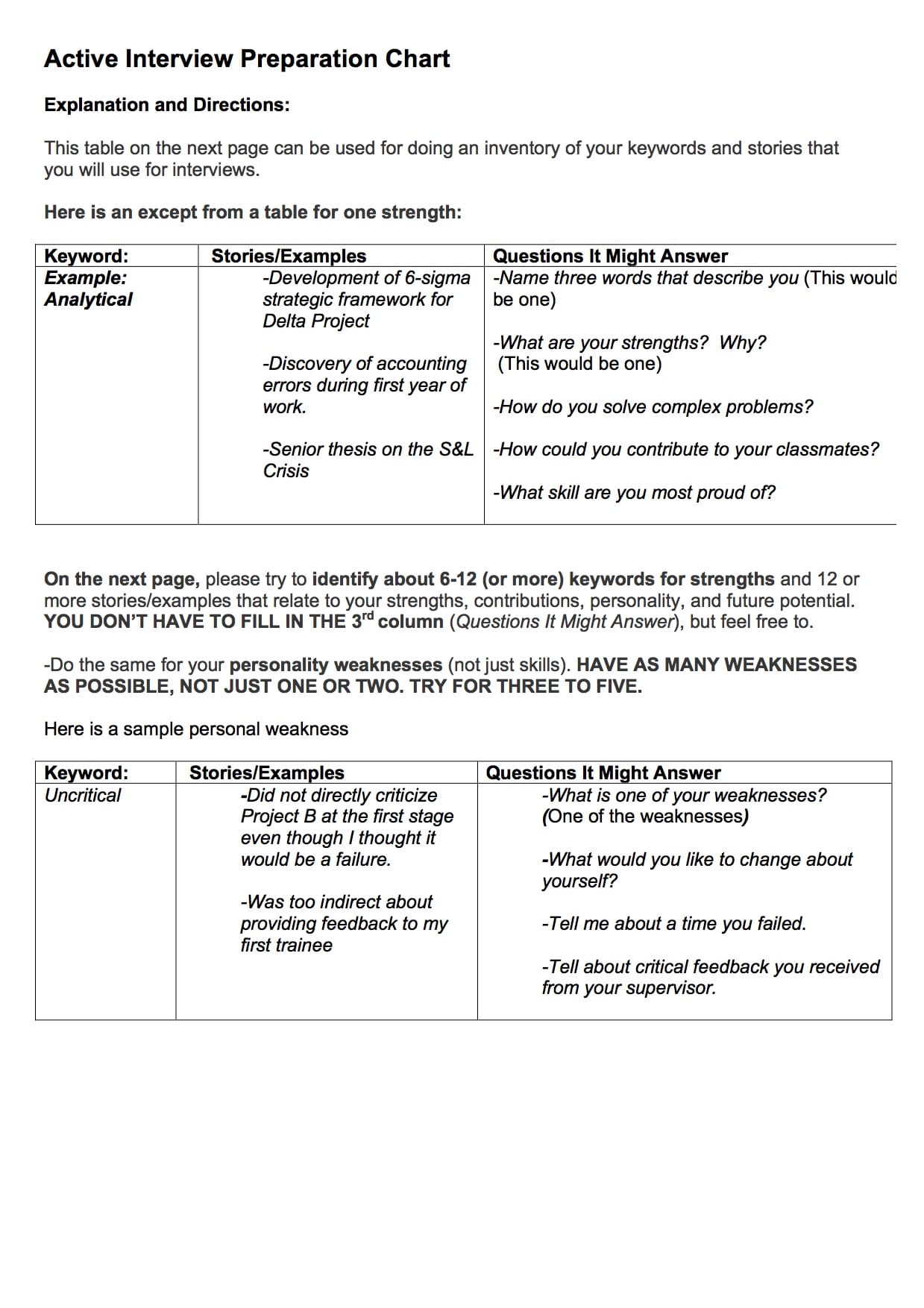
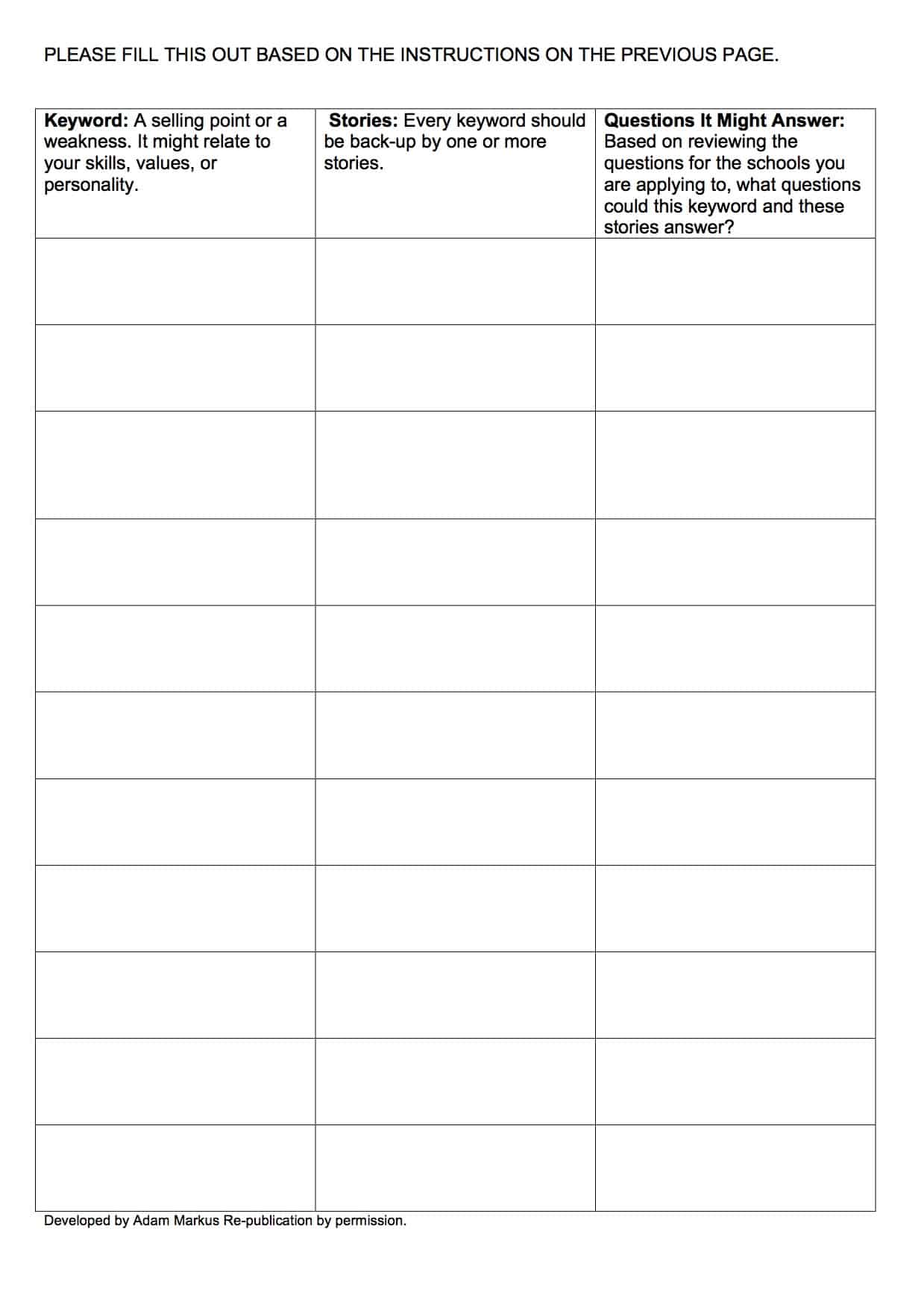
One way of being proactive is prepare a chart like the following  JPEG images of a two page document):


This table, which is available here via Googledocs,  can be used for doing an inventory of your keywords and stories that you will use for interviews.

KEYWORDS AND STORIES
Here are some specific types of keywords and stories you need to develop:


Strengths/Contributions/Future Potential/Personality
1. One of my key strengths is X. A story that demonstrates this strength is… Another story that does is… This strength will be a contribution at your school because… This strength will contribute to my future goals because…
2. Another of my key strengths is Y. A story that demonstrates this strength is… Another story that does is… This strength will be a contribution at your school because… This strength will contribute to my future goals because…
3. Another of my key strengths is Z. A story that demonstrates this strength is… Another story that does is.. This strength will be a contribution at your school because… This strength will contribute to my future goals because…
For each X, Y, Z insert a keyword describing your strength. Connect keywords to specific stories. If possible, find more than one story that demonstrates the keyword. Next think how this strength could be a contribution when you are student. Next think how this strength will contribute to your goals. By using this method, you will have prepared answers to such common questions as “What are your strengths” and “How will you contribute to our school.” Additionally you will be ready to show how your past experience will help you achieve your goals. Additionally when asked questions which are less direct about your strengths, you will already have keywords and stories ready for those questions you can’t predict. Keep in mind that your strengths might include particular skills as well as personality characteristics. You should think about strengths in the widest sense. Try to develop about 6-12(or more) keywords and 12-20 (or more) stories that rel ate to your strengths, contributions, personality, and future potential.


Weaknesses/Failures
1. One of my weaknesses is X. A story that demonstrates this is… Another story that does is… I want to overcome this weakness by… This weakness resulted in failure when…
2. Another of my weaknesses is Y. A story that demonstrates this is… Another story that does is… I want to overcome this weakness by… This weakness resulted in failure when…
3. Another of my weaknesses is Z. A story that demonstrates this is… Another story that does is… I want to overcome this weakness by… This weakness resulted in failure when…
HAVE AS MANY WEAKNESSES AS POSSIBLE, NOT JUST ONE OR TWO. TRY FOR THREE TO FIVE. Here you be preparing answers to the very common questions that are asked about weakness, but in addition you will need to think about how the MBA program and/or some other aspect of yourself will make it possible for you to overcome this weakness. Weaknesses should be real and not abstract. You should have clear stories that demonstrate your weaknesses, something many applicants initially have a problem with. Additionally knowing how a program will help you overcome your weakness will explain why you want to attend that school. Finally, SOME, BUT NOT All weaknesses make for great failure stories, another very common topic for interviews.


Leadership and Teamwork Skills/Potential
All applicants should have keywords and supporting stories describing their leadership and teamwork skills and potential. Given the very common nature of questions related to both leadership and teamwork, you should also be prepared for the following:
1. My definition of leadership/teamwork is… because… I demonstrated this kind of leadership by…
2. One leader I really admire is… because… I am similar/want to be like this person because…
3. I think I am a good team member because…

Tell stories that show the range of your experience
Keep in mind that you should use stories from different parts of your life. Don’t overemphasize one specific situation. Instead tell stories that showcase the range of your experience. To do so effectively, means preparing a sufficient amount of keywords and stories ahead of time.

Have enough keywords and stories! If you have enough keyword and stories you will have a solid basis for answering the great range of questions that you are likely to be asked about yourself. Don’t develop more than you can master, but don’t skimp either.


Questions you should be ready to answer
In addition to having keywords and stories, there are certain questions that you should be ready to answer because they are commonly asked in interviews.
Goals/Why MBA?/ Why this school?
You should have outlined answers to the following:
1. I want an MBA now because…
2. I want an MBA from your school because…
3. Your school is my first choice because…
4. After my MBA, I will…
5. My goals are…
6. If I was not able to attend an MBA program next year, I would…


Ethical Dilemma Questions
Once very common in the 2000s, ethical dilemma questions seem to have become less frequent but due come up now and again. Be ready. Have a story or two ready. If you are having a difficulty formulating ethical dilemma questions, please take a look at the Institute for Global Ethics. Also see Business Ethics Research – Knowledge@Wharton.


Questions for the interviewer
You should be ready to ask questions to your interviewer. What you ask should be governed by the following considerations:
1. Is the answer to the question obvious? If so, don’t ask the question. Instead ask a question related to something that is not obvious about the program.  For an admissions officer, the question might be something as simple as when admits are informed about financial aid.
2. Is the answer to the question really relevant to you? If not, don’t ask it. General questions that have no specific connection to you are probably not worth asking. Instead ask a question that relates to you. For example, if you are interested in entrepreneurship at the school, ask an admissions officer about recent successful entrepreneurs who attended the program and  ask student and alumni interviewers if they have taken any of the entrepreneurship courses or are/were involved in other  entrepreneurial activities at the school.
3. Will the interviewer be able to answer the question? In general avoid asking interviewers questions that they are not really able to answer. Asking an alum who graduated five years ago about what is new at the school would be one such bad question. Instead ask alumni more open-ended questions about their experience until you are able to better ask more narrow questions. It is fine to ask admissions officer logistical type questions, which they might not be able to answer immediately, but can answer eventually, but it would be odd to ask an admissions offer who was not an alumnus of the program about what taking a specific class  is like.
When formulating questions it is obviously important to consider who you will be interviewing with because what you ask an alum is not the same as what you ask an admissions officer or current student.


Behavioral Questions
My post on MIT is comprehensive as this has been their longstanding practice.  Please see here for that analysis. Many schools use behavioral questions, so I do recommend going over that post.


Keep it simple and don’t recite from memory
Regardless of how complex the topic might be, when you tell a story, keep it simple enough for your listener to follow. The human brain can only absorb a limited amount of information, so when you tell a story make sure that it is something that can be easily followed and delivered very briefly.
For that reason (and others), memorizing long stories and reciting them should be avoided because it will likely result in your interviewer being unable to absorb your story. If the story takes too long to recite, the may also become bored or annoyed. Additionally memorized answers from a non-native speaker of English are a sign that the interviewee’s English skills might be weak.
Don’t write a script, just a very brief outline
Unless your English speaking ability is very weak, I would strongly recommend that you don’t write scripts of your answers, instead prepare a very brief outline and practice telling the story. Tell your stories repeatedly so that you are comfortable doing so, but since you want to come across as polished, but natural, don’t memorize it.


How to Prepare? 
The best way to do well in any interview is be prepared for an interview that will be harder than the actual interview and to have prepared a much greater range of topics and questions than can be covered in a single interview. I write this based on my experience. Since 2001, I have been told by grateful clients that my practice interviews were harder though realistic versions of  the real thing and as a result they could confidently handle the real thing. I think any highly experienced graduate admissions consultant should be able to provide this kind of practice to their clients. If you don’t use an admissions consultant to help you prepare, find someone, a friend or mentor perhaps, who can help you. Whoever you seek advice from, getting actual critical feedback from person who understands the MBA admissions process is best.

Just as critical is your own preparation. The amount of practice (with someone else and alone) you require will really depend on  two or three variables:
1. Your comfort with interviews. Some people are just really good at interviewing and others are not.  If you know you have weaknesses in this area you will need to do significant amounts of self preparation and need to practice with others who can judge and help you enhance your performance.

2. The difficulty of the interview. Some schools simply have difficult interviews (HBS for example), while others do not (Duke for example), so take that into account. A great way to determine the difficulty of a particular school’s interviews is to read reports written by applicants (See the links above to the Accepted and Clear Admit interview reports).

3. English Ability. While not an issue  for native level English speakers, it does become a significant factor effecting preparation time for those who are not at least advanced level speakers.  To a certain extent, this is a function of comfort and confidence when speaking English, but increasingly becomes an issue for those who have less than advanced level English. It can also be an issue for those non-native speakers with heavy accents.
Use an audio and/or video recorder
For many people, except for watching yourself on video, nothing is worse than listening to your own voice. However as painful as it maybe, doing so will help you identify weakness in your answers and overall performance. Therefore record and analyze yourself.

Prepare intensively for any category of question that you are especially uncomfortable with.
Many applicants hate answering questions about weakness or failure. Other don’t like ethical dilemma. Whatever it is you don’t like, master it.

Practice for specific interviews
Finally, don’t just practice for any interview, practice for specific interviews. While you may initially need to think about overall strategy and need to prepare your stories, you should focus some of your practice on specific interviews. BOTTOM LINE: If you have mock interviews, make sure they are school specific because a very important aspect of the interview really is about you showing your connection and fit to the school. You can find my school specific posts for interviews in the Interview Analysis section of Key Posts

-Adam Markus


-Adam Markus
I am a graduate admissions consultant who works with clients worldwide. If you would like to arrange an initial consultation, please complete my intake form. Please don't email me any essays, other admissions consultant's intake forms, your life story, or any long email asking for a written profile assessment. The only profiles I assess are those with people who I offer initial consultations to. Please note that initial consultations are not offered when I have reached full capacity or when I determine that I am not a good fit with an applicant.

September 09, 2015

Tokyo MBA Interview Workshop: Proactive Interview Preparation and Active Listening

I wanted to let any MBA applicants in Tokyo know about upcoming interview workshops I will be co-leading in Tokyo, Japan in October.


MBA Interview Workshop: Proactive Interview Preparation and Active Listening


Offered by Adam Markus and John Couke 


We will hold this workshop twice in 2015:

Sunday, October 11th, 3:00pm-6:00pm

Saturday, October 24th, 7:30pm – 10:30pm

Location: E4TG      Isshin Building 5F, 2-11-7 Yaesu Chuo-ku, Tokyo

東京都中央区八重洲  2-11-7 一新ビル 5階


Proactive Interview Preparation:

In the first part of the workshop, we will describe and practice (in groups and with instructors) a method of interview preparation that many applicants have used to gain admission to the world's top MBA programs.


Our objective is that you become better at preparing for MBA interviews, by focusing on your own stories and key points and practicing those, rather than working from a script. At its core, proactive interview preparation is based on thinking about your message, no matter what the question. You don't know what you will be asked, but you do know your message. Being ready for the unexpected is thus incorporated into the very method itself because you don't focus on preparing for answering specific questions, but rather for knowing things you want to discuss about yourself.


For more about proactive interview preparation, see http://www.adammarkus.com/mba-application-interview-strategy-3/.


Active Listening:

We will then focus on enhancing your ability to listen and engage with others during an interview. While it is important to know what you want to say, it is equally important to focus on having a conversation during an interview. Based on our experience, interviewees don't always actively listen enough. Sometimes they just focus on speaking and speaking too much at once. By focusing as much as on what the other person is saying as on what you want to say, you can better connect with an interviewer, which is critical for making a positive impression. For some kinds of interviews, such as Wharton's Group Interview, active listening is critical because you have to engage with other members of your interview group.


After a brief introduction, there will be active listening group exercises monitored by both instructors.


Cost:   16,200 yen paid in advance by bank transfer

19,000 yen if paid in cash on the day of the event. (all prices are inclusive of 8% sales tax)

Prepayment is mandatory. The October 11th event payment is due by October 5th. The October 24th event payment is due by the 16th. If we cannot confirm your payment by the due date, you will need to pay in cash on the day of the event.


Recording: We encourage you to audio record the workshop. To protect your personal information please do not reveal anything about yourself that you would be uncomfortable having recorded by others. Therefore changing the name of your company, clients, etc. is highly advised during participatory parts of the workshop.


To make a reservation and arrange for payment, please email John Couke at john.couke@gmail.com


-Adam Markus
I am a graduate admissions consultant who works with clients worldwide. If you would like to arrange an initial consultation, please complete my intake form. Please don't email me any essays, other admissions consultant's intake forms, your life story, or any long email asking for a written profile assessment. The only profiles I assess are those with people who I offer initial consultations to. Please note that initial consultations are not offered when I have reached full capacity or when I determine that I am not a good fit with an applicant.

June 27, 2015

Dartmouth Tuck MBA Essay Questions for Academic Year 2015-16

In this post I analyze the Tuck School of Business at Dartmouth MBA Application Essay Questions for Academic Year 2015–16 (Class of 2018). Tuck is great school in a small town. This is both its strength in terms of forming a close knit community and weakness in terms of being a location that some find unattractive. Sometimes when I talk to clients and mention Tuck, I know immediately that I made a mistake. Other times, I working with someone whose second or third top choice is Tuck. To be honest, I have worked with only a few clients who ever considered Tuck their top choice.  The location seems to be the issue. That Tuck is not the applicant pool as a whole’s first choice is reflected in its yield of 54% (BusinessWeek). It is important to keep this in mind as showing a strong interest in attending the program is something you should convey both in your application and interview.  Tuck allows for student initiated campus-only interviews, which I strongly recommend unless your budget and time makes doing so impossible. Please see here for my post on interviewing at Tuck.


Essay Questions for 2015–16
Let’s take a look at the essay questions. I took the questions from the Tuck blog (As of this posting the online application is not up yet). The instructions are to “Please respond fully but concisely to the following essay questions. There are no right or wrong answers. We encourage applicants to limit the length of their responses to 500 words for each essay. Please double-space your responses.” I don’t know why Tuck can’t be more explicit and not use such wimpy language (“We encourage..”). I will strongly encourage my own clients to keep it to 500 words or so. Since they want 500, I think it best to give them something that is “500-wordish” meaning around 500-550 words.

In addition to the main essays questions, I have also included an analysis of the international experience question from the application form, which I assume will be included this year, but I will alter this post if it is removed or changed when the the online application is updated later this summer.

1. What are your short- and long-term goals? Why do you need an MBA to achieve those goals? Why are you interested in Tuck specifically?
The first part of this question is a very standard version of the Why MBA essay question and remains unchanged from last year. See my Stanford GSB Essay B analysis of goals, why MBA  and why a particular school because it applies here.

Regarding the second part of the question, anyone applying to Tuck, should most certainly watch the video series “Applying to Tuck: The Inside Scoop” with Dawna Clarke, the Director of Admissions. if you are really interested in attending Tuck, I strongly suggest making a real effort to visit or at least to attend a reception. This will be a great way to meet with admissions officers in a very friendly environment. It is also an amazing way to network with the alum at the event and afterwords. At a Tokyo reception I attended, we were actually provided with a list of alumni who would be happy to communicate with potential applicants. In “Tips on Applying,” Ms. Clarke emphasizes the importance of getting in touch with Tuck alumni. She, in fact, specifically says that mentioning that you met with alumni is something you should do both in your essays and interviews. She also mentioned that she considers notes from alumni as being in an applicant’s favor.  Click here for information about Tuck events.

Learning from students and alumni by networking with them is also incredibly valuable.  See my Q&As with former clients who are members of the Class of 2011 and Class of 2013.
One thing that is consistent is that current students, alumni, and  admissions officers emphasize that Tuck is about being part of a community. Especially in regards to the community aspect, I suggest reading the Q&A I conducted with  a member of the Class of 2011.  In particular:
Adam: What is the Tuck community like? 
Tuck 2011: The Tuck community is like family. Literally for those who live on campus since they spend most of time together. Everybody is friendly and you don’t need to worry about making friends here. From an academic point of view, collaboration between students is highly emphasized in Tuck and you will experience and learn to work together with others.


2. Tell us about your most meaningful leadership experience and what role you played. How will that experience contribute to the learning environment at Tuck?
Keep in mind that according to Dawna Clarke in “Tuck’s holistic admissions process” video, leadership ability and/or demonstrated potential is one of three key common characteristics of Tuck students. Weak versions of this essay will focus too much on simply telling a leadership story, not focus on why the experience was meanings,  and/or what you contribute at Tuck based on that experience.

most meaningful: Since the leadership experience you write about should be he the one that you consider most meaningful, you clearly explain that.  Applicants frequently assume the significance of a story without interpreting it sufficiently.  Make sure you have clearly explained why the particular leadership experience you write about is meaningful to you.  This is not just a function of explaining your strengths and weaknesses as a leader, but of actually explaining why this particular experience is so significant.

While not required I would consider collaborative leadership experiences: Tuck is a highly collaborative environment, so it is highly likely that they are particularly interested in gauging an applicants collaborative leadership ability.   Given the part of the question that is focused on contribution at Tuck, this essay is actually very much one about fit. You should be particularly focused on a leadership situation that highlights your capability and self-awareness in respect to leading, negotiating, persuading, mentoring,  and/or working  with other people. Such stories are likely to be the basis for showing how you can contribute to the learning environment at Tuck.

Given that the structure of the first year program includes mandatory study groups of 5-6 students in the Fall and Winter terms and  the Cohen Leadership Development Program,  as well as Tuck’s intensely community-focused nature, being able to show how you will contribute to  the learning environment should go well beyond mentioning a particular area of knowledge that you might have

Leadership is no easy thing. Nor is it always obvious.  The worst possible thing is to conceive of leadership as simple formal responsibility or a title because this conveys nothing about the person in that  role. While some applicants will have held formal leadership positions, many will not. Formal leadership positions are great to write about if they involve the applicant actually having significant impact, making a difficult decision, being a visionary, showing creativity, or otherwise going beyond their formal responsibility, but the same is true for those showing leadership without having a formal title.

Some clients I have worked with have never really considered themselves as leaders. I think it is critical that if you are applying to Tuck that you have idea about what kind of leader you are.  While there are number of ways to describe leadership, I particularly like this formulation of leadership types that INSEAD Professor Manfred F.R. Kets de Vries has used in one of his Harvard Business Review blog posts (Disclosure I am a student in an INSEAD  program that he co-directs):

I have previously suggested that applicants who are having difficulty really understanding leadership find out what kind of leader they are by taking this quiz based on Lewin’s classic framework.  While leadership  is more complicated than Lewin’s framework, the quiz is a great way to get you started thinking about yourself, a key part of answering any leadership essay question effectively. However I think the 8 archetypes above provide a much better guide for those who both have extensive leadership experience and those who think they lack it.  Think of these 8 archetypes as aspirational images of certain kinds of leader. You may fit into more than one category. You may find you don’t feel like you are really good at any of the above in comparison to the descriptions above, but that is OK because yo u are trying to identify your potential even if it seems based on relatively little “objective evidence.” I have never worked with anyone who could not demonstrate potential in at least one of the categories above.
Some types of leadership experiences that make for effective content in  this essays,  (as well as recommendations and interviews):
-A time you convinced someone or some group.
-A time you led others.
-A time you demonstrated courage.
-A time you made a difficult decision.
-A time you were innovative.
-A time you formulated and executed a strategy or tactics.
-A time you turned around a situation, overcame an obstacle.
-A time reformed something.
-A time you changed something.
-A time you effectively negotiated with someone.
-A time created something.
-A time you managed or organized something.
-A time you mentored or coached someone.
-A time you represented an organization in public.
-A time you managed up, down, or across an organization.
Some of these are simply derived from the archetypes above, but  all reflect what I have seen in my clients’ leadership essays over the years.

3. (Optional) Please provide any additional insight or information that you have not addressed elsewhere that may be helpful in reviewing your application (e.g., unusual choice of evaluators, weaknesses in academic performance, unexplained job gaps or changes, etc.). Complete this question only if you feel your candidacy is not fully represented by this application.

As with other school’s optional questions, do not put an obvious essay for another school here. If you read the above, it should be clear enough that this is the place to explain anything negative or potentially negative in your background. If you have no explanation for something negative, don’t bother writing about it. For example if your GPA is 2.9 and you have no good explanation for why it is 2.9, don’t bother writing something that looks like a lame excuse. This is more likely to hurt than help you. In the same vein, don’t waste the committee’s time telling them that your GMAT is a much better indicator than your GPA (the opposite is also true). They have heard it before and they will look at both scores and can draw their own conclusions without you stating the obvious. That said, if you have a good explanation for a bad GPA, you should most certainly write about it.
In addition to GMAT/GRE, TOEFL, and GPA problems, other possible topics include issues related to recommendations, serious gaps in your resume, concerns related to a near total lack of extracurricular activities, and  major issues in your personal/professional life that you really think the admissions office needs to know about.You can certainly write on something positive here if you think its omission will be negative for you, but before you do, ask yourself these questions:
1. If they did not ask it, do they really need to know it?
2. Will the topic I want to discuss significantly improve my overall essay set?
3. Is the topic one that would not be covered from looking at other parts of my application?
4. Is the essay likely to be read as being a specific answer for Wharton and not an obvious essay for another school?
If you can answer “Yes!” to all four questions, it might be a good topic to write about.

4. (To be completed by all reapplicants) How have you strengthened your candidacy since you last applied? Please reflect on how you have grown personally and professionally.
An effective answer here will do the following:
1. Showcase what has changed since your last application that now makes you a better candidate.
2. Refine your goals. I think it is reasonable that they may have altered since your last application, but if the change is extreme, you had better explain why.
3. Make a better case for why Tuck is right for you.
For more about reapplication, please see “A guide to my resources for reapplicants.”


UPDATE: The International Experience Question from the application is no longer an essay, but a list. 

International Experience Question from the online applicationBriefly describe all experiences you have working, studying, living, or traveling outside your home country. Include the location, purpose, and length of stay. If relevant, reflect on how these experiences have shaped your world view. (Limit 250 words) 
NOTE: THIS MAY CHANGE ONCE THE APPLICATION IS RELEASED.
The usual problem many of my clients encounter is how to even minimally account for their international experience in 250 words.
My advice is to focus on 1-3 key experiences which had a significant impact on you. You need to actually say something meaningful about these experiences in terms of the way they have effected your thinking, perspectives, choices you have made and/or beliefs. Given what you have said about yourself so far in the other essays, what other aspects of who are you and what you have done would you like to tell Tuck about?  This can be a nice way to get an additional key story or two into your application.
If you have limited experiences outside of your home country, you will need to make the most out of very little.
If you lack international experience, go get some! Just kidding, well sort of.  My suggestion to not try to answer this question, but identify international experience in the optional essay or Essay 1 as something you want to get at Tuck.

"Briefly list all experience you have working, studying, living, or traveling outside your home country. Include the location, purpose, and length of stay. (300 words)"
While you have 300 words for this, they are not looking for any essay, but actually a list consisting of the location, purpose, and length of stay.  Don't make purpose into an essay, but provide a few words, phrases, or a sentence to describe the purpose.  If they wanted an essay, they would not have changed the question. 


-Adam Markus
I am a graduate admissions consultant who works with clients worldwide. If you would like to arrange an initial consultation, please complete my intake form. Please don't email me any essays, other admissions consultant's intake forms, your life story, or any long email asking for a written profile assessment. The only profiles I assess are those with people who I offer initial consultations to. Please note that initial consultations are not offered when I have reached full capacity or when I determine that I am not a good fit with an applicant.

June 26, 2015

Starting July 19, 2015 the GMAT can be retaken after 16 days!

Big news from GMAC.  The GMAT is certainly becoming even more friendly to test takers.  Effective July 15th, the GMAT can retaken after 16 days and not the current 31 days.  Another great change for test takers is that cancelled tests will not be reported to schools.  All the details are below and here:

Improving the GMAT Exam Experience for MBA Candidates: New Features Launching July 19


Jun 24, 2015
Tags: Official GMATPrepare for the GMATStudy Tips for the GMATTest Security
The Graduate Management Admission Council® (GMAC®) is committed to enabling potential MBA candidates to connect with the best opportunity for and access to graduate management education. As such, GMAC is introducing three new features to improve and streamline the GMAT exam experience for test takers. GMAC asked thousands of candidates and test takers about their GMAT experience and how to make it better. We listened and took action. These new features and options for test takers are effective July 19, 2015.


Cancelled Scores Removed from Score Reports  
  • The "C" that represents a candidate's cancelled scores will not be shown on any future GMAT score reports generated by GMAC. This means that when a test taker cancels their score, only the test taker will know. This feature will be applied retroactively to all previously cancelled test scores, which will be removed from all future score reports that are sent to schools. However, score reports with cancelled scores have already been sent to schools, they can't be modified.
  • Removing cancelled scores from the score reports will help candidates gain more control and confidence of their GMAT experience—something that candidates have repeatedly asked for. In a survey of more than 3,000 students, 85% of respondents indicated that they would like to see the "C" removed from their score reports. This feature will also help deter any misinterpretations of cancelled scores in candidate profiles.
  • Please reference the Cancelled Score Policy Update FAQ for additional questions.
Repeat Exams Allowed after 16 Days
  • Candidates have the option to retake the GMAT exam after a 16-day time period (versus the current 31-day retake period). This allows candidates the flexibility to retake the exam within a shorter period of time in order to accommodate their schedules, study habits, peak performance times, and/or school deadlines.
  • As always, candidates can't exceed five GMAT exams within a 12-month period.
Authentication Code Replaced with Date of Birth 
  • Candidates will be able to view their Official Score Report online using their date of birth to authenticate their access. A separate authentication code will no longer be issued at the test center.
  • This change is expected to streamline the process for candidates to access their GMAT scores—and everyone likes one less password/code to remember.”


-Adam Markus
I am a graduate admissions consultant who works with clients worldwide. If you would like to arrange an initial consultation, please complete my intake form. Please don't email me any essays, other admissions consultant's intake forms, your life story, or any long email asking for a written profile assessment. The only profiles I assess are those with people who I offer initial consultations to. Please note that initial consultations are not offered when I have reached full capacity or when I determine that I am not a good fit with an applicant.

June 18, 2015

Short, Medium, and Long-term Planning for Graduate Admission

In this post I discuss graduate degree planning. Whether you are applying for admission to programs with a start this year, next year, in a few years, or maybe in five years or more, having a plan in place increases your chances of success.  While I work mostly with MBA applicants (Clear enough from reviewing my client results), this post is equally applicable to those applying for any sort of graduate program. Beyond MBA (and EMBA), since 2001, my clients have been admitted to a full range of graduate degree programs including Masters of Law (Harvard, Stanford, Yale, Columbia, NYU, Chicago, Northwestern, Berkeley), Public Policy (Harvard Kennedy School of Government), International Relations (Columbia, Fletcher & Georgetown), Finance (London Business School, London School of Economics), Economics (University of Chicago), Engineering (Stanford), Computer Science (Stanford),  Environmental Studies (Yale), and Physics ( Harvard and Stanford). While I work primarily those applying for masters degrees, I have also helped clients gain entry to doctoral programs.  This post draws on the full range of my experience as a graduate admissions consultant.

 Planners and Procrastinators
Let’s start at the end of the process for  submitting applications: Are you a Planner or a Procrastinator? When it comes to applying to graduate school, there are those who plan, are organized, and stick to a timetable that does not involve them pulling an “all nighter”  to get an application in and then there are those who do the opposite and create a situation where they are applying at the last moment. I have worked with both types of clients, though thankfully more of the former than the latter.  When I work with someone who is organized and takes the application seriously enough to give it their best shot, my work is a consultant is at its best because my client has time to implement what I suggest, time to review and rewrite, and even put a draft away and come back to it with fresh eyes. Clients who procrastinate, who must submit first or second drafts, and are more worried about having an answer that is decent rather excellent, are missing the opportunity to submit truly excellent applications.  I am  a results based coach and consultant: I only consider it a win if my client gains admission, not just if I get paid for my work.  The last minute types rarely get results that are as good. I can make fast emergency room type suggestions to make an essay viable, but that is not the way I want to work and it is not the kind of essay I want my clients or anyone applying to graduate school to submit. That is one reason  I think planning is important.

If you are someone who does procrastinate, who tends to submit things at the last moment, and who has gotten away with it, feel free to try your luck again. But sooner or later doing stuff at the last minute will backfire. Especially as you get older, your ability to do  all nighters will decline.  I am 47 and I know this.  If you are trying to produce quality deliverables, working in a panic and with little time to edit will work against you.  Consider the application process an opportunity to alter your behavior so that in whatever career you pursue you don’t find yourself repeatedly in situations where you are doing stuff at the last minute and making careless mistakes. And careless mistakes are so common with hastily prepared applications. As someone who works regularly with reapplicants, one of the most common mistakes I find is an application filled with typos and contradictory information. Such mistakes would have been eliminated had the applicant not been working against the clock.

Make Planning Your Friend
A friend is someone who you like and who supports you. Your plan for graduate school should be like that too.  Don’t make a plan that you can’t keep. You know your own schedule and how much free time you will have for the admissions process. While I don’t have data for non-MBA programs, based on the 2013 AIGAC survey, applicants spent a total of 90-140 hours on their applications including test preparation time, not including any time needed for TOEFL or IELTS preparation.  For those applying to non-MBA graduate programs that require multiple essays such as the Harvard Kennedy School of Government, the total hours would probably be somewhere around 75-125 hours (not including TOEFL or IELTS preparation) because interview preparation is not needed.  For applying to graduate programs that only require a statement of purpose and a GRE or GMAT, the time cou ld be significantly less. Of course, this does not include any time for writing samples or portfolios for programs that require it.

English language preparation can be a significant barrier for some international  applicants, while for others taking TOEFL or IELTS is merely a minor inconvenience.  If you need to further develop your English abilities you should really factor this in to the time you will need. English performance can easily delay the application process by months and in some cases by a year or more.

Being realistic about the time you will likely spend on the process is a core part of coming up with a realistic plan.  Especially for those who are applying in the next admissions cycle, a realistic plan is critical.

In the rest of the post, I will outline short, medium, and long term planning.  In subsequent posts, I will elaborate on the topics mentioned here. Eventually I will hyper link different parts of this post with subsequent and previous posts.

Short Term Planning
If you are less than 12 months away from the deadlines for the school(s) that you will apply to, you will need to engage in short term planning.  A good short term plan typically consists of the following elements:
-Reviewing applications to determine what you need to submit (test scores, transcripts, a resume, recommendations, writing samples,  proof of foreign language proficiency , etc.)
-Planning out a schedule for studying for and taking GRE, GMAT, TOEFL, and/or IELTS as needed.
-Determining whether you need an admissions consultant or otherwise who will review your application content.   Even if you don’t have use an admissions consultant and can’t get anyone with knowledge about the program you are applying to to assist you, have at least someone who you can use for proofreading.
-Determine who you will use as your recommenders.
-Investigate and prepare for any scholarships that might be applicable to you.
-Prepare/update your resume/CV
-Figure out which schools you really want to apply to and investigate them throughly.
-Determine why you need to attend the degree program, why particular programs, and what you intend to do with the degree subsequently (future goals).
-Begin drafting essays once the school releases the essay question(s). For graduate programs other than MBA, you most likely need not wait  because such programs don’t often change their essay content.  It always fine to contact an admissions office to ask if they will be changing their essay question(s).
-Create a schedule with set target dates from completing the above.

In addition, ask yourself what you can do in terms of your professional or extracurricular activities to enhance your candidacy.  If you are only a few months or less from the time of application, it might be hard to start something new that is meaningful, but for those with greater time, it is still possible to add something to your profile. In subsequent posts, I will discuss what might be added even in a limited time frame.

Medium Term Planning
If you are 1-2 years years away from the deadlines for the school(s) that you plan to apply to, you can begin the above short term plan to get an early start.  But given your time frame you can do even more than that. You have time to start new activities to build your experience in order to make you a stronger candidate.  Whether it is taking on leadership roles at work or in extracurricular activities (Good for MBA and MPA applicants especially), conducting research on topic related to the field you want to study, enhancing valuable skills (foreign language skills, quantitative skills, skills related to your future academic and/or professional plans), overcoming a prior weakness in your background (like lack of volunteer or community service), if you are 1-2 years away from applying you have much more of an opportunity to really enhance your candidacy.  Changing jobs might be of immense value for some. For others, it might mean be more aggressive about seeking out leadership opportunities on the job or in extracurricular activities. For others, it might be about getting some international experience.  Whatever the gap or whatever way you wish to enhance your candidacy, you have some time to address it

If you are 1-2 years away from applying, it is really good time to take care of any standardized tests (Just keep the period of validity for the test in mind, so that you make sure your score will be valid when you make application) that you might need to take and also to enhance your foreign language skills if that is needed for the programs you will apply to.

You also have plenty of time to engage in detailed research, including school visits and networking with alumni and/or current students. If you are applying to academic programs for a Masters or Ph.D., you should be reading work by faculty you are interested in studying with.

Long Term Planning
If you are 3 or more years away from applying to graduate school, you really are in a position to do all the things mentioned above, but more than that, you really have the potential to build an extensive track record of activity to enhance your credibility as a candidate.  That is to say, you can really make significant changes to yourself. Do you need to enhance your work experience?  Diversify your experience? Gain new skills?  Develop academic expertise?  Produce high quality writing samples or a portfolio(Typically for creative writing and arts degrees)?  You have the time to do it if you make the effort.

Do you have a general sense that you should pursue a graduate degree, but are unclear about what kind of degree you want?  Now is a good time to begin to figure out what you want. Whether it is through career coaching, degree advising, networking, researching about various options, taking courses in different fields of interest, if you are 3 or more years away from applying, engage in some experimentation and open yourself up to a range of possibilities before narrowing down.

Once you  are certain about what kind of degree you want, ask yourself and others what you can do now to make that degree into a reality.  Getting advice early means that you have the bandwidth to ask a great range of people before reaching any final conclusions. Getting advice early also means you are more likely to be able to act on any advice you decide to follow.

Even if you are three or more years aways from application, set some goals for yourself and break them down sufficiently into a series of steps that are realistic to complete. Don’t overwhelm yourself with goals stated so grandly that you will fail, but also don’t underwhelm yourself. If you are not willing to push yourself now, when will you be ready?

Finally, if you are seeking advice on degree planning, I offer personalized coaching for those in college, recent graduates, and anyone else who is considering an MBA or other graduate degree. To learn more about this service, please see here.


-Adam Markus
I am a graduate admissions consultant who works with clients worldwide. If you would like to arrange an initial consultation, please complete my intake form. Please don't email me any essays, other admissions consultant's intake forms, your life story, or any long email asking for a written profile assessment. The only profiles I assess are those with people who I offer initial consultations to. Please note that initial consultations are not offered when I have reached full capacity or when I determine that I am not a good fit with an applicant.
Real Time Web Analytics