Go to a better blog!


You can find a better version of my blog at http://www.adammarkus.com/blog/.

Be sure to read my Key Posts on the admissions process. Topics include essay analysis, resumes, recommendations, rankings, and more.

March 04, 2014

IMD MBA Admissions Essays for January 2015 Admission (R2-R5)

As IMD completely changed its essay questions for Rounds 2-5 for January 2015 Admission, this post replaces my prior post on 2015 Admission. It also serves as an update and expansion on what I have previously written about the new R2-R5 essay questions.  By the way, unless it is for curiosity’s sake, there is not much point in reading those earlier posts. 


I highly recommend reading my February 2014 and September 2012 interviews with Lisa Piguet, IMD’s Associate Director of MBA Admissions and Marketing.  You might also want to read my Q&A with a former client who is a member of the Class of 2009. I think these interviews will provide you with some key insights into IMD. My report on my visit to IMD can be found here. You may also be interested in my report on my May 2012 visit to IMD.

In this post, I  first discuss IMD and then the three essays, the short questions on short-term goals and skills required to reach them, and the optional essay.

IMD (The Institute for Management Development), consistently ranked among the best MBA programs in the world, is a small intensive one-year program that starts in January.  IMD, along with Columbia January Term and INSEAD (INSEAD has both September and January start dates) are three of the best options for those who want to start in January 2015 at a top MBA program.

To learn about IMD, visit the website. You should download three PDFs from the website: “MBA Program Brochure,” “MBA Class Profiles,” and “Class and Placement Overview.”  In addition, if possible, I suggest either attending an information session or visiting. Getting an alumni perspective would also be particularly helpful. Review the website completely and by all means read the MBA Diary to get IMD students’ perspectives.  To learn about IMD faculty perspectives, please visit Tomorrow’s Challenges.

IMD’s small size sets it apart from other top programs, as its brochure states: “90 Exceptional People Who Will Shape The Future of Business.” If you get into IMD, chances are quite high that you will go there.

When you think about IMD, two keywords to focus on are “international” and “leadership.” Based on my experience working with clients admitted there for Class of 2014,  Class of 2013, the Class of 2011, Class of 2010,  and Class of 2009, I can say that IMD is looking for those individuals who both already have and aspire to increased capacity in both being international and being leaders. Visiting the program in 2012 and through conversations with Lisa Piguet and my former clients who attended IMD has only further convinced me that international and leadership are key to IMD.

In any given year, I work with only a few people applying to IMD because this is most certainly a very unique program.  Almost all of my clients who applied to IMD have been interviewed.  Even for the Class of 2012, when I had no admits, the two clients I worked with on IMD were offered interviews, but one was admitted to his/her first choice school and did not interview and the other, was unfortunately dinged after interview.  Getting dinged after an IMD interview, especially for candidates without solid English ability, effective presentation skills, and/or the perceived potential to work well in a small group is common enough.  In some cases, the candidate is indeed solid, but in the process of building the right class of 90 students simply does not fit. For the Class of 2013, I had two clients who who were offered interview, one was admitted. For the Class of 2014, I had two clients apply and both were admitted (one is listed as 2013 result because he/she was admit ted to another school in 2013).

THE ESSAYS ARE THE EASY PART OF THE IMD APPLICATION PROCESS.
Even though the new essays are in some sense more challenging (though fewer in number) than the previous essay set, there is no MBA interview that compares to the day of trial that IMD puts potential applicants through.  Reading a report of an IMD interview makes me feel exhausted.  The particular style of group and individual interviewing and observation admissions does, is truly impressive and totally necessary given their class size and reputation.  The IMD interview eliminates those who will not be able to survive in a very intense program. IMD interviews a rather high percentage of those who apply, but again, the program is rather self-selecting so this percentage makes sense. Consider that IMD is trying to fill a class of 90.  They are working with limited numbers and based on my conversations with Lisa Piguet since 2010 as well as what the program states in public, I know that they are being highly selective when it comes to making final decisions.  As I mentioned in my school visit post,  I visited on an interview day and saw the candidates “relaxing” at lunch, when in fact they were being observed by the students they were having lunch with.  That is how much IMD cares about fit!  Finding the right 90 who will come together is what the IMD admissions process is about. The application serves as the basis to determine whether you should be considered for their interview, but based on what I understand the application can’t mitigate a bad interview day.

INTERNATIONAL
Like its bigger rival INSEAD, IMD is truly an international program with a very diverse student body and faculty. You can actually view all of the current class as well as read a statistical summary of their backgrounds on PDFs found on the IMD site. Doing so will certainly help you understand that IMD students are incredibly diverse and multilingual.  I think it also important to keep in mind that being international is about being open-minded to diversity and to having mental flexibility.  Both through the essays and interview you will be assessed for capacity to be an open-minded person.

LEADERS
The IMD program is focused on making leaders, not just managers or experts in a particular business field. It is therefore not designed for those who primarily want to develop expertise in a business subfield. IMD makes the program’s focus very clear on page 2 of the PDF version of their brochure:
Top executives of leading multinational companies tell us clearly: they need leaders, not managers. Leaders with the insight and ability to address issues and problems that are more complex and changing more quickly than ever before. Leaders who are confident, creating their own solutions to these emerging issues with integrity and high ethics. Leaders who understand themselves and how they interact with others. Leaders who understand the needs of their organizations and their business environments. Leaders who can drive change through innovation. Leaders who can move their businesses forward. The single aim of the IMD MBA program is to develop these leaders.
If you are not looking for an education focused on leadership, do not apply to IMD, but if you are, IMD offers a very intensive one-year leadership education:
The program starts with a foundation in the core business courses, e.g. accounting, finance, marketing and operations. This helps you to understand all of the functional areas of the organization and how they work together. It continues with real-world projects and additional courses that allow you to apply what you have learned in the classroom to real leadership situations
A review of the program structure makes it perfectly clear that it is not a degree for those wanting expertise in a particular business subfield (e.g. finance or marketing) because there is actually only one three-week period of study available for electives.

THE  THREE ESSAY QUESTIONS
The questions were greatly revised for R2-R5 2015 admission. In February 2014, Lisa Piguet and I discussed the changes to the essay set.
——————————————————————————————————————-
ADAM: Regarding the changes to the application essay questions, what is the overall intention of changing them so extensively?


LISA: We wanted greater concision in our essay set. Due to our interview process we can ask much more intensively and extensively about the applicant's background.  What we want from the essays is to know who the person really is.  The essays should bring us closer to understanding the applicant.


ADAM: Should this be interpreted as a change in what IMD is looking for from applicants?


LISA: No, the same basic criteria apply.


ADAM: Do the changes in questions relate to other changes to the MBA program?


LISA: No, we just really wanted to revise our essay set.

——————————————————————————————————————

1.       Describe yourself in two hundred words or less.
In a Class of 90, there is no room for letting in someone who can’t function well and does not have something distinct to contribute.   What are the key aspects that IMD really needs to know about you that will make them want to invite you for their interview?


The question is straightforward, but keep in mind the third question below.  They relate to each other. Essay 1 is about who you are now, while Essay 3  is about who you will become.


Think of this as a your "elevator pitch" to IMD.  Given the limited space I suggest you think very carefully about what to include. I suggest trying to focus more an analytical description of yourself rather than a life story.


Some Questions to get you brainstorming:
1. What do you want IMD to know about you that would positively impact your chances for admission? After all, you might consider getting the love of your life to marry you to be something really important to know about you, but will Lisa and her colleagues care? If what you write does not reveal (whether stated or implied) potential and/or contribution, chances are likely that it is not significant enough.
2. What major positive aspects of your life have not been effectively INTERPRETED to the admissions committee in other parts of the application?
3. Through the application form they will have learned quite a bit about your employment experience, so remember to focus here on who you are and not simply on what you have done.
4.  What could you discuss about yourself that you think would really help admissions understand you and want to admit you?
5. How can you make the most effective first impression?
6.  Are you being dull? Don’t be! Mentioning ”I studied hard to get a 4.0 in university ” is most likely very dull and rather obvious.  On the other hand if you overcome great challenges to get such an academic result, you could have a great story.  Obvious stories are dull.  Reveal something important about yourself that goes beyond the surface level and could not be easily assumed from reviewing other aspects of your application.


2.       Give an example of a time when you were confronted with an unrecoverable event. How did it affect you and what were your greatest learnings?
(300 words)
——————————————————————————————————————-
ADAM: Regarding Essay Question 2, which I frankly love because it really requires a genuine response, it strikes me that beyond any considerations about an applicant's ability to respond to total failure (A possible way of responding to the question), IMD is really asking about the resilience of the applicant.  Would you care to comment on my opinion?


LISA: What we are testing is resilience, coping skills, attitude and self-awareness.


The extent of the failure need not be catastrophic.  Above all, it has to be honest.


We want to know how the applicant overcame the situation.  What did they do about it?   How did they think about it?  How did they respond to it?
——————————————————————————————————————
An unrecoverable event could be a total complete failure with no upside.  At the extreme (and remember Lisa states above the extreme is not necessary), this could be losing a client who you will never get back, getting rejected from an academic program, losing a job, making a terrible investment decision, being responsible for destroying a friendship or relationship with someone else, being the source of damage or harm to others, experiencing something tragic (death of a loved one), losing something personally valuable to.  
What an unrecoverable event is not is a situation that one can overcome. Therefore a setback situation is unlikely to work well here if you were able to overcome the setback (hence recover from it). For instance, you provide an initial draft of a presentation to a supervisor who rejects it, tells you why, and then you provide a revision which she accepts. This situation is recoverable and hence out of bounds.  For your supervisor rejected your presentation, kicked you off the project, and reassigned the presentation to a colleague, that would surely be an unrecoverable event.

They are looking to see how you deal with the worst in life.  They want insights into your resilience and self-awareness.  Don’t write about some trivial bullshit here, real pain, tragedy, and failure are just what the doctor ordered.

A key question requirement is real learning because without that, you will not be answering the question. What is real learning?  Real learning means the insights gained during and after the experience are not obviously things you knew before your unrecoverable event took place. What learn might have helped you subsequently and ideally should have because the best demonstration of learning is application. 


The basic components of an answer:
1. Clearly state what the situation was.
2. Clearly state your role.
3. Clearly state what was unrecoverable.
4. Explain what you learned (and, if possible, how you applied it).


3.       On your 75th birthday someone close to you presents your 
laudatio (tribute). It can be a friend, colleague, family member  etc. Please describe in detail what this person would say about you and your life. 
(300 words)
I think it is particularly interesting to use the word “laudatio” when it will be perfectly meaningless to many applicants unless they have studied Latin.  At least, based on my search of both the British and American English Oxford dictionaries, it is not even a Latin word that has been incorporated into English.  Hence only those with a background in Latin will even have an idea of what this is.    If you try Google, you will not find a actual description of laudatio in English very easily. The first English listing a found was for “”Laudatio Turiae”, where “Laudatio” refers to an epitaph, which is a fine word in English.  I am glad that IMD choose to include “tribute” in parenthesis so that those without a Latin education will be ab le to understand the question.  Still I think the question could have been stated more simply.
Therefore, to restate this question in English and in way that will be, hopefully, easy for anyone to understand, I give you the following: On your 75th birthday someone of your choosing makes a speech in praise of your life from their perspective. 
Hence this question is asking you to imagine your future.  IMD wants to test your ambition and long-term vision.  What kind of life do you want to lead?  What will your future look like? This is quite a departure for an MBA program that has not emphasized long-term vision before:
——————————————————————————————————————-ADAM: Regarding Question 3, I was struck by the fact that IMD was now asking applicants to consider themselves in the long-term.  The long-term has long been absent from IMD's written application process, though certainly common at most MBA programs.  Care to comment?LISA: What we are looking for is how you project yourself into the future.  I would suggest considering the following when writing this: 
-What mark do you want to leave on the planet?


-What would you tell your children/grand kids?


-What kind of person would you like to be?


-What kind of accomplishments would you like to make in the future?


- What do you want out of your life?


-Where are you going?


While surely focused on long-term vision, it is an achievement question in a way because it is testing drive, passion, and possibly altruism.
——————————————————————————————————————-
Keep in mind that is an achievement question. Just one focused on your future achievements. 
Think about what skill(s), value(s), or unique experience are being showcased: Your achievement needs to reveal valuable thing(s) about you. Some will call these selling points, but more specifically they consist of skills, values, or unique experiences. One might use a specific achievement to emphasize one’s leadership skills,  one’s ethical values, and to explain a significant barrier that was overcome. If you breakdown the meaning of an achievement it might easily reveal multiple important things about you.
Think about what potential for success in the MBA program or afterwards is being demonstrated by your future achievement: You may or may not be directly stating this in the essay, but you should think about what how your achievement  reveals in terms of your potential. IMD will most certainly be considering how your achievement demonstrates your potential to succeed in their program and afterwards, so you should as well.
Think about how your achievement could become a contribution to others in the MBA program: Think about whether your achievement demonstrates your ability to add value to other students at IMD.  IMD is very focused on understanding your ability to function as part of a group of 90 people. This is very much at the center of the education they offer and how how they differentiate their program. What you write about your future potential long-term also reflects on your potential to contribute at IMD.
Finally, this is also a test of your ability to see things from someone else’s perspective.  After all, if IMD simply wanted to know about what you think you will accomplish by the end of your life, they could have asked the question in a much more direct way. Instead you have to imagine yourself from the perspective of the person who is speaking about you.

Two Short Questions in the Employment Section
You have 200 characters each (NOT 200 WORDS!) to answer the following:
What is your career goal post IMD?
What are the skills you need to develop in order to achieve your goal?

These are very simple questions, which should require more time to think about than to write.  Given the limited space, you really need to provide as direct of an answer as possible to both questions.

While this might seem excessive, if you are not clear on the answers to the above questions,  you can use my GAP, SWOT, AND ROI TABLE FOR FORMULATING GRADUATE DEGREE GOALS for this purpose (see below). I think GapSWOT, and ROI analysis are great ways for understanding what your goals are, why you want a degree, and how you will use it.


The following image may not work for all browsers. If so, see here. Click to enlarge it.
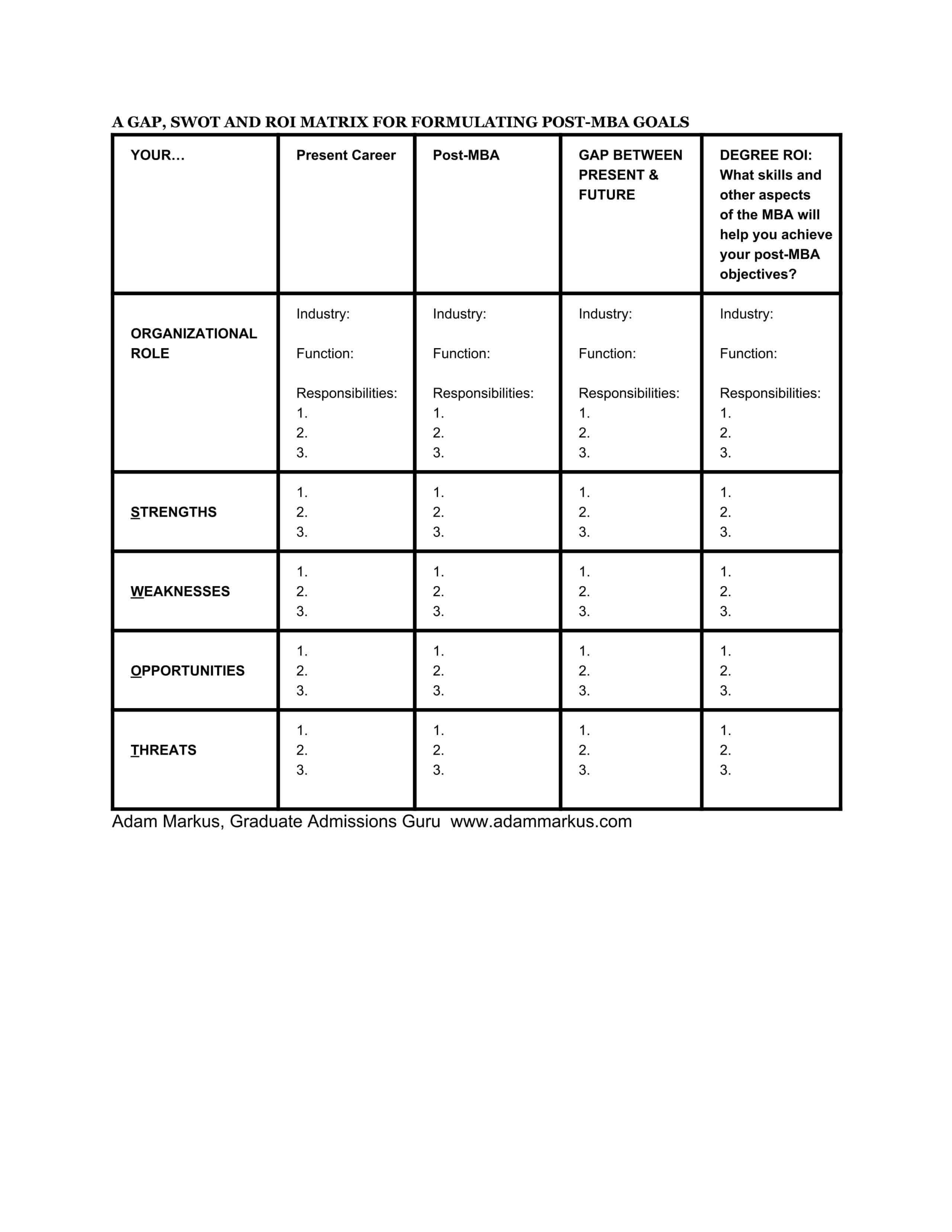
How to use this table:
Step 1. Begin by analyzing your ”Present Situation.” What job(s) have you held? What was/is your functional role(s)? What was/are your responsibilities?


Next, analyze your present strengths and weaknesses for succeeding in your present career. REMEMBER:WHEN YOU ARE THINKING ABOUT YOUR STRENGTHS AND WEAKNESS DON’T ONLY THINK ABOUT WORK, THINK ABOUT OTHER ASPECTS OF YOUR LIFE. In particular, some of your greatest strengths may have been demonstrated outside of work, so make sure you are accounting for them.
Strengths: What are you good at? Where do you add value? What are you praised for? What are you proud of?
Weakness:What are you bad at? What are you criticized for? What do you try to avoid due to your own limitations? What do you fear?
Next, analyze the environment you work in right now. What opportunities exist for your growth and success? What threats could limit your career growth?


Step 2. Now, do the same thing in Step 1 for your ”Post-Degree” future after you have earned your MBA. IF YOU CANNOT COMPLETE STEP 2, YOU HAVE NOT SUFFICIENTLY PLANNED FOR YOUR FUTURE and therefore you need to do more research and need to think more about it.


Step 3. If you could complete step 2, than you should see the ”Gap” between your present and your future. What skills, knowledge, and other resources do you need to close the gap between your present and future responsibilities, strengths, and opportunities?


Step 4. After completing Step 3, you need to determine how an MBA will add value to you. It is possible that an increased salary as a result of job change will be sufficient ”ROI” for the degree to justify itself, but you should show how a degree will allow you to reach your career goals. How will the degree enhance your skills and opportunities and help you overcome your weaknesses and external threats? If you can complete Step 4 than you should be ready to explain what your goals are, why you want a degree, and the relationship between your past and future career, as well as your strengths and weaknesses.


The above table will also help you answer such common interview questions as: Where do you want to work after you finish your degree? Why do you want an MBA (or other degree)? What are you strengths? What are your weaknesses? What are your goals? Thinking about these issues now will help you to develop a fully worked-out strategy for how you will best present yourself both in the application and in an interview.
After going through this formal process, review what you know about IMD again. In your answer to the question, please focus on showing how IMD will help make your post-MBA future objectives a reality.  BOTTOM LINE: Conceptualize this as a business plan with IMD as a partner who will help enable that plan.


OPTIONAL ESSAY
Is there any additional information that is critical for the Admissions Committee to know which has not been covered elsewhere in this application?
If you would like to comment on career gaps, education, GMAT/GRE, a disability or illness, please use this space. (Optional)


While I suppose it is possible to answer this question with “No,” in most cases I would not recommend doing so.  I always tell my clients to write at least one positive thing in this essay even if they must deal with a negative subject as well.


For some applicants who have to discuss something negative such as a low GPA, the topic for this essay will be clear enough. Just make sure your answer is a clear and believable explanation and not an excuse.


In terns of writing something positive, think about one or two topics that you believe would help admissions to understand you and support your admission. Be careful that you do not pick a trivial topic or one that really has been handled in another essay.  Whatever you do, make sure what you put here does not look like it came from another school.


Finally, best of luck with your IMD application.


-Adam Markus
I am a graduate admissions consultant who works with clients worldwide. If you would like to arrange an initial consultation, please complete my intake form. Please don't email me any essays, other admissions consultant's intake forms, your life story, or any long email asking for a written profile assessment. The only profiles I assess are those with people who I offer initial consultations to. Please note that initial consultations are not offered when I have reached full capacity or when I determine that I am not a good fit with an applicant.


February 16, 2014

McCombs MBA Admissions Interviews

My comments below are based on my experience and my review of McCombs School of Business in University of Texas at Austin MBA interview reports found at accepted.com.

Before reading this post, I suggest reviewing some or all of the following previous posts:
-MBA Application Interview Strategy
-Further Comments on MBA Admissions Interviews 
-General Characteristics of Admissions Officers, Students, and Alumni Interviewers
-Recovering from a bad answer during an MBA admissions interview
-10 Ways to Blow an MBA Admissions Interview
-and my more recent post, When to start MBA interview practice? How to prepare?
The above posts are my general remarks on MBA admissions interview strategy and apply here.

The interviewer will only have access to your resume. Interviewers for McCombs (students, admissions officer, or alumni) try to create a friendly interview atmosphere. This is an interview about fit and your own potential, so make sure you can explain in depth why you want to attend McCombs, how you will contribute to it, and what you intend to do afterwords. You may want to look at an interview I conducted with a former client who was a McCombs Adcom member. Previous contact with alumni, visits to campus, and/or intensive school research are all great ways to prepare as showing fit for McCombs is critical.

Must interviews last about 45 minutes with some going for an hour and a few lasting only 30 minutes.

I see no reports of any trick questions really, but you must be prepared to address weakness, failure, and what you want to learn at McCombs. Be prepared to ask questions about the program. If you have an alum interview, be prepared to have a number of questions.

The Questions
Like he has done with many other schools, my colleague, Steve Green has compiled the following list of questions from from all the reports submitted to accepted.com   and clearadmit.com.  In addition to our client reports, we use lists of questions like these as part of our prep sessions with clients.

Resume
Tell me about your background. / Tell me about yourself.
What do you consider to be your biggest accomplishment?
Tell me about the highlight of your career so far.
What is the most difficult professional decision you ever made?

Goals
Why do you want an MBA now? / Tell me 3 reasons you want an MBA.
Why McCombs?  / Tell me three reasons you want to go to McCombs.
What attracts you the most in the McCombs MBA program?
What do you hope to see in your fellow students?
It's the first day of class and new students are being introduced. What do you look for in the introductions?
What will you bring to McCombs?  / How will you contribute/add value to McCombs?
How do you want to be associated with McCombs 10 years after you graduate?
What other MBA programs have you applied to?
What do you want to do after business school?

Leadership
Describe a leader you admire.
How are you applying the qualities that you admire in this leader in your own leadership?
Tell me about your experience leading teams.

Teamwork
Tell me about a time when you worked with someone who was not pulling their own weight.
What would you look for in a successful team?
What qualities do you like in your teammates?
What do you not like in a team member?
What are 3 ways you contribute uniquely to teams?

Strengths and Weaknesses
How would your boss describe you?
How would your co-workers describe you?
How would you introduce and describe yourself at a cocktail party?
What is the weakest part of your application?
What is the strongest part of your application?
When you have you put forward an idea and failed? What happened?
Describe a work scenario that was outside your comfort zone and how you handled it with a creative solution.
When you have you put forward an idea and failed? What happened?
If you had two round-trip tickets to anywhere, where would you go and whom would you take?
What did you learn about yourself after going through the application process?
Tell me about a time when you improved a process?

Conclusion
Do you have any questions for me?


Best of luck with your McCombs interview!


-Adam Markus
I am a graduate admissions consultant who works with clients worldwide. If you would like to arrange an initial consultation, please complete my intake form. Please don't email me any essays, other admissions consultant's intake forms, your life story, or any long email asking for a written profile assessment. The only profiles I assess are those with people who I offer initial consultations to. Please note that initial consultations are not offered when I have reached full capacity or when I determine that I am not a good fit with an applicant.

February 15, 2014

An Interview with IMD's Lisa Piguet on Changes to Curriculum & Application Essays

This post is an interview with IMD's Lisa Piguet, Associate Director MBA Admissions and Marketing. You can find my previous interview with Lisa here.  In addition, she was kind enough to give me a tour of the IMD campus in 2012.  Please see IMD MBA Admissions Essays for January 2015 Admission (R2-R5) for my full analysis of IMD MBA application.


In this post, Lisa and I first discuss the changes to the MBA curriculum introduced for the Class of 2014, which are specifically designed to enhance the job opportunities for students by "making IMD MBA's a product."  We then discuss the MBA admissions essays that will be used for Rounds 2-5 (April 1, June 1, August 1 and September 1) for the Class of 2015.

This interview was conducted by phone on 2/7 and subsequently revised by both Lisa and me prior to posting.

ADAM: Could you explain the changes that have been made to the curriculum for the Class of 2014?


LISA:  IMD has always been known for leadership, which runs throughout the program. While the program is still roughly the same, our new MBA Program Director, Professor Ralf Boscheck, has conceptualized the program as built on three pillars:


Technical competence: Students will take Business Fundamentals, which runs for the first six months and is a return to the way the program was structured prior to the Class of 2012.  Our MBA Program Director, Professor Ralf Boscheck, wants the students to be as prepared as possible for the projects that occur in the second half of the year.


Self-Awareness:  Throughout the program, from the first day to last day, building leadership through personal development is critical. To that end, 95% of students take an elective, which includes 20 sessions with a licensed psychoanalyst to maximize their self-awareness and leadership development throughout the program.


Moral Values: By setting up situations in the program, mostly electives at the end of the program, MBAs can focus on morals and different values orientations.


Building on these pillars, Professor Boscheck, a longstanding and popular member of the faculty, has altered the overall structure of the program to give our students enhanced opportunities to gain exposure to potential employers.


ADAM: Both in terms of students' experience during the program and in terms of post-MBA outcomes, what kind of impact does IMD expect from these changes?

LISA:  We anticipate the students will be better prepared for ICP and the other projects by taking all the courses up front and therefore better exposed to key international job markets.  The objective is that our MBAs have an even better network. We want to make the IMD MBA a product that will be even more attractive to future employers.


The following changes should especially give students an opportunity to demonstrate their competence and enhance their visibility to future employers:
- Our Discovery Trip this year will be to three key thriving markets for employment and consist of a mini-internship with different companies including consulting firms. Our 90 students will be divided into three groups, going to Singapore, Sao Paulo, or New York City.
- A completely new addition to the curriculum is the opportunity for our students to not just attend, but actively participate at our major executive training program, Orchestrating Winning Performance (OWP), which is held on-campus in June.  Our MBAs will present and teach executives enrolled in the program. The objective is to more actively expose students to executives in order to showcase them and give students additional networking and enhanced job opportunities.
-They will also participate in an executive conference to be held on the IMD Lausanne campus in November called "Navigating the Future". They will be asked to present and showcase themselves an additional time.


ADAM: Does IMD plan further changes to the curriculum for 2015?


LISA: No, not for now. Ralf will continue to build on the changes he has implemented in 2014.

ADAM: Regarding the changes to the application essay questions, what is the overall intention of changing them so extensively?


LISA: We wanted greater concision in our essay set. Due to our interview process we can ask much more intensively and extensively about the applicant's background.  What we want from the essays is to know who the person really is.  The essays should bring us closer to understanding the applicant.


ADAM: Should this be interpreted as a change in what IMD is looking for from applicants?


LISA: No, the same basic criteria apply.


ADAM: Do the changes in questions relate to other changes to the MBA program?


LISA: No, we just really wanted to revise our essay set.


ADAM: Regarding Essay Question 2, which I frankly love because it really requires a genuine response, it strikes me that beyond any considerations about an applicant's ability to respond to total failure (A possible way of responding to the question), IMD is really asking about the resilience of the applicant.  Would you care to comment on my opinion?


LISA: What we are testing is resilience, coping skills, attitude and self-awareness.


The extent of the failure need not be catastrophic.  Above all, it has to be honest.


We want to know how the applicant overcame the situation.  What did they do about it?   How did they think about it?  How did they respond to it?


ADAM: Regarding Question 3, I was struck by the fact that IMD was now asking applicants to consider themselves in the long-term.  The long-term has long been absent from IMD's written application process, though certainly common at most MBA programs.  Care to comment?

LISA: What we are looking for is how you project yourself into the future.  I would suggest considering the following when writing this:

-What mark do you want to leave on the planet?


-What would you tell your children/grand kids?


-What kind of person would you like to be?


-What kind of accomplishments would you like to make in the future?


- What do you want out of your life?


-Where are you going?


While surely focused on long-term vision, it is an achievement question in a way because it is testing drive, passion, and possibly altruism.

I want to thank Lisa for taking the time to answer my questions. 


-Adam Markus
I am a graduate admissions consultant who works with clients worldwide. If you would like to arrange an initial consultation, please complete my intake form. Please don't email me any essays, other admissions consultant's intake forms, your life story, or any long email asking for a written profile assessment. The only profiles I assess are those with people who I offer initial consultations to. Please note that initial consultations are not offered when I have reached full capacity or when I determine that I am not a good fit with an applicant.

February 14, 2014

Snowbound in the US or Japan? Or have some free time? No Valentine's Day plans?

Are you presently stuck at home because of the lousy weather in the United States or Japan?  Do you have any free time?  Maybe you  don’t have any Valentine’s Day plans.  I have some suggestions for you:


1.  Take a few minutes and get a chance to win to $500 just because you applied for or are applying for business school programs that start in 2014:
https://huron.qualtrics.com/SE?SID=SV_5avUSpmdneTZakt&RID=MLRP_0vv6IEAeIVjmdLL.
You can find the details here.  Or just take the survey!


2. Are you preparing for MBA admissions interviews?  Well, I have some blog posts for you! See the Interview Analysis Section of my Key Posts page.

3. Still trying to figure out where to apply to? See the Advice section my Key Posts page.


4.  Want to waste time looking at another list of MBA program rankings?  See
Adam's Global Top MBA Rankings 2014.  My team and I spent minutes putting this together.

5.  Did I mention taking this great survey?

Wherever you are, Happy Valentine’s Day!
Love and Kisses,
Adam


-Adam Markus
I am a graduate admissions consultant who works with clients worldwide. If you would like to arrange an initial consultation, please complete my intake form. Please don't email me any essays, other admissions consultant's intake forms, your life story, or any long email asking for a written profile assessment. The only profiles I assess are those with people who I offer initial consultations to. Please note that initial consultations are not offered when I have reached full capacity or when I determine that I am not a good fit with an applicant.

February 13, 2014

Preparing for New York University Stern MBA Admissions Interviews

In this post I discuss preparing for New York University’s Leonard N. Stern School of Business MBA admissions interviews.


Before reading this post, I suggest reviewing some or all of the following previous posts:
-MBA Application Interview Strategy
-Further Comments on MBA Admissions Interviews 
-General Characteristics of Admissions Officers, Students, and Alumni Interviewers
-Recovering from a bad answer during an MBA admissions interview
-10 Ways to Blow an MBA Admissions Interview
-and my more recent post, When to start MBA interview practice? How to prepare?
The above posts are my general remarks on MBA admissions interview strategy and apply here.


NYU Stern’s Isser Gallogy, Assistant Dean, MBA Admissions,   provides short audio advice on admissions interviews (What follows is mostly a transcription):
1. Interviews are by invitation only. About 20-25% of MBA applicants are invited to interview.
2. Nearly all interviews are conducted by Stern’s Admissions Committee. 
3. Stern admissions interviews are not blind.  Your interviewer will have read your application. 
4. The majority of interviews are held on-campus at Stern.
5. It will be a highly personal and individualized exchange and goes beyond what you presented in your application. 
6. Be ready to discuss your post-MBA career path and why Stern can help you achieve your goals. 
7. Come prepared with questions for the interviewer.
8. To prepare, re-read your application and consider what further insight you can provide since submitting your application. 
9. Take some time to practice interviewing.
10. Relax. About 70% of those interviewed are admitted.
Based on interview reports, unlike the interviews at HBS, which tend to involve lots of individualized questions for applicants, NYU interviewers (like those at LBS) will have read your application for sure, but their questions are likely to be very standard as you will see below. Even though the Stern interview might not be as hard as HBS, I would recommend using the active strategy and method I discuss in my HBS interview post. If you utilize this method of preparation you will be well prepared for handling NYU’s  interview. Stern interviewers are consistently described as friendly and the interview should last 30 minutes.


The Questions
Like he has done with many other schools, my colleague, Steve Green has compiled the following list of questions from from all the reports submitted to accepted.com   and clearadmit.com.  In addition to our client reports, we use lists of questions like these as part of our prep sessions with clients.

Background
  • Detailed questions about personal / creative essay.
  • Tell me about yourself.
  • What do you feel is the weakest part of your resume?
  • How did you end up in your current job?
  •  How did (a previous role) help you in your current role?
  • What frustrates you most at your current role?
  • Why did you leave company X to join company Y?
  • Why did you choose company Z after graduation?
  • Why did you choose your undergrad school? What is your best memory of your time there?
  • Tell me what you like to do in your free time?

Why MBA?  Why Stern?
  • Why Stern?
  • What one thing draws you to Stern?
  • What other schools are you applying to?
  • How did you first hear about Stern, and in what ways did you learn about it?
  •  Is Stern your first choice? If admitted to other schools, what will be your criteria for choosing?
  • Why do you think you are ready for an MBA at this point in your career?
  • Why now?
  • Why do you want to do your MBA in NYC?
  • What do you like about New York? Which neighborhoods would you consider living in?
  • What are specific Stern programs that will help you?
  • Where do you want to do your summer internship? How will you market yourself to that firm? What is your backup plan if you do not get your first choice?
  • Which clubs do you want to participate in?
  • What do you bring to the Stern community?
  • What are you hoping to learn from your future classmates?
  • How will you distinguish yourself during the first few weeks at Stern?
  • What are you looking forward to at Stern?
  • What most surprises you about Stern?
  • What would you like me to think when I introduce you at graduation?
  • What job do you imagine yourself doing during your first summer break?
  • What makes Stern's culture different from others?
  • Which county would you choose for "Doing Business In"? Why?


Goals
  • What is the main difference between your current position and your goals?
  • How will your post-MBA role be different from your current role?
  • What companies would you like to work for after graduation, and why?
  •  What five companies do you want to work for after graduation?
  •   How would you market yourself in your target industry?
  • What is your Plan B if you do not get your dream job?
  •  As a foreign national, how will you find a job outside your country?
  •  If you were asked to speak at Stern 25 years from now, how would you want to be introduced?


Strengths and Weaknesses
  • What would your supervisor say is one of your strengths? One of your weaknesses?
  • What is the best constructive criticism your boss has ever given you?
  •   How would your friends describe you?
  • What could prevent you from achieving your short-term goals?
  •  What has been your greatest achievement in your current job?
  • What is something (work or non-work) that you are proud of?
  •  Tell me about a challenging time or a time you failed. What did you learn?
  •  Tell me about a conflict you faced and how your overcame it.


Leadership and Teamwork
  • What is your leadership style?
  • Tell me about a time you led a team through a difficult situation?
  •  What is your role on a team?


Conclusion
  • Is there anything else you'd like me to know?
  • Any questions for me?
Best of luck with your NYU Stern MBA interview!


-Adam Markus
I am a graduate admissions consultant who works with clients worldwide. If you would like to arrange an initial consultation, please complete my intake form. Please don't email me any essays, other admissions consultant's intake forms, your life story, or any long email asking for a written profile assessment. The only profiles I assess are those with people who I offer initial consultations to. Please note that initial consultations are not offered when I have reached full capacity or when I determine that I am not a good fit with an applicant.

February 12, 2014

How to Prepare for MIT Sloan MBA Admissions Interviews

In this post, which is significantly updated, I discuss how to prepare for an MIT Sloan MBA admissions interview. If you have been invited to interview for the Class of 2016, this post is for you!

Beyond my 16 comprehensive service clients admitted to MIT Sloan since Fall 2008 entry (I began my own consulting service in September 2007), I have worked with additional clients only on interviews. and more still from 2001-2007 when I was working for a top test prep company’s consulting service.  The advice below is thus based on working with clients on MIT interviews for over ten years.

I do believe in the value of intensive preparation and doing mock interviews that are harder than the actual ones. As my client admitted in R1 for the Class of 2016 wrote in his testimonial, “Once I got the interview invitation, Adam gave me two comprehensive mock interviews that made my real interview looks like children’s game in comparison.” Whether you prep with me or otherwise, I hope this post helps you view the real interview in the same way!

YOU NEED TO BE A STAR!
Before reading the rest of this post, I strongly suggest reviewing  MIT’s  Preparing for Your MIT Sloan School Interview, because reading it first will maximize the value of my comments below.

The STAR technique is really the core method you need to use for answering Behavioral Event Interviews (BEI) questions. It is simply this:
Situation: define the situation or "set the stage."
Task: identify the task/project performed.
Action: describe the action you took.
Result: summarize the outcome

The STAR technique was created by Bill Byham, who originated the behavioral interviewing method in 1970. When you are using STAR, just keep in mind that you need to be introspective as well, so in an interview say what you thought as well as what you did. Don’t just present “the facts” but actively interpret your actions. There is really nothing overly complicated about this as long as you understand that you need to tell a DETAILED story. Pure abstractions disconnected from a concrete set of action steps are highly likely to result in a weak answer. Similarly, grand actions not told in any depth are also likely to be weak. Identify specific actions that contributed to the result so as to establish a clear link between cause and effect.

As when answering any kind of question, another important consideration is to think very critically about what your story selection, understanding of the task, actions taken, and results say about you. Keep in mind that the whole point of asking behavioral questions is to determine how someone acts and thinks as a basis for selecting or rejecting that person. It is obviously critical to be aware of your own message. Specifically think of examples you can use to highlight your intelligence, creativity, leadership skills, interpersonal communication skills, and conflict resolution skills.

How To Prepare Outlines for Practicing BEI Questions
I would suggest making some simple STAR (Situation Task Action Result) outlines.  For example:
Team Story 1: Project X
S:  Harry was not cooperating with the rest of the team on Project X.
T: My job was get the team to work together because Project X really required everyone to participate. Harry was important because of his technical skills.
A: In order to get Harry to cooperate I..  (ACTION 1) first talked with him privately to better understand his perspective.  Next, (ACTION 2) I talked with the rest of team to try and make an adjustment so that Harry would feel more comfortable. Finally (ACTION 3) Established information sharing sessions so that everyone understood what needed to be done and how our work fit together.
R: Project X succeeded.
The above outline could be used to answer such questions as “Tell me about a time when you were part of a team that had poor dynamics/didn’t get along well,” “Tell me about a time when you had to deal with someone who wasn’t pulling his/her weight,” and "Describe a time when you have worked as part of a team working towards an important goal, when you have addressed conflict between two or more team members."
Now, when you actually practice the above for a behavioral interview, you would need to flesh out the story and provide more details.  If you have outlined a STAR story, you  have not practiced it yet.   The only reason to outline STAR stories is if you cannot systematically turn any spoken story into STAR automatically.  Actually once you start using STAR, chances are that you will not need any outlines.  STAR is actually a highly intuitive way to tell stories and useful for telling stories in any situation.

A “typical” MIT Interview, which can last anything from 20-60 minutes (assume approximately 30 minutes), might consist of the following questions:
1. Any updates since you last applied?
2. 1-2 questions based on specific details from your application and/or resume related to a hobby, award, or work activity.
3. 3-6 of the above behavioral questions.
4. Perhaps a question about your goals or motivation for Sloan.
5. Questions for the interviewer.
DISCLAIMER: The above is just a general guide as the actual interview will vary greatly. If I do multiple MIT interview prep sessions with a client, I alter my style to account for the different interviewing styles an interviewee might encounter.

The Questions
Like he has done with many other schools, my colleague, Steve Green has compiled the following list of questions from from all the reports submitted to accepted.com   and clearadmit.com.  In addition to our client reports, we use lists of questions like these as part of our prep sessions with clients.
Two things that Steve encourages all applicants to remember: 
1. Expect detailed follow up questions about the content of your answers.
2. Expect questions based on specific points in your essays. (Your essays may be quoted back at you.) 
The questions in Italics were reported to Clear Admit and Accepted.com over the past year.

Resume and Background (Not usually BEI questions)
  • Do you have any recent accomplishments you want to share? / Are there any changes to your resume since you submitted it? /  Tell me about a recent accomplishment that is not in your application.
  • Tell me more about 
  • Walk me through your resume. (FOLLOW UP)
  • Why did you change jobs? / Why have you changed jobs frequently?
  • Tell me more about the leadership role you played in (NON-PROFESSIONAL ACTIVITY ON RESUME.)
  • What do you do outside work?
  • How do you have time for all the things that you do (REFERENCING RESUME)
  • Tell me about your job, have your responsibilities changed since your promotion.
  • Tell me about yourself, what have you been doing in the last two years.
  • What exactly do you do? What have you been doing in your position recently?
  • Tell me about something at work you have been proud of in the last year.
  • What’s a personal goal that you’ve set for yourself recently?
  • Where do see your business heading?
Goals (Not BEI Questions: They did not ask about your goals in the essays, but they can certainly do so in the interview!)
  • Why an MBA?
  • Why now?
  • What do you think about MIT?
  • Why did you decide to apply to Sloan? Tell me your thought process.
  • What are your professional goals?
  • What are two professional goals you've set for yourself?
  • What are two personal goals you've set for yourself?

THE BEI QUESTIONS
While public reports over the last year show a smaller range of questions, based on my own client reports, I do recommend preparing for questions beyond those that are italicized.

Teamwork and Relationships 
  • Tell me about a time when a colleague had a different opinion or gave you feedback and how you incorporated that into your approach.
  • Tell me about a time when someone challenged your opinion.
  • Describe a time when your idea was rejected. How did you feel?
  • Tell me about a time when you had to work with people not at your intellectual level.
  • Describe a time when you had to manage a conflict. How did you resolve it?
  • Tell me about when you had a difficult time with your job.
  • How did you manage to resolve a conflict situation and move the team forward?
  • Tell me about a difficult conversation you had to have with someone.
  • Tell me about a time when you had to present something to someone who you did not like.
  • Tell me about a time you had a challenging interaction with someone.
  • Tell me a time when you influenced someone
  • Tell me about a time when you butted heads with a co-worker/client/employee.
  • Tell me about a time when you were part of a team that had poor dynamics/didn’t get along well.
  • Tell me about a time when you had to deal with someone who wasn’t pulling his/her weight
Leadership
  • Tell me about a time when you mentored someone.
  • Tell me about a mentor or someone in your life who influenced you. Describe that influence.
  • Tell me about a time when you had to persuade your colleagues.
  • Tell me about a time when you set a goal and moved towards achieving it.
  • Tell me a time when you thought outside of the box.
  • Tell me when you did something innovative.
  • Tell me about a time when you were managing someone who did not meet your expectations.
  • Tell me about a time when you took the lead on something.
  • Tell me about a time you led a team to a solution.
  • Tell me about a time when you had to persuade/convince others.
  • Tell me about a time you convinced others to follow your plan.
  • Tell me about a time when you had to decide among multiple options.
Strengths and Weaknesses
  • Tell me about feedback you've received, and how you responded to it.
  • Describe a time when you took a big risk.
  • Tell me about a recent setback at your current position. What happened, how did you feel and what did you do?
  • Tell me about something you’ve done that you’re proud of.
  • Tell me about a recent disappointment where you believe you failed or did not do justice to your responsibilities.
  • What would recent team members say about what it was like to work with you?
  • How would a friend describe you? A client?
  •  Tell me about a time when you had to step out from your comfort zone.
  •  Tell me about a time you had to ask for help.
  •  Tell me about a time you failed.
  • Tell me about a time your idea was rejected.
  • Tell me about a time when your expectations were not met.
  • Tell me about a time when someone needed your help.
Conclusion (Not BEI)
  • Any questions for me?
  • I’m meeting a lot of people today, what is going to make me remember you?
  • What do you wish I had asked you?


 Further Advice on Practicing for MIT Interviews
The map is not the territory!
Clients often want me to read their interview preparation notes. I usually refuse because I think it is a total waste of their money to have me do that.  I believe such outlines are useful for the person doing the preparation, but all I can really evaluate is their performance.  If I have a client with a TOEFL under 100, I might review their scripts because given that they may lack basic English vocabulary for effectively telling their stories. This is not case with the vast majority of my clients, even those with TOEFL scores at the 100 level.

An outline is a map, but in the case of an interview it is really limited map because an interview is all about performance, the territory. You can have the best stories in the world, but if you can’t deliver them effectively, you are dead.


Actual Practice
Depending on your communication skills, available time, and comfort with interviews you may need days or weeks or months to be at your best. Whatever amount of practice you think you need, try to actually do more than that.  One of my clients who had already been admitted to two top schools, did 50 hours of practice on his own to get ready for HBS.  He was successful because he put in enough time actually speaking the answers  to many common questions that he could feel comfortable and confident.  He did just a couple of hours of interview practice with me and one of my colleagues. He was admitted to HBS. I wish all my clients followed this example of extensive self-practice.  While the exact ratio of counseling hours (strategy sessions focused on developing good answers and mock interviews) to self-study will vary, I think somewhere between a 1:5 and 1:20 ratio is ideal.  I am always depressed when a client only does interview practice during sessions with me and then does no practice by themselves because I know they are not maximizing their performance. Like a great musician or actor, you need to internalize your script/notes/outline to perform it effectively. I can best help a client by judging that performance.  Something could look great or horrible on paper, but very much the reverse when actually performed.


How to practice:
1. Speak.  Doing it in your head is not enough.  Actually perform to the hardest audience you will ever encounter: yourself.
2. Record yourself and listen and/or view the results. Note problems and practice more.
3. Speak in front of other people who can give you feedback.  Even if you are using a consultant try to practice in front of other people. This will help make you comfortable having an audience.
4. Have school specific mock sessions, either with a admissions consultant or someone who can at least ask you the questions.
5. Given that the MIT Interview will be either with an admissions officer (Always the case if the interview happens overseas. My International clients have had a much higher chance of interviewing with Rod Garcia than those who were based in the US!) or a contracted interviewer (Usually an MIT Sloan staffer, but not in adcom) who has read your file, you should closely review your own Sloan application.  It is best not to repeat the stories you told in your essays, but feel free to discuss variations based on the same situation. You don’t want to make your interviewer feel like they hearing the same story they already read.


For additional suggestions on interview strategy, please see:
-MBA Application Interview Strategy
-Interview Practice is ABOUT SPEAKING!
-Further Comments on MBA Admissions Interviews 
-General Characteristics of Admissions Officers, Students, and Alumni Interviewers
-Recovering from a bad answer during an MBA admissions interview
-10 Ways to Blow an MBA Admissions Interview
-When to start MBA interview practice? How to prepare?

I know that what I am suggesting might be burdensome and time consuming, but so what?  The whole application process is like that.  And at least with interview practice, you might actually become better at telling stories (Good for making friends!) and interviewing for jobs. Best of luck with your MIT Sloan MBA interview!


-Adam Markus
I am a graduate admissions consultant who works with clients worldwide. If you would like to arrange an initial consultation, please complete my intake form. Please don't email me any essays, other admissions consultant's intake forms, your life story, or any long email asking for a written profile assessment. The only profiles I assess are those with people who I offer initial consultations to. Please note that initial consultations are not offered when I have reached full capacity or when I determine that I am not a good fit with an applicant.

February 11, 2014

Fill out an MBA admissions survey for those applying/admitted for 2014 entry: Chance to Win $500

I have a request: could you spare a few minutes to complete an MBA admissions survey? You will get a chance to win $500.  If you have been admitted to or applying to MBA programs with a 2014 start date, this survey is for you. 

I’m a member of AIGAC, the Association of International Graduate Admissions Consultants. I am also a member of our survey committee. So getting as many of  many of my blog readers and clients to take this survey (See below for background information on the survey) as possible is something I would like to do. 

I would love to get your response by the end of February. Can you help? If you do, you’ll be eligible to enter a drawing for a $500 cash payment (to be sent via PayPal). Your email address would be used only for prize notifications.

The survey should take 10-15 minutes to complete and can be accessed by clicking this link: https://huron.qualtrics.com/SE?SID=SV_5avUSpmdneTZakt&RID=MLRP_0vv6IEAeIVjmdLL.
Alternatively, you can paste this URL into your browser’s address bar: https://huron.qualtrics.com/SE?SID=SV_5avUSpmdneTZakt&RID=MLRP_0vv6IEAeIVjmdLL

Background: In May, we will hold our annual conference in New York City. While there, we will present anonymous data about MBA applicants to the top MBA programs. That data will come from these surveys, and we need a lot of responses to make the data useful. The process works like this: AIGAC helps the MBA programs, which leads them to like admissions consultants more and give us better information and access, which leads us to serve our clients better. Past applicants taking the survey allowed me to help you better; your taking the survey is a nice way to pay that forward. If you are curious, you can read more about our survey here.

I truly appreciate you taking this time to help us improve the MBA admissions process.
Cheers,
Adam


-Adam Markus
I am a graduate admissions consultant who works with clients worldwide. If you would like to arrange an initial consultation, please complete my intake form. Please don't email me any essays, other admissions consultant's intake forms, your life story, or any long email asking for a written profile assessment. The only profiles I assess are those with people who I offer initial consultations to. Please note that initial consultations are not offered when I have reached full capacity or when I determine that I am not a good fit with an applicant.

University of Chicago Booth MBA Admissions Interviews

In this post I discuss MBA admissions interviews for the University Chicago Booth. 


If you are looking for my analysis of Booth’s essays for Fall 2014 admission, you can find it here.


Beyond my 21 comprehensive service clients admitted to Booth since Fall 2008 entry (I began my own consulting service in September 2007), I have worked with additional clients only on interviews. and more still from 2001-2007 when I was working for a top test prep company’s consulting service.  The advice below is thus based on working with clients on Booth interviews for over ten years.

For my detailed suggestions on overall interview preparation, please see:
-MBA Application Interview Strategy
-Interview Practice is ABOUT SPEAKING!
-Further Comments on MBA Admissions Interviews 
-General Characteristics of Admissions Officers, Students, and Alumni Interviewers
-Recovering from a bad answer during an MBA admissions interview
-10 Ways to Blow an MBA Admissions Interview
-When to start MBA interview practice? How to prepare?

The above posts are my general perspective on MBA admissions interview strategy and apply here.


 Booth interviews are conducted blind, so your interview will not have read your application and Interviews are conducted by admissions staff, students, or alumni. They are held on campus or in a location convenient for the prospective student. All interviews, regardless of who conducts them, receive equal weight in the evaluation process. The only thing they will have is your resume.


Most recent Booth interview reports I have seen (both public reports and from my clients), portray the interviewer as friendly.  This is not typically a stress interview.  Booth typically is using younger alumni for interviews, which is a good idea because they are much closer to the current culture of the school, which changed  significantly in the last ten years. Almost all interviews involve student interviewers on campus or alumni off-campus. 


Most interview reports indicate extensive questions about the contents of the resume.  You need to know your resume completely as you will most likely be asked about content in it. Review it carefully and consider what your interviewer might ask you to explain more thoroughly. If it is on your resume, it is fair game.
A First Impression: Most interviewers will have your resume even before they meet you. For resume-only interviews, it really is their first impression of you.  Make sure your resume is really designed for ease of use by the interviewer.  One of my objectives when helping a client with a resume is always to focus on how effective the resume is for this purpose.
Agenda Setting Device: To a greater or lesser extent, a resume has an agenda setting function in many interviews.  While schools will provide interviewers with varying levels of guidance about what questions to ask, the resume may very well form the basis for some of the questions that you receive.
Booby Trap:  The resume can blow-up in your face if you are not careful.  Failure to review your own resume closely prior to interviewing can put you in an awkward position if you are not fully prepared to discuss everything on it.
Your Main Depository of Past Experience Answers: Since you have presumably highlighted many of the key things you would actually want to discuss on your resume, it is in essence, a primary source for your answers to past experience questions. Especially when I working with a client with limited English ability, I will tell them to practice explaining "Who What Why How When" questions related to their resume.
In addition, since you might get asked to "Tell me something about yourself that is not covered on your resume," you can use the resume to figure out what that would be.

Prepare to answer routine MBA questions. Most reported interviews simply consist of themHave a few questions ready to ask your interviewer about the things that are most important to you and your MBA experience. Getting answers to your questions is an equally important part of any B-school interview.”
Like he has done with many other schools, my colleague, Steve Green has compiled the following list of questions from from all the reports submitted to accepted.com   and clearadmit.com.  In addition to our client reports, we use lists of questions like these as part of our prep sessions with clients.


RESUME
  • Walk me through your resume, but make sure you highlight just a couple of key achievements.
  • Tell me about yourself.
  • Why did you pick your major? Why did you earn a Master's degree?
  • What are you hobbies / other interests and why?


GOALS & BOOTH
  • What are your short-term goals?
  • Why are you pursuing an MBA?
  • What do you expect from your MBA in the long term?
  • Why now?
  • Why Booth?
  • What other schools have you applied to?
  • How do you compare them to Booth?
  • How would you decide between two schools?
  • Why would you choose Booth over those?
  • What will you contribute to Booth?
  • What do plan to do outside the classroom at Booth?
  • What is your Plan B if you don't get accepted to any b-schools?
  • You will not meet most of you classmates after the two years at school. How will you make sure you learn the most from this distinguished set of people? How will YOU make sure they learn from you?
  • Clarifying questions about Booth's program.
  • What professional groups will you join?
  • Which social groups will you join?
  • Booth has classes that present different settings: group-based, individual, project-based. Which ones do you have a preference for? Why?
  • What will you contribute to Booth, or what will you bring to the Booth community?
  • What if you hate your internship – what is Plan B
  • Place yourself 30 years in the future… what would you define then as having been successful?


LEADERSHIP
  • What is your leadership style, and how do you function when you are not a leader in a team?
  • Tell me about your leadership style?
  • What is one area of weakness you would like to work on regarding your leadership style why earning an MBA?
  • Discuss a time when you had to manage a difficult team or teammate, and how did handle that experience?
  • Tell me about one occasion in which you displayed leadership.
  • Tell me a solution you have recently proposed to your employer (asked for an example in my last setting)
  • Can you tell me about a time when you made an unpopular decision
  • What is your most defining leadership experience
  • Describe your leadership style with an example
  • Tell me about your leadership experience. What/who has influenced your leadership style?
  • Please give me an example of a leadership-based conflict you experienced.
  • Tell me about a leadership failure you experienced. How will it help you at Booth?


TEAMWORK

  • What role do you take on in a team? How have you handled a team-based conflict?
  • Can you tell me about a time that you led your team / convinced your team to do something
  • Can you tell me about a time that you led a team over a period of time
  • Can you tell me about a time that you resolved conflict within your team
  • Can you tell me about a time when you disagreed with someone at your level
STRENGTHS & WEAKNESSES
  • Tell me about a time you encountered a challenge?
  • Tell me about a decision you made that you later regretted.
  • You have had a lot of success in the past. How do you handle failure?
  • Tell me something you feel passionate about.
  • What do you think is a weakness that people can have inside or outside of work
  • Tell me something about you that I could not know from reading your resume
  • What are 3 things your friends would describe about you?
OTHER
  • What are the differences you’ve found between different nationalities while working in a multinational?
  • How is a regular day in your line of work?
CONCLUSION
  • Is there anything that we have not covered that would like to point out, on or off your resume?
  • Do you have any questions for me?


Reported interview length is typically about 45-50 minutes. Both shorter, 30 minutes, and longer, 60 minutes, interviews are possible. 


Best of luck with admission to Booth for Fall 2014!


-Adam Markus
I am a graduate admissions consultant who works with clients worldwide. If you would like to arrange an initial consultation, please complete my intake form. Please don't email me any essays, other admissions consultant's intake forms, your life story, or any long email asking for a written profile assessment. The only profiles I assess are those with people who I offer initial consultations to. Please note that initial consultations are not offered when I have reached full capacity or when I determine that I am not a good fit with an applicant.

February 10, 2014

Michigan Ross MBA Admissions Interviews

This post supplements my main post on preparing for Michigan Ross MBA Admissions Interviews.  It updates that list of questions found in that previous post.

Like he has done with many other schools, my colleague, Steve Green has compiled the following list of questions from from all the reports submitted to accepted.com   and clearadmit.com.  In addition to our client reports, we use lists of questions like these as part of our prep sessions with clients.


Resume:
  • Tell me about yourself.  Walk me through your resume. What should I know about you? (*Probe resume: Cross-reference, push for details about why and how.)
  • Tell me about your current position.
  • How would you sell your undergraduate university to a potential applicant?
  • What do you do outside of work?


Goals:
  • What are your career goals?
  • Why do you want an MBA?
  • Why now?
  • Why Ross?
  • What criteria did you use when choosing MBA programs?
  • Have you visited the campus? How do you feel about moving to the Midwest?
  • How are you unique compared to other applicants? What can you bring to Ross that sets you apart from others?
  • How will you be involved outside of class?
  • What will you do if not accepted to Ross?


Teamwork:
  • What is your approach to teams?
  •  How would you deal with a teammate who doesn't act like a team player?
  •  Tell about a time when you dealt with a struggling team member.
  •  Tell me how you dealt with a team member who was under-performing / not on par.
  •  Tell me about your role on a team.
  •  Tell me about a time when you took initiative on a team.
  •  Tell me about a time when your team faced a lot of obstacles? (WHAT LEARNED?)


Leadership:
  • Tell me about a time you showed initiative.
  • Tell me about a situation when you had to think outside the box.
  • How do you manage conflict?
  • Please give me 3 examples of your leadership experience?
  • What does leadership mean to you?

Strengths and Weaknesses:
  • Tell me about a time when you had to deal with an abstract situation.
  • Tell me about a time when you failed, and what you learned.
  • What are you key strengths and one weakness?
  • What is your greatest accomplishment to date?
  • What 3 adjectives would your friends use to describe you and why?
  • What makes you unique?
  • What was a challenging experience in your life?
  • Tell me about a time when you had a professional failure and what did you learn from it.
  •  Tell me about a time when you received negative feedback from a supervisor and how did you respond.


Other:
  • What was the last book you read?
  •  Do you have any questions for me?
Best of luck with your Ross interview.  For more on Ross interview prep, see my main post on this subject.


-Adam Markus
I am a graduate admissions consultant who works with clients worldwide. If you would like to arrange an initial consultation, please complete my intake form. Please don't email me any essays, other admissions consultant's intake forms, your life story, or any long email asking for a written profile assessment. The only profiles I assess are those with people who I offer initial consultations to. Please note that initial consultations are not offered when I have reached full capacity or when I determine that I am not a good fit with an applicant.

Duke Fuqua MBA Admissions Interviews for the Class of 2016

In my experience, Duke interviews are all about fit. Frankly, I would not characterize the interviews for Team Fuqua as hard when compared to those of other top schools.  As you will see from the questions, below, Fuqua interview questions are very typical MBA interview questions. If you are preparing for interviews for other schools, you will surely see overlap here.

In addition to my experience,  My colleague, Steve Green,  and I  have reviewed reports of Duke University ‘s Fuqua School of Business interviews found at accepted.com and clearadmit.com.

You need to know your resume completely as you will likely be asked about content in it. Review it carefully and consider what your interviewer might ask you to explain more thoroughly. If it is on your resume, it is fair game. That said, don’t be surprised if the interviewer is using a standardized list of questions. I think it is worth remembering the kind of roles a resume is likely to play in your interview:
A First Impression:   Make sure your resume is really designed for ease of use by the interviewer.  One of my objectives when helping a client with a resume is always to focus on how effective the resume is for this purpose.
Agenda Setting Device: To a greater or lesser extent, a resume has an agenda setting function in many interviews.
Bobby Trap:  The resume can blow-up in your face if you are not careful.  Failure to review your own resume closely prior to interviewing can put you in an awkward position if you are not fully prepared to discuss everything on it.
Your Main Depository of Past Experience Answers: Since you have presumably highlighted many of the key things you would actually want to discuss on your resume, it is in essence, a primary source for your answers to past experience questions. Especially when I working with a client with limited English ability, I will tell them to practice explaining "Who What Why How When" questions related to their resume.
In addition, since you might get asked to "Tell me something about yourself that is not covered on your resume," you can use the resume to figure out what that would be.

You need to be prepared to answer routine MBA questions. Most reported interviews simply consist of them. Please refer to my prior overall MBA admissions strategy interview posts (herehere, here, and here) for general advice on prepare for the Fuqua interview.

Like he has done with many other schools, my colleague, Steve Green has compiled the following list of questions from from all the reports submitted to accepted.com and  clearadmit.com.  In addition to our client reports, we use lists of questions like these as part of our prep sessions with clients.

Resume
Tell me your story. / Walk me through your resume, please.
Tell me about your company. (+Follow-up questions.)
Tell me about your job. (+Follow-up questions.)
Tell me two things you like and dislike about your job.
Explain your job to me as if I were an 8 year old child

Goals/Why Duke?
What do you want to do and why do you need an MBA to do it?
Why do you want an MBA from Fuqua?
Who have you talked to from Fuqua?
Why do you think you understand the Fuqua culture?
Why not other schools?
Why now?
How will you contribute to Fuqua?
What teams will you contribute to?
How are you unique? Why should Fuqua accept you?
How will you network at Duke?

Leadership & Teamwork
Tell me how you work on a team.
Tell me about a time when you were in a group setting and you had a difficult team member and how you handled the situation.
If you were to build a team what would be important for you?
Tell me about a time when you were in a group setting and you gave an idea that was successful
What’s your leadership style / experience?
Tell me about your favorite boss. Why did you like him/her?
Please tell me about a time you went above and beyond.
Please tell me about your leadership experience outside work.
Tell me about a leadership experience where you failed

Strengths and Weaknesses
Please tell me about your greatest success.
Please tell me about your greatest failure.
Tell me about a time you overcame a challenging situation.
In what areas do you think you need to improve?
What do you do when you face a setback?
Tell me about a regret you have and the lesson you learned from it.
What motivates you?
Please tell me about a time that you failed.
How would your friends describe you?
What are three words your colleagues would use to describe you?
What accomplishment are you most proud of?

Conclusion
Any questions for me?

While there are occasional unexpected hypothetical and/or critical thinking questions, especially from alum and adcom, this is very rare.

Interviewers (students, adcom, or alum) are friendly, passionate about Duke, and consistently try to create a very relaxed interview atmosphere. This is an interview about fit (just like Duke’s essays), so make sure you can explain in depth why you want to become a part of Team Fuqua and how you will contribute to it. Previous contact with alum, visits to campus, and/or intensive school research are all great ways to prepare.

Reported interview length could be from 30 to 60 minutes, with most reported interviews taking 45 minutes.

Best of luck with your admission the Fuqua Class of 2016!


-Adam Markus
I am a graduate admissions consultant who works with clients worldwide. If you would like to arrange an initial consultation, please complete my intake form. Please don't email me any essays, other admissions consultant's intake forms, your life story, or any long email asking for a written profile assessment. The only profiles I assess are those with people who I offer initial consultations to. Please note that initial consultations are not offered when I have reached full capacity or when I determine that I am not a good fit with an applicant.

Wharton MBA 1-to-1 Interview Questions

This post supplements my main post on preparing for Wharton MBA Admissions Interviews.  It provides a list of the common non-Team-Based Discussion questions that are part of the one-to-one interview.

Like he has done with many other schools, my colleague, Steve Green has compiled the following list of questions from from all the reports submitted to accepted.com 
and clearadmit.com.  In addition to our client reports, we use lists of questions like these as part of our prep sessions with clients.

Questions about the Team-Based Discussion
1) How do you think the TBD went?
2) Was your behaviour typical of how you work in a team? / Was your behavior in the Team-Based Discussion representative of the way you typically act in group settings?

Resume/Introductions
1. Introduce yourself. / Tell me about yourself. / Walk me through your resume.
2. Discuss your career progress.
3. Are there any changes to your resume since you applied?
4. What do you do in your free time?
5. Tell me about your international experience.
6. Do you want to highlight anything in your application?

Teamwork and Leadership
7. Tell me about a time when you had to overcome an obstacle while working in a group and what you would do differently if you had to do it again.
8. Tell me about a time when you worked in a group in which everyone did not agree and how did your team resolve the situation?
9. Tell me about a how you have had to persuade others.
10. What are the top 3 qualities you think a leader should have?
11. Tell me about a time you failed, and what you learned from it.

Goals
12. What the 3 things you look for in a business school, especially in Wharton?
13. What do you see yourself doing at Wharton?
14. Why do you want an MBA? Why now?
15. Why Wharton? What will you do if you are not accepted?

Conclusion
16. Do you have any questions for me?

Best of luck with your Wharton interview.  For more on Wharton interview prep, see my main post on this subject.


-Adam Markus
I am a graduate admissions consultant who works with clients worldwide. If you would like to arrange an initial consultation, please complete my intake form. Please don't email me any essays, other admissions consultant's intake forms, your life story, or any long email asking for a written profile assessment. The only profiles I assess are those with people who I offer initial consultations to. Please note that initial consultations are not offered when I have reached full capacity or when I determine that I am not a good fit with an applicant.

The stupidest thing any applicant invited for an MBA admissions interview can do is...

The stupidest thing any applicant invited for an MBA admissions interview can do is not prepare sufficiently for the interview!

Every year, I work intensively with clients who prepare great MBA applications to top MBA programs, but regardless of what I suggest, regardless of the extensive resources of this blog or other blogs, regardless of what the interview reports indicate, regardless of what other people might tell them, they still don’t prepare sufficiently. Sometimes it all works, but too often it does not.

If you are avoiding preparation for your HBS, Stanford, London Business School, INSEAD, Duke, Columbia, etc. interview, you are taking unnecessary risk.  What is your excuse?

Some of my favorite excuses:

I’m too busy: Right, you were not too busy to study for GMAT or GRE (or possibly TOEFL or IELTS) or for campus visits or alumni networking or information sessions or making essays or filling out application, but now you are too busy.  Sleep less,  don’t watch TV,  forget Facebook, or whatever. Give yourself the time to develop winning content. Close the deal.  You spent so much time getting to the point where your chance of admission would increase dramatically, can’t you make time for the next 1-4 weeks before your interview to prepare for it.

I don’t want to over prepare Fine, don’t, just prepare. See here.


I feel stupid reciting answers to no one in particular, I hate hearing my own voice on a recorder, watching myself on video, or otherwise reflecting on my performance during practice:  Join the club. Now get over it.  Hearing your own voice and becoming comfortable with what it speaks pays off when you have to perform in front of others.  Listening to your performance helps you figure out how to say things effectively.  Watching your performance helps you understand how you appear to someone else. Self-awareness leads to performance correction.


The whole thing makes me so nervous, I rather not think about it. Actually practicing makes me nervous: I feel for you, but I would hate to be you when you have the real thing, which will be worse.  If you experience serious feelings of anxiety, lack confidence in interviews or public speaking situations, I highly recommend reading this.  Be open to changing your psychology. You are too young to remain in fear for the rest of your life.

Whatever your rationale for not practicing, get over it. You have come this far.  Finish at your best!


-Adam Markus
I am a graduate admissions consultant who works with clients worldwide. If you would like to arrange an initial consultation, please complete my intake form. Please don't email me any essays, other admissions consultant's intake forms, your life story, or any long email asking for a written profile assessment. The only profiles I assess are those with people who I offer initial consultations to. Please note that initial consultations are not offered when I have reached full capacity or when I determine that I am not a good fit with an applicant.
Real Time Web Analytics